Refractor vs Reflector Telescope for Viewing Planets

Refractor vs Reflector Telescope for Viewing Planets
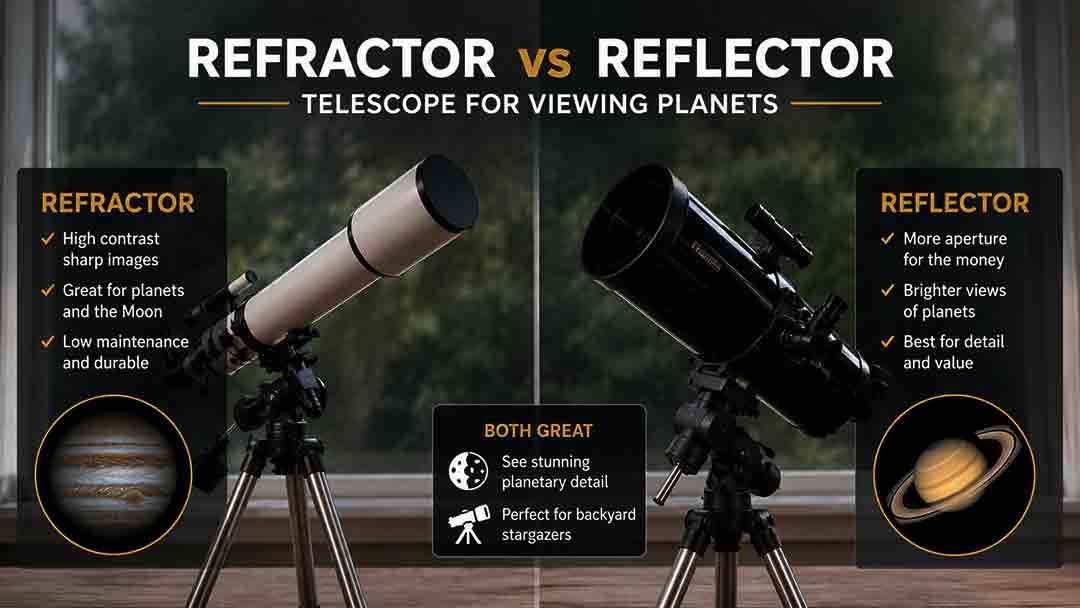
For planetary viewing, a good refractor is usually the easier, cleaner-looking instrument at the same aperture, while a reflector usually delivers more planetary detail for the same budget because it can provide a larger mirror. Choose an ED or apochromatic refractor for low maintenance and fast setup; choose a well-collimated Newtonian reflector when maximum useful aperture and value matter more.
Key Takeaways
- At the same aperture, a well-made refractor has no central obstruction and usually needs less alignment and thermal preparation.
- At the same budget, a reflector normally offers substantially more aperture, which can improve brightness and theoretical resolution.
- Achromatic refractors can show violet or blue color fringing on bright planets; ED and apochromatic designs reduce this problem.
- Newtonian reflectors avoid chromatic aberration but require collimation and benefit from mirror cooling.
- The mount, atmospheric seeing, optical quality, focus, and observing technique can matter as much as the optical design.
This guide explains how refractors and Newtonian reflectors differ on the Moon, Jupiter, Saturn, Mars, Uranus, and Neptune. It also compares equal-aperture and equal-budget choices, calculates a realistic aperture example, provides a buyer decision framework, and diagnoses common reasons a planetary telescope underperforms.
Scope note: In this article, “reflector” primarily means a visual Newtonian reflector or Dobsonian telescope. Schmidt-Cassegrain, Maksutov-Cassegrain, and other catadioptric designs have different tradeoffs and are not treated as standard reflectors here.
Editorial note: This guide is based on published specifications, authoritative optical documentation, and practical selection criteria rather than hands-on testing of a specific refractor or reflector.
Which Is Better for Viewing Planets: A Refractor or Reflector?
A refractor is the better low-maintenance planetary telescope, while a reflector is usually the better aperture-per-dollar planetary telescope.
| Decision factor | Refractor | Newtonian reflector |
|---|---|---|
| Same aperture | Often cleaner contrast and simpler operation | Similar resolution potential but affected by obstruction, collimation, and cooling |
| Same budget | Usually smaller aperture | Usually larger aperture |
| Chromatic aberration | Possible in achromats; reduced in ED/APO designs | None from the primary mirror |
| Central obstruction | None | Secondary mirror obstructs part of the aperture |
| Collimation | Seldom required in ordinary use | Routine checks are normal |
| Thermal preparation | Usually quick for small models | Larger mirrors may need more time and airflow |
| Maintenance | Low | Moderate |
| Portability | Small refractors are easy; long refractors need substantial mounts | Tube may be bulky, but Dobsonian mounts are simple |
| High magnification | Convenient when mount is stable | Excellent when aligned and thermally stable |
| Best buyer | Values convenience and immediate use | Values maximum planetary performance per dollar |
The answer changes depending on whether you compare the two designs at equal aperture, equal price, or equal portability. A high-quality 100 mm ED refractor can outperform a poorly prepared 150 mm reflector, while a properly cooled and collimated 150 mm reflector has greater theoretical resolving power than the 100 mm instrument.
Why Does Aperture Matter So Much for Planets?
Aperture controls light gathering and the theoretical ability to resolve fine detail.
RASC explains that a telescope’s resolution depends on aperture and optical quality, while OpenStax describes the diffraction limit as inversely related to aperture.[1][2]
Planets are bright, so the main reason to want more aperture is not simply brightness. Greater aperture can support:
- Finer angular resolution
- A brighter image at the same magnification
- Higher magnification at the same exit pupil
- More secure detection of low-contrast features
- Easier focus judgment during steady seeing
- Better visibility of faint planetary moons
A practical calculation: 100 mm refractor vs 150 mm reflector
Nominal collecting area scales with the square of aperture diameter.
Collecting-area ratio:
(150 ÷ 100)² = 2.25
A 150 mm reflector therefore has about 2.25 times the nominal geometric collecting area of a 100 mm refractor before accounting for the reflector’s secondary obstruction and differences in optical transmission.
Diffraction-limited angular resolution scales approximately as the inverse of aperture. Moving from 100 mm to 150 mm reduces the theoretical minimum resolvable angle by about:
1 − (100 ÷ 150) = 33%
That is a theoretical improvement, not a guarantee of 33% more visible planetary detail. The atmosphere, mirror temperature, collimation, focus, optical quality, and observer experience determine how much of the advantage is usable.
What Does a Refractor Do Better on Planets?
A refractor offers an unobstructed optical path, stable alignment, and fast readiness, which can produce a calm, high-contrast planetary image for its aperture.
No central obstruction
A conventional refractor has no secondary mirror in the incoming light path. This avoids the diffraction effects and contrast redistribution associated with a central obstruction and spider vanes.
The practical result can be:
- Clean-looking planetary edges
- Dark sky immediately around a bright planet
- Subtle low-contrast detail that is easy to interpret
- No diffraction spikes from a Newtonian spider
- Consistent performance without secondary alignment
This does not mean a smaller refractor automatically outperforms a much larger reflector. Aperture remains a major part of resolution.
Little routine collimation
Sky-Watcher describes collimation as routine in reflectors but seldom required in refractors.[3]
A properly assembled refractor usually remains aligned during normal transport and storage. Beginners can spend more time focusing and observing rather than learning mirror adjustment immediately.
A refractor with an adjustable lens cell can still become misaligned, and a dropped or damaged instrument may require professional service.
Faster thermal readiness
Small refractors often stabilize quickly because their objectives are smaller and exposed near the front of the tube. A short observing session can begin with less preparation.
Large refractors are not thermally immune. Thick lens groups, indoor-to-outdoor temperature differences, and enclosed tube air can still affect the image.
Convenient focus and seated observing
Many refractors use a rear diagonal, placing the eyepiece in a comfortable position as the telescope points higher. This can make long planetary sessions easier.
A stable observing position helps the eye detect subtle detail. Convenience therefore has an optical consequence: a comfortable observer is more likely to wait for brief moments of steady seeing.
What Does a Reflector Do Better on Planets?
A Newtonian reflector can provide more aperture for the same purchase price, making it easier to obtain higher theoretical resolution and a brighter high-magnification image.
OpenStax notes that refractors of a given aperture are generally more expensive than reflectors because a lens requires accurate work on multiple surfaces and light must pass through the glass.[4]
Larger aperture for the budget
A buyer comparing a modest ED refractor with a Dobsonian reflector may find a substantial aperture difference.
The larger reflector can make it easier to see:
- Fine structure in Jupiter’s belts
- Small variations within the Great Red Spot region when visible
- Saturn’s ring divisions under suitable conditions
- Subtle shading on Mars near a favorable opposition
- Planetary moon transits and shadow events
- Uranus and Neptune as small disks
- Fainter planetary moons
The exact view changes with planetary distance, altitude, season, and atmospheric conditions.
No chromatic aberration from the mirror
A Newtonian primary mirror reflects visible wavelengths rather than refracting them through an objective lens. OpenStax explains that reflecting telescopes avoid chromatic aberration from the objective.[5]
This is particularly useful on bright targets such as:
- Venus
- Jupiter
- Mars
- The lunar limb
- Bright stars used for focusing
The eyepiece, atmospheric dispersion, and other optical components can still introduce color effects.
Simple, stable Dobsonian mounting
A Dobsonian mount can support a relatively large Newtonian tube without the cost and complexity of a heavy equatorial mount.
The tradeoff is manual tracking. At high magnification, the observer must nudge the telescope smoothly and keep the planet near the center of the field.
Does the Central Obstruction Make Reflectors Bad for Planets?
No. A central obstruction changes the diffraction pattern and can reduce contrast at some spatial scales, but a sufficiently larger, well-made reflector can still outperform a smaller unobstructed telescope.
A Newtonian secondary mirror blocks part of the incoming aperture. Spider vanes also produce diffraction effects.
The practical impact depends on:
- Obstruction diameter
- Optical quality
- Collimation
- Mirror support
- Tube currents
- Eyepiece quality
- Planetary seeing
- Difference in aperture between the telescopes
Avoid comparing optical design labels without comparing actual aperture. A 150 mm reflector with a moderate obstruction is not equivalent to a 100 mm unobstructed refractor simply because both are marketed for planetary viewing.
The useful comparison rule
Use this order:
- Compare optical quality.
- Compare usable aperture.
- Confirm the reflector is collimated and cooled.
- Compare the mounts.
- Compare the observing conditions.
- Only then judge the obstruction’s visible effect.
A poor mirror does not become a strong planetary optic because it has more aperture. A premium refractor does not overcome the diffraction limit of a much smaller aperture.
Does Chromatic Aberration Make Refractors Bad for Planets?
Achromatic refractors can show false color around bright planets, while ED and apochromatic refractors reduce color error substantially.
Chromatic aberration occurs because different wavelengths refract by different amounts and may not focus at exactly the same position.[6]
Achromatic refractor
An achromat combines lens elements to reduce chromatic aberration, but visible color can remain.
On planets, residual color may:
- Create a violet halo
- Reduce confidence in subtle color differences
- Soften the highest-contrast edges
- Make exact focus harder
- Become more noticeable at high magnification
Longer-focal-ratio achromats generally control color better than short, fast achromats of the same aperture.
ED refractor
An ED refractor uses extra-low-dispersion glass or a related design to improve color correction. Performance varies with glass type, mating element, focal ratio, optical figure, and design.
A good ED doublet can be an effective visual planetary telescope without the price or weight of a larger triplet.
Apochromatic refractor
An apochromatic refractor is designed for high color correction across multiple wavelengths. The term does not guarantee identical performance among every product.
For visual planetary use, the buyer should evaluate:
- Aperture
- Focal ratio
- Optical design
- Published color correction
- Focuser quality
- Mount requirement
- Independent technical evaluation
Do not buy only because a product name contains “APO.”
How Do Refractors and Reflectors Compare on Each Planet?
How Do They Compare on the Moon?
Both designs can be excellent lunar telescopes. Aperture and seeing determine fine resolution, while refractors offer convenient, high-contrast views with little preparation.
A refractor can provide:
- Crisp crater rims
- Clean terminator contrast
- Comfortable diagonal viewing
- Rapid setup
A larger reflector can provide:
- Finer small-crater resolution
- Brighter high-magnification views
- Better access to subtle rilles and small features
- More image scale at a useful exit pupil
An achromatic refractor may show color along the bright lunar limb.
How Do They Compare on Jupiter?
Jupiter rewards both contrast and aperture, making optical preparation especially important.
A good refractor can make belts, zones, polar shading, and moon transits easy to interpret. The stable image and lack of collimation work are valuable during short sessions.
A larger reflector can reveal more fine structure during steady moments, but only when:
- The mirror is thermally stable
- Collimation is accurate
- Jupiter is centered
- Magnification is appropriate
- The atmosphere is steady
Jupiter’s details are often low contrast. Excessive magnification can make the image larger without adding information.
How Do They Compare on Saturn?
Aperture helps resolve fine ring and atmospheric detail, while optical quality and seeing determine whether the theoretical advantage appears.
Both designs can show the rings clearly. A larger reflector may make ring divisions, globe shading, and faint moons easier.
A refractor can deliver a clean image with little preparation, which is useful when Saturn is visible only briefly between buildings or clouds.
How Do They Compare on Mars?
Mars benefits strongly from aperture, accurate focus, and excellent seeing because its apparent disk is often small.
An ED or apochromatic refractor avoids distracting color fringing and can show high-contrast albedo features cleanly.
A larger Newtonian can resolve finer detail near favorable oppositions, but thermal currents and small collimation errors become obvious at the magnifications Mars often requires.
How Do They Compare on Venus?
Venus is bright and often shows its phase clearly in either design.
An achromatic refractor may show strong violet fringing. A reflector avoids objective-lens color error, although atmospheric dispersion can still create red and blue edges when Venus is low.
Never search for Venus close to the Sun without a controlled expert procedure. Beginner daytime planetary searching is outside the scope of this guide.
How Do They Compare on Uranus and Neptune?
Aperture usually matters more than unobstructed contrast because these planets are small and relatively faint.
A larger reflector is often the better value for:
- Distinguishing a small disk from a star
- Using higher magnification
- Detecting faint moons under suitable conditions
- Maintaining image brightness
A refractor can still show the planets as colored disks when aperture and conditions are sufficient.
Which Comparison Is Fair: Same Aperture, Same Price, or Same Portability?
All three comparisons are useful, but they answer different purchasing questions.
| Comparison method | Likely winner | What it actually tells you |
|---|---|---|
| Same aperture | Refractor often wins for convenience and unobstructed contrast | Optical design and maintenance difference |
| Same price | Reflector often wins for resolution potential | Aperture-per-dollar difference |
| Same total weight | Depends on mount and tube design | Real transport burden |
| Same setup time | Small refractor often wins | Probability of frequent use |
| Same storage footprint | Model-specific | Whether the telescope fits the home |
| Same optical quality | Larger aperture often wins when conditions allow | Performance ceiling |
| Same poor seeing | Difference may be small | Atmospheric limitation |
| Same excellent seeing | Larger well-prepared instrument can pull ahead | Usable resolution potential |
A fair buying comparison should start with the user’s constraint. A person with ten minutes for a balcony session has a different answer from an observer with a ground-level garage and an hour to prepare a Dobsonian.
What Refractor and Reflector Sizes Make Sense for Planets?
Small high-quality refractors are convenient, while medium-aperture Newtonians offer a strong balance of resolution and affordability.
80–100 mm ED or apochromatic refractor
Best for:
- Fast setup
- Limited storage
- Travel
- Double stars
- Lunar observing
- Casual planetary sessions
- Users who dislike collimation
Limitations:
- Resolution is limited by aperture
- Faint moons are harder
- High-quality models can be expensive
- A stable mount is still required
100–120 mm long-focus achromatic refractor
Best for:
- Budget-conscious visual observing
- Users accepting some residual color
- Longer sessions from a stable location
Limitations:
- Long tube
- Large mount requirement
- Chromatic aberration remains
- Wind can affect stability
100–130 mm ED or apochromatic refractor
Best for:
- Dedicated lunar and planetary observing
- High optical quality
- Low-maintenance use
- Observers willing to buy a substantial mount
Limitations:
- Cost
- Mount weight
- Slower thermal behavior than a small refractor
- Less aperture than many similarly priced reflectors
130–150 mm Newtonian reflector
Best for:
- High planetary value
- Manageable aperture
- Users willing to learn collimation
- Portable tabletop or full-size designs, depending on model
Limitations:
- Mount quality varies
- Some short-tube beginner reflectors use complex corrector systems
- Cooling and alignment matter
- Very fast models are less forgiving
150–200 mm f/6–f/8 Newtonian or Dobsonian
Best for:
- Serious visual planetary performance per dollar
- Strong lunar and deep-sky versatility
- Higher resolution under good seeing
- Users with suitable storage and transport
Limitations:
- Larger tube
- Thermal preparation
- Manual tracking in a basic Dobsonian
- Routine collimation
- Eyepiece position changes with target altitude
Avoid choosing aperture without checking the exact tube length, component weight, mount stability, and optical design.
Is a Dobsonian Reflector Good for High-Magnification Planetary Viewing?
Yes, provided the mount moves smoothly and the observer can track manually.
At high magnification, a planet crosses the field faster. A Dobsonian should allow small, controlled movements without sticking or overshooting.
Helpful features include:
- Smooth altitude and azimuth motion
- Adjustable bearing tension
- A comfortable observing chair
- A moderate or wide apparent-field eyepiece
- Accurate finder alignment
- Cooling fan
- Easy-to-reach collimation controls
A tracking platform or motorized Dobsonian can reduce manual nudging, but it is not required for visual planetary observation.
Does the Mount Matter More Than the Optical Design?
A weak mount can erase much of the advantage of a good optical tube.
At high magnification, vibration makes focus and fine detail difficult to judge.
A planetary mount should:
- Settle quickly after focusing
- Hold the telescope without slipping
- Move smoothly at high power
- Place the eyepiece comfortably
- Remain stable in light wind
- Match the tube’s length and weight
Refractor mount challenge
A long refractor creates a large lever arm. Even a modest aperture may require a heavier mount than expected.
A lightweight tripod sold with an entry-level refractor can be the limiting part of the system.
Reflector mount challenge
A Dobsonian base is inexpensive and stable, but manual motion quality matters. An equatorially mounted Newtonian may place the focuser in awkward positions as the tube rotates.
Compare complete telescope systems, not optical tubes alone.
How Much Magnification Do Planets Need?
Use the lowest magnification that reveals the desired detail, then increase gradually while the image remains sharp and stable.
Sky-Watcher publishes approximately 2× per millimeter of aperture as a practical upper guideline, but this is not a routine target or a guarantee.[7]
For example:
- 100 mm aperture: a published upper guideline may be around 200×
- 150 mm aperture: a published upper guideline may be around 300×
On many nights, atmospheric seeing supports less. A crisp 150× image is more useful than a soft 300× image.
Magnification calculation
Magnification = telescope focal length ÷ eyepiece focal length
A 1,200 mm telescope with an 8 mm eyepiece gives:
1,200 ÷ 8 = 150×
A 2× Barlow with the same eyepiece would produce approximately 300×, but conditions may not support it.
Which Telescope Is Better Under Poor Seeing?
Neither design defeats poor atmospheric seeing. A smaller refractor may appear calmer, while a larger reflector may show more turbulence along with brief flashes of finer detail.
RASC emphasizes that seeing is especially important for planetary observation.[8]
Aperture interacts with seeing in a complex way:
- Smaller apertures can produce steadier-looking images.
- Larger apertures have a higher resolution ceiling.
- Large instruments can reveal short moments of exceptional detail.
- Thermal currents can be confused with atmospheric seeing.
- Low planetary altitude increases atmospheric distortion.
Do not judge a telescope from one unstable night.
Which Telescope Is Better for a Beginner?
A small refractor is easier to operate, while a 150–200 mm Dobsonian is often the stronger long-term value when the beginner is willing to learn collimation and manual tracking.
Choose a refractor when the beginner wants:
- Minimal setup
- No routine mirror alignment
- Terrestrial use
- Easy carrying
- Short spontaneous sessions
- A conventional rear eyepiece position
Choose a reflector when the beginner wants:
- More planetary and deep-sky aperture
- Better performance per dollar
- A simple Dobsonian base
- Room to grow into higher resolution
- Willingness to learn basic maintenance
Avoid very small aperture sold primarily with unrealistic magnification claims. Also avoid unstable mounts, which can make either optical design frustrating.
What Are the Pros and Cons?
Refractor advantages
- No central obstruction
- Little routine collimation
- Fast setup
- Closed tube protects internal surfaces
- Comfortable diagonal viewing
- Strong contrast for aperture
- Small models are travel-friendly
- Good daytime versatility
Refractor limitations
- Higher cost per aperture
- Achromats can show false color
- Large lenses and mounts become expensive and heavy
- Long tubes require stable mounting
- Limited resolution when aperture is small
- Internal lens problems are not simple user repairs
Reflector advantages
- More aperture per dollar
- No objective chromatic aberration
- Strong resolution potential
- Dobsonian mounts support large apertures economically
- Mirrors can be made in larger sizes
- Excellent general-purpose astronomy value
Reflector limitations
- Central obstruction and spider diffraction
- Routine collimation
- Mirror cooling
- Open tube collects dust more easily
- Manual tracking in basic Dobsonians
- Eyepiece position can be less convenient
- Fast focal ratios demand more care
A Planetary Telescope Decision Framework
Use the following order instead of choosing by optical design alone.
Step 1: Set the real budget
Include:
- Optical tube
- Mount
- Tripod or Dobsonian base
- Eyepieces
- Barlow if needed
- Collimation tool for a reflector
- Dew control for a refractor
- Observing chair
- Storage and transport
Step 2: Identify the observing pattern
Ask:
- Will sessions last 15 minutes or two hours?
- Are stairs involved?
- Is storage indoors and dry?
- Will the telescope travel?
- Is manual tracking acceptable?
- Is terrestrial viewing useful?
- Will the observer learn collimation?
Step 3: Compare usable aperture
Do not compare a 100 mm refractor and 100 mm reflector as though that is the only fair choice. Compare the actual telescopes available within the complete budget.
Step 4: Evaluate the mount
A stable mount is mandatory for planetary focus and tracking.
Step 5: Check optical compromises
For a refractor, assess:
- Achromat, ED, or apochromat
- Focal ratio
- Color correction
- Focuser quality
For a reflector, assess:
- Primary mirror design
- Focal ratio
- Secondary obstruction
- Collimation access
- Cooling
- Mount motion
Step 6: Choose for repeated use
The better telescope is the one that reaches useful temperature, remains stable, and gets outside when a planet is well placed.
Real-World Buying Scenarios
Scenario 1: Short balcony sessions
The observer has limited storage and often observes for 20 minutes.
Better fit: 80–100 mm ED refractor on a stable alt-azimuth mount.
Fast readiness and low maintenance matter more than maximum theoretical resolution.
Scenario 2: Ground-level suburban home
The telescope moves from a dry garage cabinet to a driveway. Jupiter, Saturn, Mars, and deep-sky targets are all important.
Better fit: 150–200 mm Dobsonian reflector.
The transport route is easy, and the additional aperture can be used regularly.
Scenario 3: Dedicated planetary observer with a substantial budget
The observer wants consistent high-contrast performance, low maintenance, and a tracking mount.
Better fit: 100–130 mm ED or apochromatic refractor, depending on mount and budget.
A larger premium reflector may show more detail under ideal conditions, but the refractor offers a predictable observing workflow.
Scenario 4: Family telescope
Several users need a straightforward instrument for the Moon, planets, clusters, and occasional daytime viewing.
Conditional choice: refractor for simplicity, or 150 mm Dobsonian for better astronomy value.
The mount’s stability and eyepiece accessibility may decide the result.
Scenario 5: Existing small achromat owner
The observer already owns a 70–90 mm achromat and wants a meaningful planetary upgrade.
Better value: 150–200 mm reflector, unless compactness and color-free refractor viewing are the top priorities.
A larger ED refractor can be excellent, but the total cost includes a suitable mount.
What Buying Mistakes Should You Avoid?
| Mistake | Why it causes a poor choice | Better approach |
|---|---|---|
| Assuming refractors are always sharper | Ignores aperture and optical quality | Compare actual systems |
| Assuming reflectors are always better value | Ignores setup friction and mount quality | Include usage pattern |
| Buying by magnification claim | Magnification does not create resolution | Compare aperture and stability |
| Ignoring achromatic color | Bright planets expose false color | Evaluate design and focal ratio |
| Ignoring collimation | A misaligned reflector loses detail | Budget time and a tool |
| Buying a weak mount | Vibration prevents fine focus | Prioritize stability |
| Comparing only optical tubes | Mount and accessories change cost | Compare complete systems |
| Expecting aperture to defeat seeing | Atmosphere limits both designs | Observe during steady periods |
| Buying a large refractor without measuring the mount | Long tubes create leverage | Check complete assembled weight |
| Using the same high power every night | Conditions change | Increase magnification gradually |
Why Does a Planet Look Blurry?
Blur is more often caused by seeing, thermal instability, focus, alignment, or excessive magnification than by choosing the wrong telescope design.
Troubleshooting sequence
- Confirm the planet is not low above the horizon.
- Use a lower-power eyepiece.
- Refocus slowly.
- Check for dew on the objective, mirror, eyepiece, or finder.
- Allow the telescope to approach outdoor temperature.
- Collimate the reflector if required.
- Verify that the mount has stopped vibrating.
- Center the planet in the field.
- Observe for several minutes to catch steady moments.
- Check whether atmospheric dispersion is producing colored edges.
Why does an achromatic refractor show a purple halo?
Residual chromatic aberration is the likely cause. Lower magnification may reduce its visibility, while an appropriate minus-violet filter can change the color balance but does not turn the telescope into an apochromat.
Why does a reflector show soft detail?
Check:
- Primary and secondary collimation
- Mirror temperature
- Tube currents
- Pinched mirror clips
- Dirty or dewed optics
- Poor focus
- Excessive magnification
- Poor seeing
Why does the image shake while focusing?
The mount or tripod is under-supported, a leg is loose, the center of gravity is poor, or the focuser requires too much force.
Shorten tripod legs when practical, tighten hardware correctly, balance the tube, and avoid touching the telescope continuously.
Planetary Telescope Buying Checklist
Optical system
- Aperture is stated clearly
- Refractor type is identified as achromat, ED, or apochromat
- Reflector is a standard Newtonian rather than an unclear short-tube corrector design
- Focal length and focal ratio are known
- Optical quality claims are supported
- Reflector has accessible collimation controls
- Cooling options are understood
Mount and tracking
- Mount is rated for the complete load
- Tripod or base is stable
- High-power motion is smooth
- Eyepiece position is comfortable
- Manual tracking is acceptable
- Tracking power and battery needs are understood
Practical ownership
- Telescope fits the storage area
- Largest component can be carried safely
- Setup time fits normal sessions
- Dew and cooling plans are realistic
- Collimation is acceptable
- Eyepiece budget remains available
- Product return and support terms are understood
Planetary expectations
- Seeing is recognized as a performance limit
- Maximum magnification is not treated as routine power
- Planet altitude and observing season are considered
- Visual views are not expected to match processed images
- The telescope will also be useful between major planetary events
How We Developed This Comparison
This article evaluates planetary telescopes through six layers:
- Aperture: light gathering and diffraction-limited resolution.
- Optical design: chromatic aberration, obstruction, and alignment requirements.
- Preparation: collimation, cooling, dew prevention, and focus.
- Mount performance: vibration, tracking, and viewing position.
- User constraints: storage, transport, session length, and maintenance preference.
- Value: the complete system that will be used regularly rather than the optical tube with the strongest specification.
No specific refractor, Newtonian reflector, Dobsonian, eyepiece, or mount was hands-on tested for this guide.
Which Telescope Should You Buy for Planets?
Choose an ED or apochromatic refractor when fast setup, stable alignment, low maintenance, and clean high-contrast views matter more than maximum aperture per dollar.
Choose a Newtonian reflector or Dobsonian when the goal is the greatest usable planetary resolution within a practical budget and you are willing to collimate, cool, and track the telescope properly.
Choose a long-focus achromatic refractor only when its size, mount, and residual color are acceptable.
For most buyers, the correct answer is not “refractor” or “reflector” in isolation. It is the complete telescope with enough aperture, a stable mount, realistic preparation, and a storage route that allows frequent use.
Frequently Asked Questions
Is a refractor sharper than a reflector for planets?
At the same aperture and comparable optical quality, an unobstructed refractor can produce a cleaner-looking, high-contrast image with less maintenance. A larger, well-collimated reflector can resolve finer detail when atmospheric and thermal conditions allow.
What size refractor is good for planets?
An 80–100 mm ED refractor is convenient and capable, while a 100–130 mm ED or apochromatic refractor offers stronger dedicated planetary performance at greater cost and mount weight. Aperture, optical quality, and mount stability all matter.
What size reflector is good for planets?
A well-made 150–200 mm Newtonian or Dobsonian provides strong planetary performance per dollar. It must be accurately collimated, thermally stable, and mounted so that high-power tracking is smooth.
Is a reflector’s central obstruction noticeable on planets?
It can reduce contrast at some detail scales and create diffraction effects, but the outcome depends on obstruction size, aperture, optical quality, and preparation. A larger reflector can still outperform a smaller unobstructed refractor.
Is an achromatic refractor suitable for planets?
Yes, especially at longer focal ratios, but residual chromatic aberration may create color fringes and reduce high-power contrast. An ED or apochromatic refractor offers better color correction.
Which design is better for both planets and deep-sky objects?
A medium-aperture Newtonian or Dobsonian usually offers the strongest all-around value because of its aperture. A refractor is attractive when portability, low maintenance, wide fields, and immediate readiness are more important.
Sources
Sources were accessed July 30, 2026.
- Royal Astronomical Society of Canada — Telescope Basics
- OpenStax University Physics Volume 3 — Circular Apertures and Resolution
- Sky-Watcher — Collimation Knowledge Base
- OpenStax Astronomy 2e — Telescopes
- OpenStax College Physics 2e — Telescopes
- OpenStax University Physics Volume 3 — Microscopes and Telescopes
- Sky-Watcher — Telescope FAQ and Practical Magnification Guidance
- Royal Astronomical Society of Canada — Observing Tips and Seeing
- Celestron — The Ultimate Guide to Optical Tubes
- Celestron — Advanced VX 6-Inch Refractor Telescope
- Sky-Watcher — Reflector Telescope Manual and Collimation Guidance
- Royal Astronomical Society of Canada — Beginner Telescopes and Accessories
- OpenStax College Physics 2e — Aberrations
- Sky-Watcher — Importance of Optical Coatings
More from Telescope Comparisons & Tests
Buying a Used Telescope: A Complete Inspection Checklist
A used telescope can offer excellent value when the buyer verifies the exact model, ownership, optical condition, mechanical safety, electronic function, and complete accessory list before payment. This guide provides a structured inspection process for refractors, Newtonian and Dobsonian reflectors, Schmidt-Cassegrains, Maksutovs, manual and computerized mounts, eyepieces, filters, cameras, and smart telescopes. It distinguishes harmless dust and cosmetic wear from fungus, coating failure, bent hardware, water damage, unsupported electronics, and unsafe solar equipment. Readers also receive seller questions, daytime and nighttime test procedures, a repair-adjusted pricing formula, transaction-safety guidance, four practical scenarios, a buy-negotiate-walk-away framework, and a comprehensive printable checklist. The central recommendation is to price only verified function and preserve enough budget for missing parts, repairs, and uncertainty.
Manual vs GoTo Telescope: Which Is Better for Beginners?
Manual and GoTo telescopes solve different beginner problems. A manual telescope offers simpler setup, fewer electronic dependencies, and often more optical capability within a limited budget, while a GoTo telescope can locate cataloged objects and track them after a successful alignment. This comparison explains why GoTo does not improve aperture, remove light pollution, or automatically make a telescope suitable for long-exposure astrophotography. It compares setup time, tracking, portability, reliability, learning value, power requirements, and total ownership cost. The article also introduces the original TRACK decision framework, an illustrative break-even calculation for session time, five real-world buyer scenarios, separate purchase checklists, and troubleshooting tables for both manual and computerized systems. Beginners can use the guide to decide whether they prefer learning sky navigation, managing an electronic alignment workflow, or choosing a push-to system that combines manual movement with digital guidance."
8-Inch vs 10-Inch Dobsonian: Is the Extra Aperture Worth It?
An 8-inch Dobsonian is the better default purchase for most first-time buyers, while a 10-inch is worth considering when deep-sky performance is the priority and the larger tube can be moved easily. This guide explains the 10-inch telescope’s approximately 56% greater nominal collecting area, higher theoretical resolution, and practical advantages on globular clusters, faint stars, galaxies, and nebulae. It also examines the less obvious tradeoffs: wider and heavier components, faster focal ratios, tighter collimation, more visible coma, larger exit pupils, thermal preparation, storage, vehicle fit, and total ownership cost. A same-series specification example, eyepiece calculations, real-world buyer scenarios, a transport fit test, troubleshooting guidance, and a detailed checklist help readers choose the telescope they are most likely to use regularly
Explore More Topics
How to Choose Your First Telescope: A Beginner’s Buying Guide
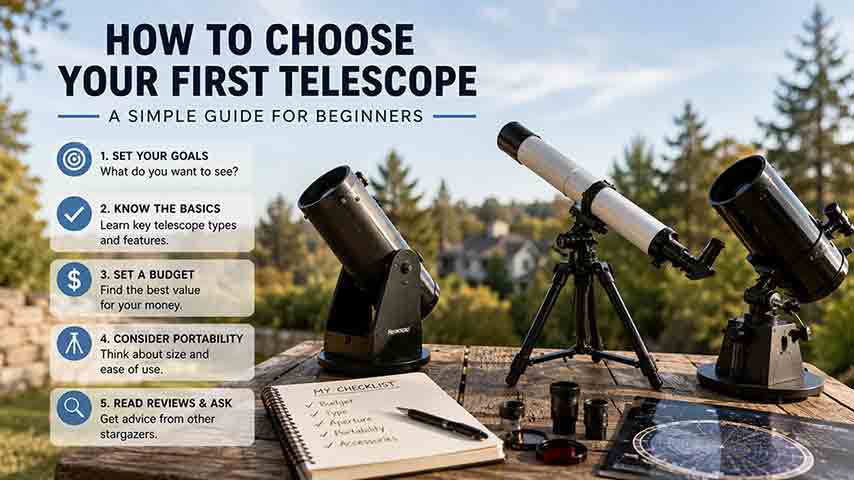
Choosing a first telescope requires more than comparing aperture or advertised magnification. This practical beginner’s guide explains how to match a telescope to observing goals, light pollution, storage space, setup tolerance, and interest in visual observing or imaging. It compares refractors, Dobsonian reflectors, compound telescopes, and smart telescopes, then shows how aperture, focal length, focal ratio, magnification, and mount stability affect real use. Readers can use a quick-selection table, the original SPACE decision framework, a worked specification comparison, realistic household scenarios, new and used equipment checklists, and a troubleshooting chart. The guide also explains why a larger aperture cannot fully overcome bright urban skies, what to verify before buying a software-dependent smart telescope, and how to observe the Sun safely. Recommendations are based on authoritative guidance and published specifications rather than hands-on product testing or paid rankings
How Much Should You Spend on Your First Telescope?
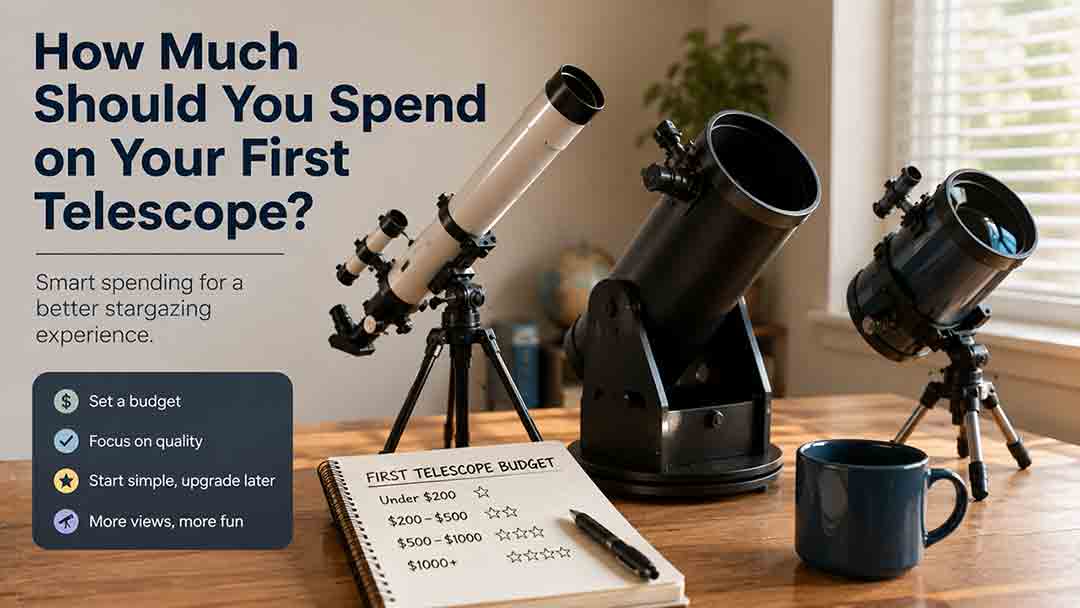
Most beginners should plan a complete first-telescope budget of roughly $350–$700, although the right amount depends on observing goals, portability, automation, and whether the buyer wants direct eyepiece viewing or screen-based imaging. This guide explains what different budget ranges can realistically provide, why very low-cost telescope packages require caution, and when spending more for aperture, GoTo control, smart imaging, or compact optics is justified. It also separates visual astronomy from modular astrophotography, calculates total ownership cost, and shows how accessories, power, storage, shipping, and software can change the real price. The original FIRST Budget Test helps readers evaluate favorite targets, included equipment, real-world portability, desired skills, and total cost. Practical scenarios, a buying checklist, common mistakes, troubleshooting guidance, safety information, and current US market examples help beginners choose a stable, complete setup they are likely to use regularly.
Are Smart Telescopes Worth It for Beginners?
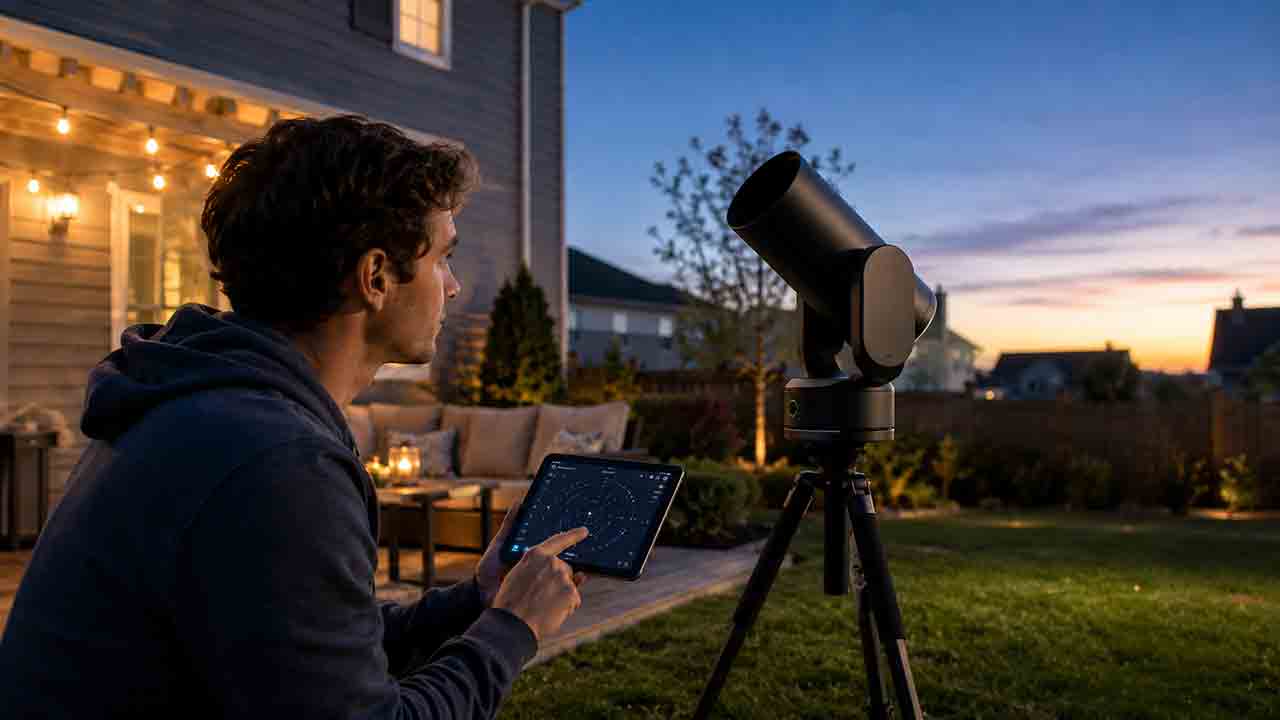
Smart telescopes can be worthwhile for beginners who want automated target finding, live-stacked deep-sky images, and a compact system controlled from a phone or tablet. However, they are not a universal replacement for traditional telescopes. Beginners who value direct eyepiece views, high-magnification planetary observing, manual sky navigation, or component-by-component upgrades may prefer a refractor, reflector, or catadioptric telescope. This guide explains how smart telescopes combine optics, cameras, motorized tracking, and image processing; compares them with traditional and modular imaging setups; and examines costs, software dependence, batteries, light pollution, target suitability, and long-term flexibility. It also provides the original WORTH decision framework, a hypothetical cost-per-session example, real-world beginner scenarios, a purchase checklist, common mistakes, and troubleshooting steps. The goal is to help readers choose based on their actual observing style rather than marketing claims or specifications alone