Eyepieces Mounts & Accessories
Explore 5 fascinating articles about eyepieces mounts & accessories
Enhance your viewing experience. Find the right optical finders, red dot sights, eyepieces, and mounts to customize your telescope rig.
All Articles (5)
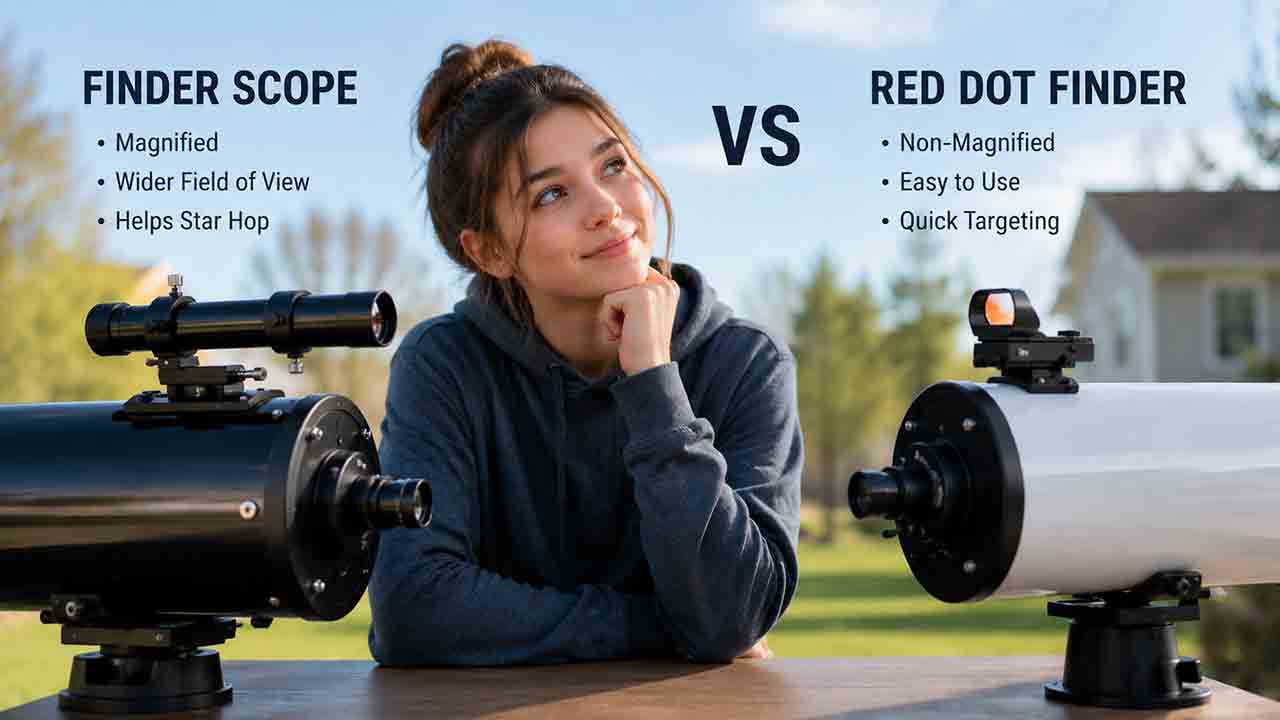
Finder Scope vs Red Dot Finder: Which One Should You Choose?
A red dot finder is usually the easier choice for quickly pointing a telescope at the Moon, planets, bright stars, or computerized-mount alignment targets. An optical finder scope is more useful when the observer needs magnification, additional light gathering, and detailed star patterns to locate faint clusters, nebulae, or galaxies. This guide compares unmagnified red dot sights with straight-through, right-angle, correct-image, and illuminated optical finders. It explains field of view, image orientation, light-pollution performance, batteries, ergonomics, mounting compatibility, alignment, and solar safety. The original SIGHT decision framework helps readers evaluate sky visibility, image orientation, geometry, hardware, and targeting method. A field-of-view calculation, dual-finder workflow, real-world scenarios, decision tree, buying checklist, common mistakes, and troubleshooting table help beginners choose a finder that matches their telescope and observing style
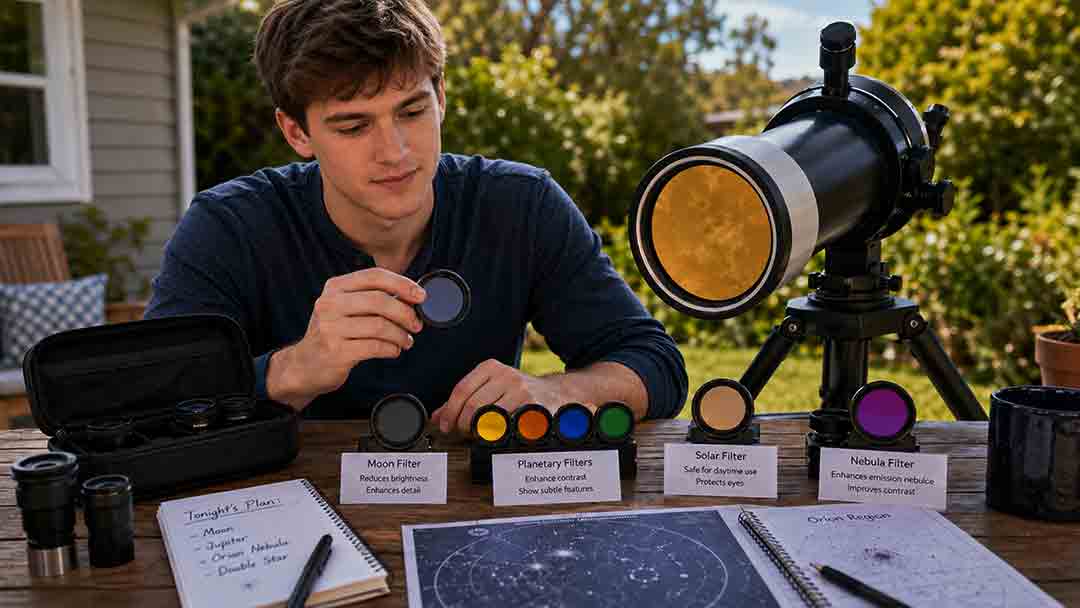
Telescope Filters Explained: Moon, Planetary, Solar, and Nebula Filters
Telescope filters solve different observing problems and should never be treated as interchangeable accessories. This guide explains how neutral-density and variable polarizing filters can improve lunar comfort, how colored planetary filters selectively change contrast, why telescope solar filters require strict front-aperture safety, and how UHC, OIII, H-beta, and broadband filters affect selected deep-sky targets. It also clarifies why nebula filters usually do not improve galaxies, star clusters, or reflection nebulae. Readers receive a target-based comparison framework, an 8-inch Dobsonian example, visual-versus-imaging guidance, 1.25-inch and 2-inch compatibility checks, troubleshooting steps, solar-safety rules, and a detailed buying checklist. The central recommendation is to choose filters by target, transmission behavior, optical system, and intended use rather than by darkness, marketing name, or price
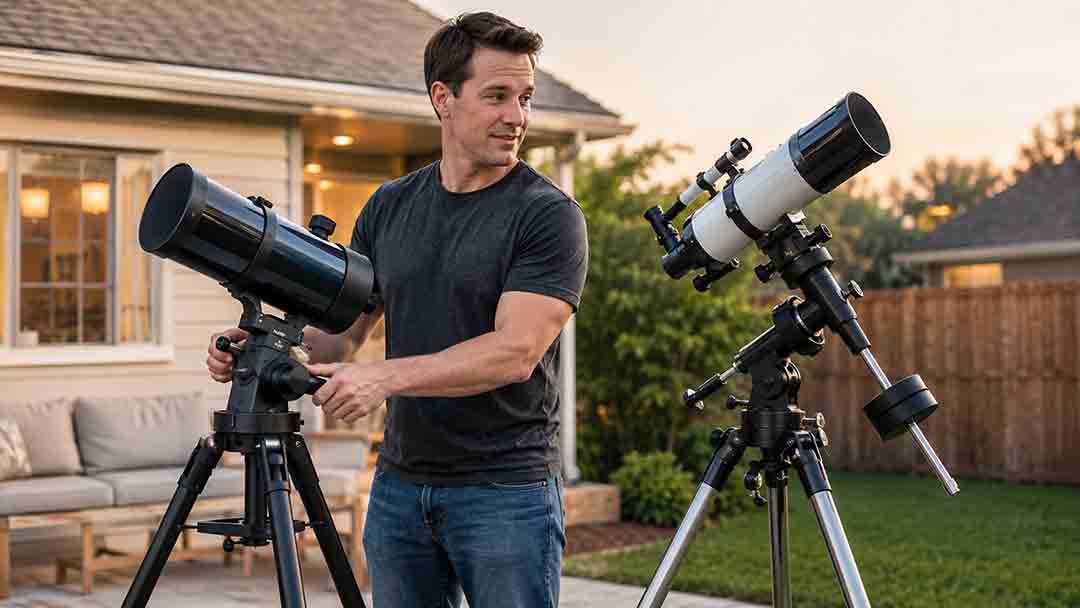
Alt-Azimuth vs Equatorial Mounts: Which Is Easier to Use?
An alt-azimuth mount is usually easier for beginners because it moves naturally up–down and left–right, sets up quickly, and works well for visual or daytime observing. An equatorial mount requires polar alignment, balancing, and more equipment, but it becomes easier for sustained celestial tracking and is generally the practical choice for long-exposure deep-sky astrophotography. This guide explains how both axis systems work, why motorized alt-azimuth tracking still creates field rotation, and when one-axis right ascension tracking becomes useful. It also provides the original TRACK decision framework, a complete payload calculation, setup workflows, real-world user scenarios, a mount-selection decision tree, a buying checklist, common mistakes, and troubleshooting guidance. Readers can compare portability, counterweights, eyepiece position, meridian flips, software requirements, and upgrade plans before choosing a mount

Do You Need a Barlow Lens? Benefits, Limits, and Buying Tips
Telescope eyepiece sizes describe two different specifications: focal length in millimeters and barrel diameter in inches. This guide explains both, then shows readers how to calculate magnification, exit pupil, and true field before purchasing an accessory. It compares common focal-length ranges from 3 mm to 40 mm, identifies practical uses for the Moon, planets, star clusters, nebulae, galaxies, double stars, and wide-field scanning, and clarifies when a 1.25-inch or 2-inch eyepiece is appropriate. Readers also receive focal-ratio and magnification tables, a worked 200 mm f/6 Dobsonian example, a three-eyepiece decision framework, fixed-versus-zoom and Barlow guidance, compatibility checks, troubleshooting steps, and a buying checklist. The central recommendation is to build a small set of distinct low-, medium-, and high-power options rather than purchasing overlapping focal lengths."

Telescope Eyepiece Sizes Explained: What Each One Is Best For
Telescope eyepiece sizes describe two different specifications: focal length in millimeters and barrel diameter in inches. This guide explains both, then shows readers how to calculate magnification, exit pupil, and true field before purchasing an accessory. It compares common focal-length ranges from 3 mm to 40 mm, identifies practical uses for the Moon, planets, star clusters, nebulae, galaxies, double stars, and wide-field scanning, and clarifies when a 1.25-inch or 2-inch eyepiece is appropriate. Readers also receive focal-ratio and magnification tables, a worked 200 mm f/6 Dobsonian example, a three-eyepiece decision framework, fixed-versus-zoom and Barlow guidance, compatibility checks, troubleshooting steps, and a buying checklist. The central recommendation is to build a small set of distinct low-, medium-, and high-power options rather than purchasing overlapping focal lengths."