Telescope Eyepiece Sizes Explained: What Each One Is Best For

Telescope Eyepiece Sizes Explained: What Each One Is Best For
By freya
For most telescopes, 25–40 mm eyepieces provide low-power, wide views; 14–20 mm covers general observing; 9–12 mm suits closer views of the Moon, planets, and compact deep-sky objects; and 3–8 mm provides high power only when the telescope and atmosphere support it. The correct size depends on telescope focal length, focal ratio, field of view, eye relief, barrel compatibility, and target—not the printed number alone.
Key Takeaways
- The millimeter number on an eyepiece is its focal length, not its magnification or physical diameter.
- Divide telescope focal length by eyepiece focal length to calculate magnification.
- Longer focal lengths usually give lower power, wider views, and larger exit pupils; shorter focal lengths give higher power and narrower views.
- The 1.25-inch or 2-inch label describes barrel diameter. A 2-inch eyepiece can support a wider field stop, but it is not automatically sharper or brighter.
- A carefully spaced low-, medium-, and high-power set is more useful than a large collection of overlapping focal lengths.
This guide explains what common telescope eyepiece sizes are best for, how to calculate their performance in your own telescope, and how to avoid incompatible, redundant, or impractical purchases.
Scope note: In this guide, “eyepiece size” mainly refers to focal length in millimeters and barrel diameter in inches. Physical weight, apparent field, eye relief, and field-stop size are included where they affect compatibility or use.
Editorial note: This guide is based on published optical formulas, professional astronomy guidance, manufacturer documentation, and practical selection criteria rather than hands-on testing of individual eyepiece models.
Which Eyepiece Size Is Best at a Glance?
These are practical planning ranges, not universal limits. Telescope focal length, aperture, optical quality, atmospheric conditions, target brightness, observer eyesight, and apparent field can justify different choices.
| Primary use | Common focal-length range | Typical role | Check before buying |
|---|---|---|---|
| Wide-field scanning | 25–40 mm | Low power | Exit pupil, field stop, barrel size, telescope illumination |
| General deep-sky observing | 14–20 mm | Medium power | Magnification, target size, sky brightness |
| Moon and planets | 8–12 mm | Medium-high power | Seeing, aperture, eye relief, mount stability |
| High-power detail | 5–8 mm | High power | Useful magnification, cooling, collimation |
| Short-focal-length telescope | 3–6 mm may be practical | High to very high power | Calculate actual magnification first |
| Minimal travel kit | Low-power eyepiece plus zoom or Barlow | Flexible | Weight, duplicated magnifications, field width |
A focal-length range should never be treated as a shopping list. Calculate the combination in the telescope before buying.
What Does the Millimeter Number on an Eyepiece Mean?
The millimeter number is the focal length of the eyepiece. It determines magnification only after the eyepiece is paired with a telescope.
The Royal Astronomical Society of Canada explains that telescope focal length is usually marked on the optical tube and that a longer telescope focal length produces more magnification with a given eyepiece. Eyepieces also carry their own focal lengths, normally printed on the body.
Use this formula:
Magnification = telescope focal length ÷ eyepiece focal length
For a telescope with a 1,200 mm focal length:
| Eyepiece | Calculation | Magnification |
|---|---|---|
| 30 mm | 1,200 ÷ 30 | 40× |
| 20 mm | 1,200 ÷ 20 | 60× |
| 12 mm | 1,200 ÷ 12 | 100× |
| 8 mm | 1,200 ÷ 8 | 150× |
| 6 mm | 1,200 ÷ 6 | 200× |
A 6 mm eyepiece is not inherently a 200× eyepiece. It gives 200× in this 1,200 mm telescope, but only 100× in a 600 mm telescope.
How much magnification do common telescopes produce?
| Telescope focal length | 25 mm eyepiece | 10 mm eyepiece | 6 mm eyepiece |
|---|---|---|---|
| 400 mm | 16× | 40× | 67× |
| 600 mm | 24× | 60× | 100× |
| 900 mm | 36× | 90× | 150× |
| 1,200 mm | 48× | 120× | 200× |
| 1,500 mm | 60× | 150× | 250× |
These are mathematical magnifications, not performance guarantees. Useful detail still depends on aperture, optical quality, alignment, atmospheric seeing, target altitude, and mount stability.
What Do 1.25-Inch and 2-Inch Eyepiece Sizes Mean?
The 1.25-inch and 2-inch measurements describe the outside diameter of the eyepiece barrel that enters the focuser or diagonal. They do not describe focal length, magnification, or optical quality.
Sky & Telescope’s astronomy glossary identifies 1.25 inches as the most common barrel size and also notes the existence of 0.965-inch and 2-inch formats.
What is a 1.25-inch eyepiece best for?
A 1.25-inch eyepiece is suitable for most medium- and high-power observing and for many low-power combinations. It is widely compatible, relatively compact, and available in a broad range of focal lengths and optical designs.
A 1.25-inch format is often practical for:
- Beginner and intermediate telescopes
- Lunar and planetary observing
- Medium- and high-power deep-sky viewing
- Lightweight focusers and diagonals
- Compact travel kits
- Observers who do not need the widest possible low-power field
Many observers can build a complete and effective set using only 1.25-inch eyepieces.
What is a 2-inch eyepiece best for?
A 2-inch eyepiece is most useful when its larger barrel supports a larger field stop, allowing a wider true field at long focal lengths.
Typical uses include:
- Sweeping large Milky Way fields
- Viewing broad open clusters
- Framing extended nebulae
- Star hopping with a manual mount
- Maximizing low-power field in a compatible telescope
Tele Vue publishes the field-stop formula:
True field in degrees = 57.3 × field-stop diameter ÷ telescope focal length
A larger barrel permits a larger possible field stop, but a 2-inch eyepiece does not automatically provide:
- More magnification
- Better coatings
- Greater sharpness
- Higher contrast
- More comfortable eye relief
- Better value
Those qualities depend on the complete design and manufacturing quality.
Does every telescope accept both barrel sizes?
No. Check the focuser or diagonal.
A 2-inch focuser commonly accepts 1.25-inch eyepieces through an adapter. A 1.25-inch-only focuser cannot accept a 2-inch eyepiece without compatible replacement hardware. Some compact telescope designs also have internal openings that limit how fully a large field can be illuminated.
Before buying a 2-inch eyepiece, verify:
- Focuser or diagonal size
- Available in-focus and out-focus travel
- Telescope illumination limits
- Eyepiece weight
- Mount balance
- Filter compatibility
- Whether a 2-inch diagonal is required
How Do Eyepiece Focal Length and Magnification Work Together?
Shorter eyepiece focal lengths produce higher magnification; longer focal lengths produce lower magnification.
The arithmetic is simple, but useful magnification is limited by the complete observing system.
High power may be restricted by:
- Telescope aperture
- Optical quality
- Atmospheric seeing
- Target altitude
- Collimation
- Thermal adjustment
- Dew
- Mount vibration
- Focusing precision
- Observer eyesight
A combination may calculate to 300× while producing a soft, dim, unstable image. High magnification enlarges blur as readily as it enlarges detail.
How can you tell when magnification is too high?
Reduce power when:
- The image becomes larger without revealing additional detail.
- Planetary edges remain soft.
- Focus never settles at a clear point.
- The view is noticeably dimmer without a useful gain.
- The target crosses the field too quickly.
- Mount vibration dominates the view.
- Atmospheric movement becomes more obvious than the target.
Start with the longest-focal-length eyepiece, center the target, and increase power gradually.
What Is Exit Pupil, and Why Does It Matter?
Exit pupil is the diameter of the beam of light leaving the eyepiece. It is a useful way to compare image brightness, magnification, and viewing comfort across different telescopes.
Use either formula:
Exit pupil = telescope aperture ÷ magnification
or
Exit pupil = eyepiece focal length ÷ telescope focal ratio
For an f/6 telescope:
| Eyepiece | Calculation | Exit pupil |
|---|---|---|
| 30 mm | 30 ÷ 6 | 5.0 mm |
| 18 mm | 18 ÷ 6 | 3.0 mm |
| 12 mm | 12 ÷ 6 | 2.0 mm |
| 6 mm | 6 ÷ 6 | 1.0 mm |
| 3 mm | 3 ÷ 6 | 0.5 mm |
Tele Vue’s published eyepiece reference suggests limiting low powers to about a 7 mm exit pupil or less for reflecting telescopes and treats approximately 0.4 mm as a practical lower boundary in its general notes. These are broad planning guidelines, not guaranteed comfort or performance limits.
Practical exit-pupil zones
| Approximate exit pupil | Common role | Typical effect |
|---|---|---|
| 4–6 mm | Low power | Bright, wide view for locating objects and observing large targets |
| 2–3 mm | Medium power | Useful balance of brightness, contrast, and image scale |
| 1–2 mm | Medium-high power | Good for many compact deep-sky objects, the Moon, and planets |
| 0.5–1 mm | High power | Dimmer and more demanding; useful for bright targets and fine detail |
| Below about 0.5 mm | Very high power | Specialized and often limited by seeing, optics, or focus |
Target brightness matters. The Moon and planets tolerate smaller exit pupils more readily than faint, diffuse galaxies or nebulae.
How Does Focal Ratio Affect Eyepiece Choice?
Focal ratio helps predict the exit pupil produced by an eyepiece. The same eyepiece gives the same exit pupil in telescopes with the same focal ratio, but it may give very different magnification if the telescopes have different apertures and focal lengths.
| Telescope focal ratio | Low power: about 4–5 mm exit pupil | Medium power: about 2–3 mm | High power: about 1–1.3 mm |
|---|---|---|---|
| f/4 | 16–20 mm | 8–12 mm | 4–5 mm |
| f/5 | 20–25 mm | 10–15 mm | 5–6.5 mm |
| f/6 | 24–30 mm | 12–18 mm | 6–8 mm |
| f/8 | 32–40 mm | 16–24 mm | 8–10 mm |
| f/10 | 40–50 mm | 20–30 mm | 10–13 mm |
This table organizes eyepieces by exit pupil, not by magnification. Always calculate both exit pupil and magnification before purchasing.
Fast telescopes, especially around f/4 or f/5, can be more demanding of eyepiece correction near the edge of a wide field. Edge distortion may come from eyepiece astigmatism, telescope coma, field curvature, or a combination of factors.
What Is Each Eyepiece Focal Length Best For?
What are 30–40 mm eyepieces best for?
A 30–40 mm eyepiece is generally used for low-power scanning, large targets, and locating objects.
Common uses include:
- Large open clusters
- Broad Milky Way fields
- Extended nebulae
- Large galaxies
- Star hopping
- Framing multiple objects
- Initial target acquisition
The main limitation is exit pupil. A 40 mm eyepiece in an f/4 telescope creates a 10 mm exit pupil, which may be larger than the observer’s eye can use. In a reflector, the central obstruction may also become more noticeable at an oversized exit pupil.
A 40 mm 1.25-inch eyepiece may provide lower magnification than a 32 mm model without showing a substantially wider true field because the barrel limits field-stop diameter.
What are 20–25 mm eyepieces best for?
A 20–25 mm eyepiece is a versatile low- to medium-power choice for general scanning and larger deep-sky objects.
This range often provides:
- Easy target acquisition
- More image scale than a 30–40 mm eyepiece
- A manageable exit pupil in many f/5 to f/10 telescopes
- Useful views of the Moon, clusters, nebulae, and brighter galaxies
- A compact low-power option in the 1.25-inch format
A 24 or 25 mm eyepiece can anchor a small 1.25-inch set. Whether it duplicates a 30–32 mm eyepiece depends on the apparent field, field stop, and resulting true field.
What are 14–18 mm eyepieces best for?
A 14–18 mm eyepiece is often a useful medium-power workhorse.
It can be effective for:
- Globular clusters
- Open clusters
- Brighter galaxies
- Planetary nebulae
- Detailed lunar overviews
- Smaller emission nebulae
- Improving image scale under a bright sky
In many f/6 to f/8 telescopes, this range produces an exit pupil around 2–3 mm, which often balances brightness and scale well.
What are 9–12 mm eyepieces best for?
A 9–12 mm eyepiece is commonly used for medium-high power on the Moon, planets, globular clusters, planetary nebulae, and double stars.
In a 1,200 mm telescope:
- 12 mm gives 100×
- 10 mm gives 120×
- 9 mm gives about 133×
These magnifications can be more productive than extreme high power because they retain brightness, field width, and tolerance for average atmospheric conditions.
What are 6–8 mm eyepieces best for?
A 6–8 mm eyepiece is usually a high-power option for lunar features, planetary detail, close double stars, and compact deep-sky objects.
In a 1,200 mm telescope:
- 8 mm gives 150×
- 7 mm gives about 171×
- 6 mm gives 200×
This range becomes useful when the telescope is thermally stable, accurately focused, correctly collimated where required, and supported by steady atmospheric conditions.
Comfort also matters. Some simple short-focal-length eyepieces have very short eye relief. A longer-eye-relief design or a longer focal length used with a suitable Barlow may be easier to use.
What are 3–5 mm eyepieces best for?
A 3–5 mm eyepiece is a specialized high-power choice, not a default purchase for every telescope.
It may be appropriate when:
- The telescope has a short focal length.
- The aperture supports the resulting power.
- The mount remains stable.
- The optics are well aligned.
- The atmosphere is unusually steady.
- The target is bright enough.
For a 600 mm telescope:
- 5 mm gives 120×
- 4 mm gives 150×
- 3 mm gives 200×
For a 1,500 mm telescope:
- 5 mm gives 300×
- 3 mm gives 500×
The first set may be practical. The second will often exceed useful conditions. Calculate first.
How Do Apparent Field and True Field Change the Choice?
Apparent field of view describes how wide the view appears inside the eyepiece. True field of view describes how much sky the telescope-eyepiece combination actually shows.
A useful estimate is:
Approximate true field = apparent field ÷ magnification
For example, a 12 mm eyepiece with a 60-degree apparent field in a 1,200 mm telescope produces 100×:
60 degrees ÷ 100 = approximately 0.6 degrees of sky
The more precise method uses field-stop diameter.
When is a wider apparent field useful?
A wider apparent field can:
- Keep a target visible longer in a manual telescope
- Reduce how often a Dobsonian must be nudged
- Show more surrounding sky
- Make high power feel less confined
- Help frame large targets
Possible tradeoffs include:
- Higher weight
- Higher price
- Greater balance demands
- More complex eye placement
- More visible edge aberrations in fast telescopes
A 10 mm 82-degree eyepiece and a 10 mm 50-degree eyepiece provide the same magnification in the same telescope, but not the same true field or viewing experience.
How Much Eye Relief Do You Need?
Eye relief is the distance from the eye lens to the position where the observer can see the full apparent field.
Eyeglass wearers often begin by considering approximately 15–20 mm of published eye relief. Usable eye relief can be shorter than the stated optical value when the eye lens is recessed or the eyeguard occupies part of the distance.
Longer eye relief can help:
- Eyeglass wearers
- Observers with long eyelashes
- Public-outreach participants
- Cold-weather observers
- Users who dislike pressing close to the lens
Excessively long eye relief can make eye placement sensitive. If blackouts or crescent-shaped shadows appear, adjust the eyeguard and move the eye slightly closer or farther away.
Observers who wear glasses only for nearsightedness or farsightedness may be able to refocus the telescope without them. Observers correcting astigmatism often need glasses, especially at larger exit pupils.
Should You Choose Fixed, Zoom, or Barlow-Assisted Eyepieces?
Fixed-focal-length eyepieces
Fixed eyepieces are useful when you want a known field, eye relief, weight, and optical design at each power.
Advantages:
- Predictable specifications
- Broad design choices
- Easier optimization of each focal length
- Often lighter than a zoom
- No accidental focal-length change
Tradeoffs:
- More items to carry
- More swapping and refocusing
- Higher total cost for a large set
- Greater risk of buying redundant focal lengths
Zoom eyepieces
A zoom eyepiece is useful when convenience and continuous power changes matter more than having a separately optimized eyepiece at each focal length.
Advantages:
- Fast adjustment to changing seeing
- Fewer accessories
- Helpful for discovering preferred magnifications
- Convenient for travel and outreach
- Less time spent changing eyepieces
Tradeoffs:
- Apparent field may vary across the range
- Eye relief may vary
- Some designs are relatively heavy
- The lowest power may not provide a genuinely wide field
- Performance and ergonomics vary by model
Check the exact specifications of the zoom being considered. Do not assume all 8–24 mm zooms have the same field, eye relief, size, or optical behavior.
Barlow lenses
A Barlow lens multiplies the effective focal length of the telescope and increases the magnification of an eyepiece.
A 2× Barlow makes:
- 24 mm behave approximately like 12 mm
- 16 mm behave approximately like 8 mm
- 12 mm behave approximately like 6 mm
Celestron’s official Barlow guidance describes the same multiplication principle.
A Barlow can expand a small collection, but it can also create duplicate powers. For example, a set with 24 mm, 12 mm, and a 2× Barlow duplicates the 12 mm result when the 24 mm is placed in the Barlow.
List every combination before purchasing.
How Do You Build a Practical Three-Eyepiece Set?
Step 1: Choose a low-power eyepiece
Aim for:
- A useful true field
- An exit pupil appropriate for the telescope
- Compatible barrel size
- Manageable weight
- Good balance on the mount
For many systems, an exit pupil around 4–6 mm is more useful than simply choosing the longest focal length available.
Step 2: Choose a medium-power workhorse
An exit pupil around 2–3 mm is a practical starting point for many deep-sky targets. This eyepiece should fill the gap between scanning and detailed inspection.
Step 3: Choose a realistic high-power eyepiece
An exit pupil around 1–1.3 mm often provides a useful regular high-power option. Add a smaller exit pupil only after learning how frequently the telescope and local atmosphere support it.
Step 4: Check magnification spacing
A set of 40×, 80×, and 160× provides clearly distinct roles. A set of 80×, 92×, and 105× may be unnecessarily crowded unless the eyepieces offer meaningfully different fields or eye relief.
Tele Vue’s general reference suggests spacing low- and medium-power field stops by ratios around 1.4 to 1.7. That is one planning approach rather than a mandatory rule.
Step 5: Check mechanical compatibility
Confirm:
- Barrel size
- Focuser travel
- Eyepiece weight
- Diagonal capacity
- Mount balance
- Filter threads
- Eyeguard adjustment
- Storage dimensions
- Whether the telescope can safely hold the accessory
Worked Example: A 200 mm f/6 Dobsonian
A 200 mm f/6 Dobsonian has:
- 200 mm aperture
- 1,200 mm focal length
- f/6 focal ratio
The following example uses assumed apparent fields. True fields are estimates.
| Eyepiece | Example apparent field | Magnification | Exit pupil | Approx. true field | Primary role |
|---|---|---|---|---|---|
| 30 mm | 68° | 40× | 5.0 mm | 1.7° | Wide-field finding and large targets |
| 18 mm | 60° | 67× | 3.0 mm | 0.9° | General deep-sky observing |
| 12 mm | 60° | 100× | 2.0 mm | 0.6° | Clusters, nebulae, lunar detail |
| 8 mm | 60° | 150× | 1.3 mm | 0.4° | Planets and compact targets |
| 6 mm | 60° | 200× | 1.0 mm | 0.3° | High power in steady conditions |
The observer does not need all five immediately.
A practical starting set could be:
- 30 mm for low power
- 12–18 mm for medium power
- 6–8 mm for high power
The final choice depends on target preference, local seeing, budget, eye relief, and whether a Barlow is included.
Which Eyepiece Strategy Fits Different Observers?
| Observer | Useful starting strategy | Main consideration |
|---|---|---|
| Beginner with 25 mm and 10 mm eyepieces | Calculate existing powers before adding anything | Fill a real gap rather than buying every focal length |
| Urban Moon and planet observer | Medium-high power plus one realistic high-power option | Seeing and mount stability |
| Dark-sky deep-sky observer | Wide low-power field plus 2–3 mm exit-pupil eyepiece | Field stop, sky darkness, weight |
| Eyeglass wearer | Long-eye-relief designs | Usable eye relief and eyeguard design |
| Manual Dobsonian user | Wider apparent field at medium and high power | Balance and nudging frequency |
| Travel observer | Compact low-power eyepiece plus zoom or Barlow | Weight and duplication |
What Are the Most Common Eyepiece Buying Mistakes?
| Mistake | Why it causes problems | Better approach |
|---|---|---|
| Buying the shortest focal length | May create excessive, unusable power | Calculate magnification and exit pupil |
| Assuming 2-inch means higher quality | Barrel size does not guarantee optical performance | Compare field stop, weight, eye relief, and design |
| Buying closely spaced focal lengths | Creates redundant magnifications | Build distinct low-, medium-, and high-power steps |
| Ignoring weight | Can unbalance a telescope or strain a focuser | Check mount and focuser capacity |
| Ignoring eye relief | Makes the full field difficult to see | Confirm usable eye relief before purchase |
| Choosing by advertised magnification | High power may only enlarge blur | Evaluate aperture, seeing, and optical quality |
| Ignoring fast-telescope demands | Edge aberrations may become distracting | Research eyepiece performance at the telescope’s focal ratio |
| Buying a Barlow without mapping combinations | Can duplicate existing focal lengths | List every resulting magnification first |
How Do You Troubleshoot Common Eyepiece Problems?
Why can’t you see anything through the eyepiece?
Start with the longest-focal-length eyepiece.
Then:
- Remove any unnecessary Barlow.
- Confirm that all protective caps are removed.
- Point the telescope at a distant terrestrial object during daylight, well away from the Sun.
- Move the focuser slowly through its full range.
- Align the finder with the main telescope.
- At night, begin with the Moon or a bright star.
Solar safety: Never point a telescope, finder scope, binoculars, or camera at the Sun unless a certified, undamaged full-aperture solar filter is securely installed over the front of the instrument. Never use an eyepiece solar filter.
Why does the image look blurry at high power?
Possible causes include:
- Excessive magnification
- Poor atmospheric seeing
- A target low above the horizon
- Incomplete thermal adjustment
- Incorrect collimation
- Dew
- Mount vibration
- Inaccurate focus
Return to a longer-focal-length eyepiece. If the smaller image is sharper and reveals the same detail, the higher power was not useful at that time.
Why do black shadows appear when you move your eye?
The eye is probably moving away from the exit pupil. Adjust the eyeguard and move slightly closer or farther from the eye lens.
Long-eye-relief and wide-angle designs may require more precise eye placement.
Why are stars distorted near the edge?
Possible contributors include:
- Eyepiece astigmatism
- Telescope coma
- Field curvature
- Observer astigmatism
- Tilt
- Poor focus
- Mechanical misalignment
Check whether the distortion changes when the eyepiece rotates and whether refocusing improves the edge. Fast telescopes generally place greater demands on edge correction.
Why does a heavy eyepiece make the telescope move?
A large eyepiece can shift the balance point. Use the mount’s tension adjustment if available, add an appropriate counterweight, or choose a lighter accessory.
Do not loosen a mount so far that the telescope can swing unexpectedly.
Telescope Eyepiece Buying Checklist
Before purchasing, confirm:
- Telescope focal length
- Telescope aperture
- Telescope focal ratio
- Focuser or diagonal barrel size
- Magnification produced by the eyepiece
- Exit pupil produced by the combination
- Approximate or field-stop-based true field
- Apparent field of view
- Published and usable eye relief
- Eyepiece weight
- Mount and focuser balance
- Filter-thread compatibility
- Required adapters
- Whether the eyepiece duplicates an existing focal length or Barlow combination
- Whether local seeing commonly supports the planned high power
- Return policy and warranty terms
- Whether specifications come from a reliable source
How We Developed These Recommendations
This guide evaluates eyepiece choices using four connected measures:
- Magnification, calculated from telescope focal length divided by eyepiece focal length.
- Exit pupil, calculated from eyepiece focal length divided by telescope focal ratio.
- True field, estimated from apparent field divided by magnification or calculated more precisely from field-stop diameter.
- Practical compatibility, including barrel size, eye relief, weight, focuser capacity, mount balance, target type, and observing conditions.
The focal-length ranges are editorial planning zones rather than universal performance guarantees. No individual eyepiece model was hands-on tested for this article. Model-specific specifications, availability, warranties, and compatibility should be confirmed with current manufacturer documentation before purchase.
Which Telescope Eyepiece Sizes Should You Buy?
Choose by function rather than by collecting focal-length numbers:
- Select a low-power eyepiece with a useful true field and an appropriate exit pupil.
- Add a medium-power eyepiece around a 2–3 mm exit pupil for general observing.
- Add a high-power eyepiece around a 1–1.3 mm exit pupil for the Moon, planets, double stars, and compact targets.
- Consider a Barlow only after checking for duplicate powers.
- Choose a 2-inch low-power eyepiece only when the telescope supports it and the wider field justifies the weight and cost.
- Prioritize eye relief and stable eye placement when observing with glasses.
- For a fast telescope, include edge correction and telescope coma in the buying decision.
The best telescope eyepiece size is the one that creates useful magnification, exit pupil, field width, viewing comfort, and mechanical balance in your specific telescope.
Frequently Asked Questions
Is a 10 mm or 20 mm eyepiece more powerful?
A 10 mm eyepiece produces twice the magnification of a 20 mm eyepiece in the same telescope. That does not make it automatically better. The 20 mm eyepiece usually provides a wider, brighter view and easier target acquisition.
Is a 25 mm eyepiece good for beginners?
A 25 mm eyepiece is a practical beginner option in many telescopes because it commonly provides low or moderate power and a useful field. Calculate the exact magnification and exit pupil before deciding whether it should be the lowest-power eyepiece in the set.
What eyepiece focal length is best for planets?
Choose a focal length that produces realistic magnification and an exit pupil around 0.7–1.5 mm as a broad starting range. In many telescopes this may be an eyepiece between 6 mm and 12 mm, but telescope focal length and aperture determine the actual result.
Is a 2-inch eyepiece better than a 1.25-inch eyepiece?
Not automatically. A 2-inch barrel can permit a wider field stop, especially at low power. A 1.25-inch eyepiece may be equally suitable for medium and high power while being lighter, less expensive, and compatible with more telescopes.
How many eyepieces does a beginner need?
Three distinct powers are enough for many beginners: low, medium, and high. A well-planned set is more useful than a large collection with overlapping magnifications. A zoom or Barlow can reduce the number of separate eyepieces required.
Can an eyepiece provide too little magnification?
Yes. If the eyepiece creates an exit pupil larger than the observer’s usable eye pupil, some collected light may not enter the eye. Very low power can also make a reflector’s central obstruction more noticeable and may leave the sky background bright under light pollution.
Sources
Sources were accessed July 30, 2026.
- Royal Astronomical Society of Canada — Telescope Basics
- Royal Astronomical Society of Canada — Beginner Telescopes and Accessories
- Royal Astronomical Society of Canada, Victoria Centre — Telescope Field of View
- Sky & Telescope — Telescope Formulas
- Sky & Telescope — Astronomy Glossary
- Sky & Telescope — Astronomy Equipment Guides
- Celestron — How to Determine Which Eyepieces to Use
- RASC — Telescope Basics
- Celestron — How to Determine Which Eyepieces to Use
- Celestron — How to Determine Which Eyepieces to Use
- Celestron — How Do I Use My Telescope Eyepieces?
- Celestron — All About Barlow Lenses
More from Eyepieces Mounts & Accessories
Finder Scope vs Red Dot Finder: Which One Should You Choose?
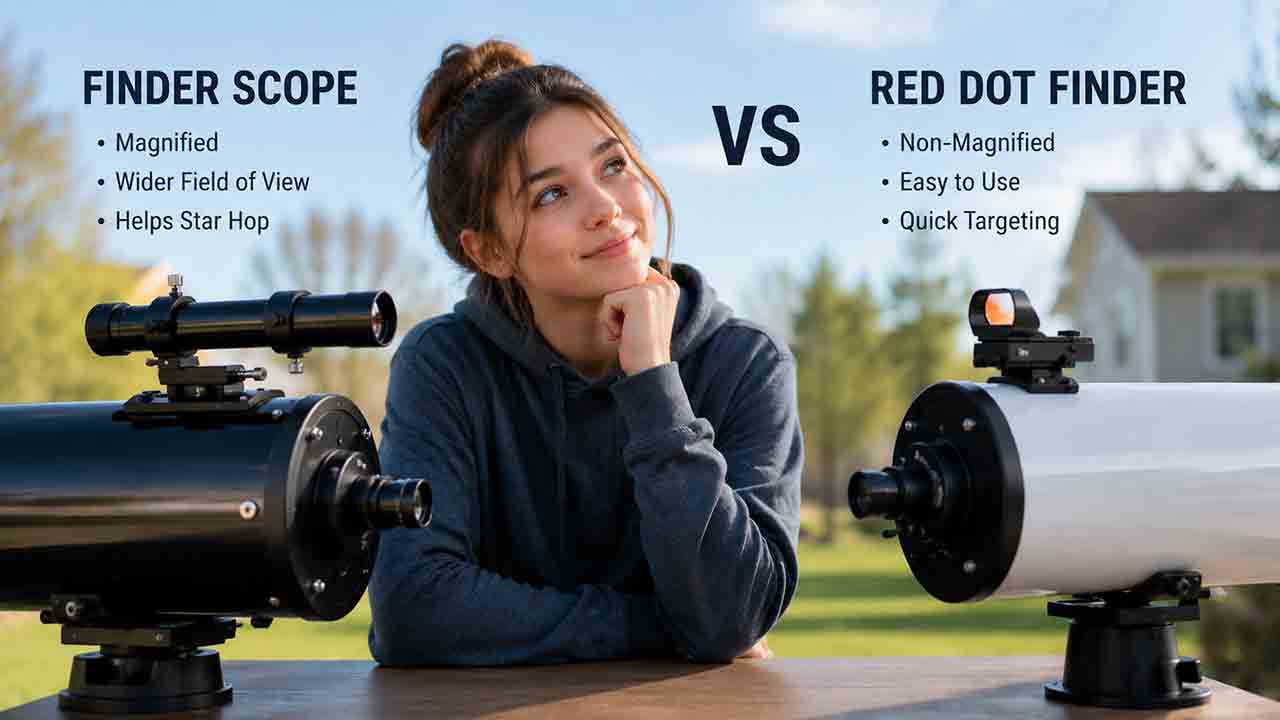
A red dot finder is usually the easier choice for quickly pointing a telescope at the Moon, planets, bright stars, or computerized-mount alignment targets. An optical finder scope is more useful when the observer needs magnification, additional light gathering, and detailed star patterns to locate faint clusters, nebulae, or galaxies. This guide compares unmagnified red dot sights with straight-through, right-angle, correct-image, and illuminated optical finders. It explains field of view, image orientation, light-pollution performance, batteries, ergonomics, mounting compatibility, alignment, and solar safety. The original SIGHT decision framework helps readers evaluate sky visibility, image orientation, geometry, hardware, and targeting method. A field-of-view calculation, dual-finder workflow, real-world scenarios, decision tree, buying checklist, common mistakes, and troubleshooting table help beginners choose a finder that matches their telescope and observing style
Telescope Filters Explained: Moon, Planetary, Solar, and Nebula Filters
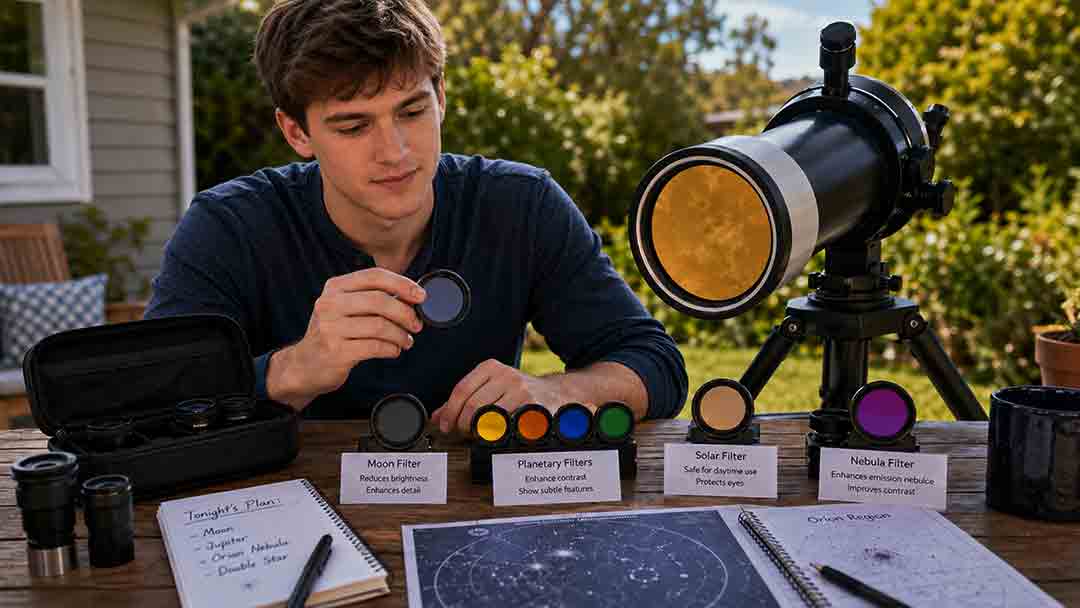
Telescope filters solve different observing problems and should never be treated as interchangeable accessories. This guide explains how neutral-density and variable polarizing filters can improve lunar comfort, how colored planetary filters selectively change contrast, why telescope solar filters require strict front-aperture safety, and how UHC, OIII, H-beta, and broadband filters affect selected deep-sky targets. It also clarifies why nebula filters usually do not improve galaxies, star clusters, or reflection nebulae. Readers receive a target-based comparison framework, an 8-inch Dobsonian example, visual-versus-imaging guidance, 1.25-inch and 2-inch compatibility checks, troubleshooting steps, solar-safety rules, and a detailed buying checklist. The central recommendation is to choose filters by target, transmission behavior, optical system, and intended use rather than by darkness, marketing name, or price
Alt-Azimuth vs Equatorial Mounts: Which Is Easier to Use?
An alt-azimuth mount is usually easier for beginners because it moves naturally up–down and left–right, sets up quickly, and works well for visual or daytime observing. An equatorial mount requires polar alignment, balancing, and more equipment, but it becomes easier for sustained celestial tracking and is generally the practical choice for long-exposure deep-sky astrophotography. This guide explains how both axis systems work, why motorized alt-azimuth tracking still creates field rotation, and when one-axis right ascension tracking becomes useful. It also provides the original TRACK decision framework, a complete payload calculation, setup workflows, real-world user scenarios, a mount-selection decision tree, a buying checklist, common mistakes, and troubleshooting guidance. Readers can compare portability, counterweights, eyepiece position, meridian flips, software requirements, and upgrade plans before choosing a mount
Explore More Topics
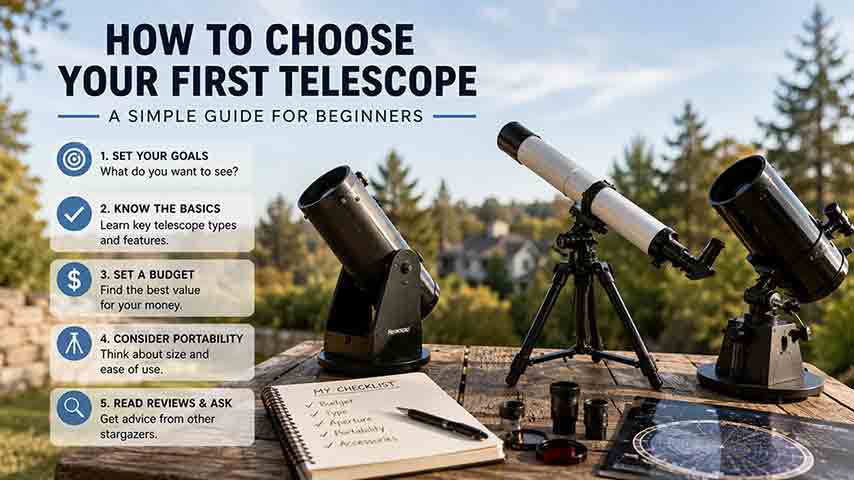
How to Choose Your First Telescope: A Beginner’s Buying Guide
Choosing a first telescope requires more than comparing aperture or advertised magnification. This practical beginner’s guide explains how to match a telescope to observing goals, light pollution, storage space, setup tolerance, and interest in visual observing or imaging. It compares refractors, Dobsonian reflectors, compound telescopes, and smart telescopes, then shows how aperture, focal length, focal ratio, magnification, and mount stability affect real use. Readers can use a quick-selection table, the original SPACE decision framework, a worked specification comparison, realistic household scenarios, new and used equipment checklists, and a troubleshooting chart. The guide also explains why a larger aperture cannot fully overcome bright urban skies, what to verify before buying a software-dependent smart telescope, and how to observe the Sun safely. Recommendations are based on authoritative guidance and published specifications rather than hands-on product testing or paid rankings
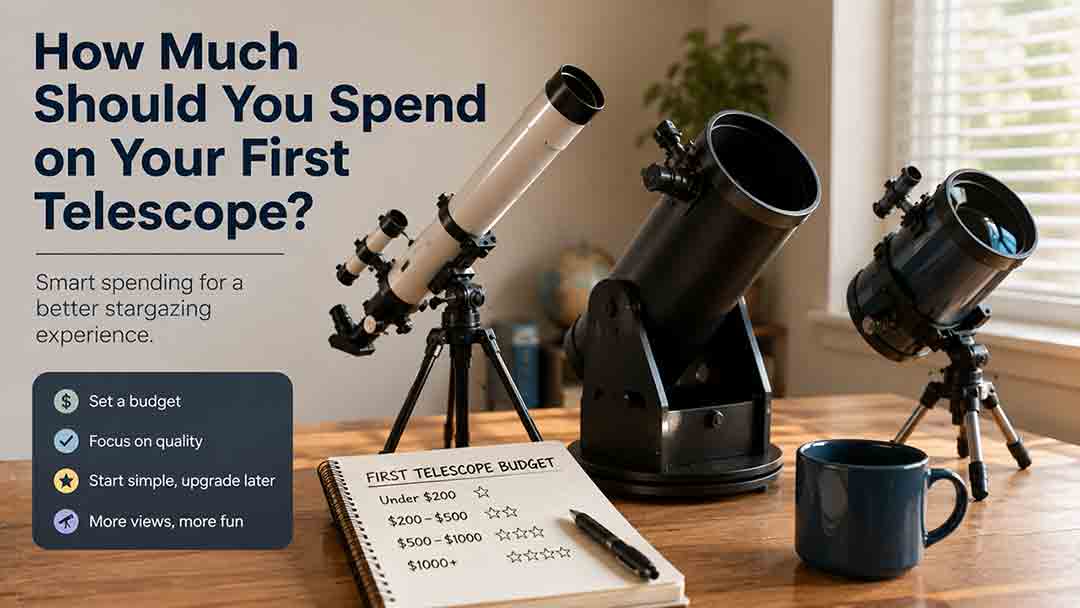
How Much Should You Spend on Your First Telescope?
Most beginners should plan a complete first-telescope budget of roughly $350–$700, although the right amount depends on observing goals, portability, automation, and whether the buyer wants direct eyepiece viewing or screen-based imaging. This guide explains what different budget ranges can realistically provide, why very low-cost telescope packages require caution, and when spending more for aperture, GoTo control, smart imaging, or compact optics is justified. It also separates visual astronomy from modular astrophotography, calculates total ownership cost, and shows how accessories, power, storage, shipping, and software can change the real price. The original FIRST Budget Test helps readers evaluate favorite targets, included equipment, real-world portability, desired skills, and total cost. Practical scenarios, a buying checklist, common mistakes, troubleshooting guidance, safety information, and current US market examples help beginners choose a stable, complete setup they are likely to use regularly.
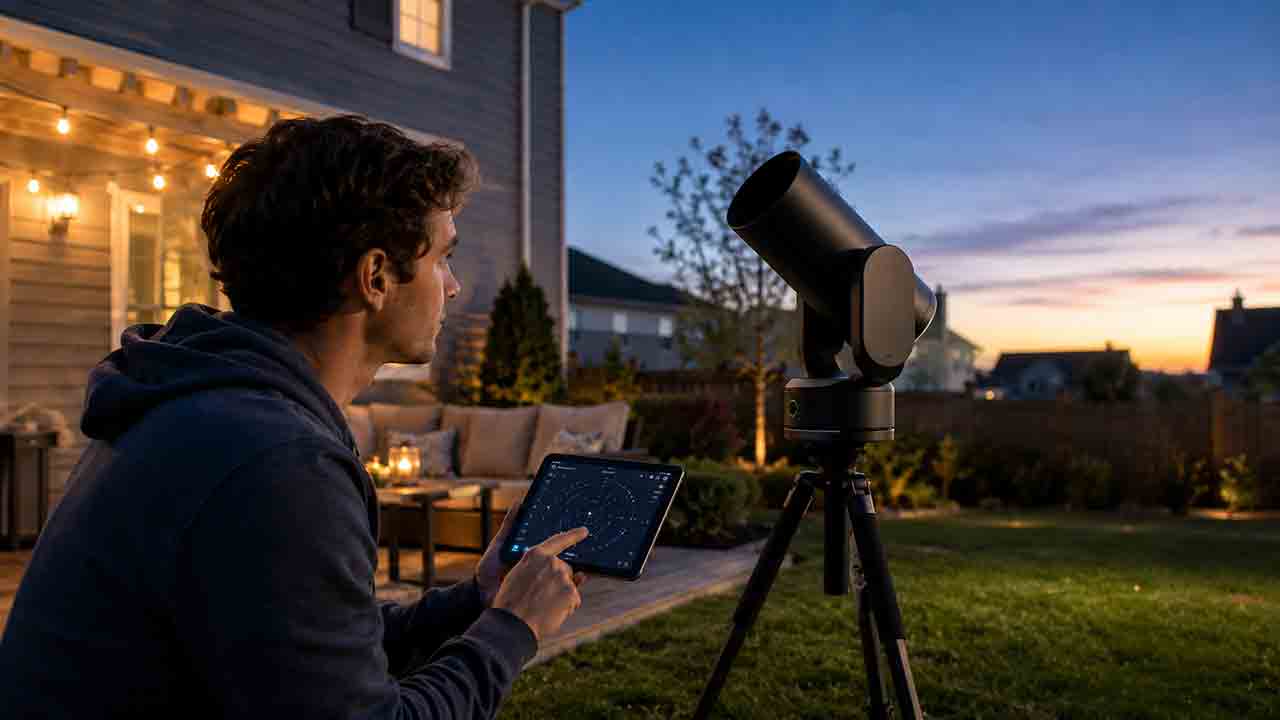
Are Smart Telescopes Worth It for Beginners?
Smart telescopes can be worthwhile for beginners who want automated target finding, live-stacked deep-sky images, and a compact system controlled from a phone or tablet. However, they are not a universal replacement for traditional telescopes. Beginners who value direct eyepiece views, high-magnification planetary observing, manual sky navigation, or component-by-component upgrades may prefer a refractor, reflector, or catadioptric telescope. This guide explains how smart telescopes combine optics, cameras, motorized tracking, and image processing; compares them with traditional and modular imaging setups; and examines costs, software dependence, batteries, light pollution, target suitability, and long-term flexibility. It also provides the original WORTH decision framework, a hypothetical cost-per-session example, real-world beginner scenarios, a purchase checklist, common mistakes, and troubleshooting steps. The goal is to help readers choose based on their actual observing style rather than marketing claims or specifications alone