Do You Need a Barlow Lens? Benefits, Limits, and Buying Tips

Do You Need a Barlow Lens? Benefits, Limits, and Buying Tips
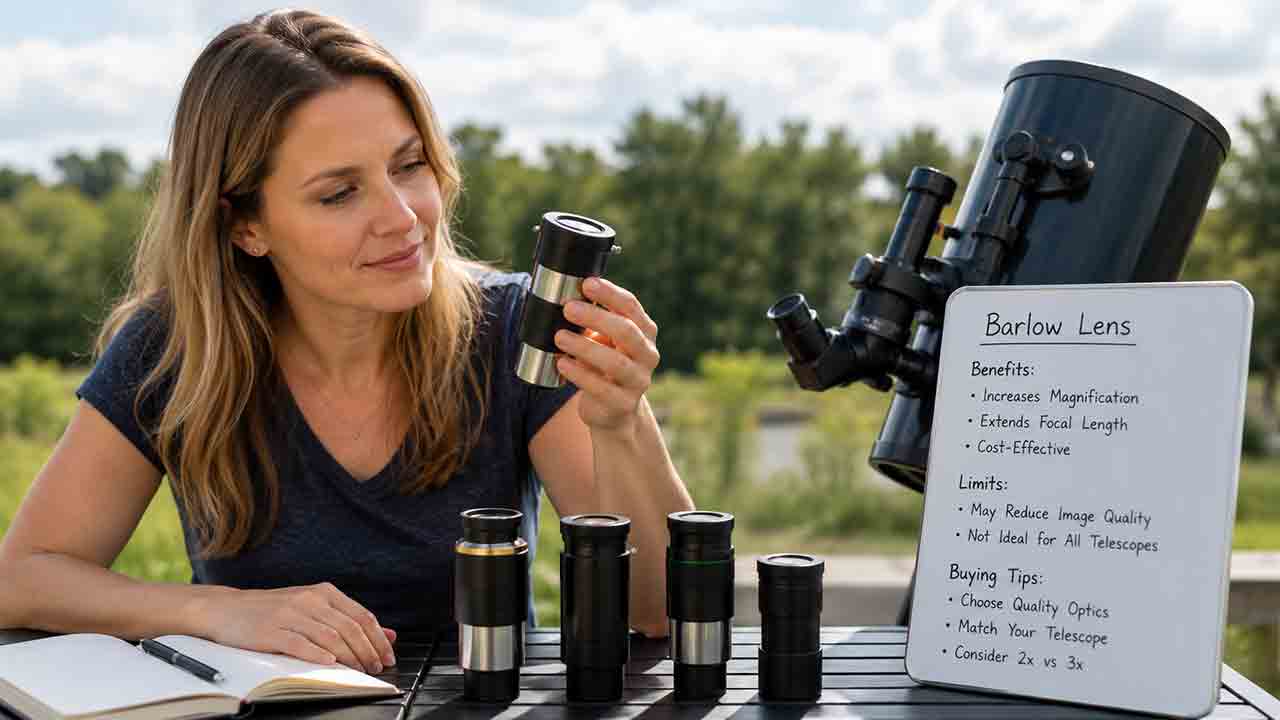
You need a Barlow lens only if it creates useful magnifications that your current eyepieces do not already provide. A well-chosen 2× Barlow can expand a small eyepiece set, preserve the comfort of longer-focal-length eyepieces, and help with lunar or planetary imaging. It is unnecessary when it duplicates existing powers, exceeds the telescope’s useful limits, causes focusing problems, or adds more weight and complexity than value.
Key Takeaways
- A Barlow increases a telescope’s effective focal length, so the same eyepiece produces more magnification.
- A 2× model is the most generally useful starting point; 3× and 5× amplifiers are more specialized.
- Calculate every eyepiece-and-Barlow combination before buying to avoid duplicate or impractical powers.
- A Barlow cannot create detail that the aperture, optics, atmosphere, focus, and mount do not support.
- Compatibility depends on barrel size, focus travel, eyepiece weight, mechanical fit, and the intended visual or imaging setup.
This guide helps you decide whether a Barlow lens solves a real problem in your telescope system, choose a sensible multiplication factor, and recognize situations where another eyepiece or a different accessory would be the better purchase.
Editorial note: This guide is based on published optical guidance, professional astronomy resources, manufacturer documentation, and practical selection criteria rather than hands-on testing of individual Barlow models.
Do You Need a Barlow Lens at a Glance?
| Your situation | Is a Barlow useful? | Why |
|---|---|---|
| You own only one or two eyepieces | Often | One accessory can add several distinct magnifications |
| Your current set has a large jump from medium to high power | Often | A Barlow may fill the gap without another very short eyepiece |
| You want more comfortable high power | Sometimes | A longer-focal-length eyepiece used with a Barlow may retain more comfortable eye relief than a simple short-focal-length design |
| Your Barlow combinations duplicate existing eyepieces | Usually not | The accessory adds little practical range |
| Your highest current power is already limited by seeing | Usually not | More magnification will mainly enlarge blur |
| Your telescope has limited focus travel | Maybe not | Some combinations may not reach focus |
| You want planetary imaging at a larger image scale | Often | A suitable amplifier can increase effective focal length for camera sampling and image scale |
| You mainly observe large nebulae and open clusters | Rarely | Low power and wide true field are usually more important |
| Your mount or focuser is already near its load limit | Maybe not | Added length and weight can increase vibration or imbalance |
The decision should be based on the complete system, not on the idea that “more power” is automatically an upgrade.
What Does a Barlow Lens Do?
A Barlow lens is an optical amplifier placed between the telescope and the eyepiece or camera. It increases the telescope’s effective focal length and therefore increases magnification.
The Royal Astronomical Society of Canada describes Barlow lenses and similar amplifiers as devices that can double, triple, or further increase effective focal length. Celestron’s current technical guide notes that commercial Barlows commonly range from about 1.8× to 5×, with 2× being the most common general-purpose factor.
For visual observing:
Magnification with Barlow = normal eyepiece magnification × Barlow factor
Normal eyepiece magnification is:
Magnification = telescope focal length ÷ eyepiece focal length
A 1,200 mm telescope with a 12 mm eyepiece produces:
1,200 ÷ 12 = 100×
With a nominal 2× Barlow:
100 × 2 = approximately 200×
The word “approximately” matters. The actual amplification of many conventional Barlows can vary with the distance between the optical element and the eyepiece field stop or camera sensor. Baader Planetarium’s technical documentation, for example, shows that changing working distance changes the measured amplification of a modular Barlow.
Does a Barlow Change the Telescope’s Aperture?
No. A Barlow does not increase aperture, light-gathering area, or the telescope’s fundamental resolving power.
A Barlow changes image scale by increasing effective focal length. It does not collect additional light.
When magnification increases:
- The apparent size of the target increases.
- The true field of view becomes smaller.
- Extended objects appear dimmer per unit apparent area.
- Tracking and focusing become more demanding.
- Atmospheric turbulence becomes more visible.
- Mount vibration becomes more obvious.
A Barlow can help the observer use detail that the telescope already resolves. It cannot manufacture detail that was never present in the focused image.
How Much Magnification Will a Barlow Produce?
Use this three-step calculation:
- Divide telescope focal length by eyepiece focal length.
- Multiply the result by the Barlow factor.
- Check whether that power is realistic for the aperture and observing conditions.
Example: 1,200 mm telescope
| Eyepiece | Without Barlow | With 2× Barlow | With 3× Barlow |
|---|---|---|---|
| 30 mm | 40× | 80× | 120× |
| 20 mm | 60× | 120× | 180× |
| 12 mm | 100× | 200× | 300× |
| 8 mm | 150× | 300× | 450× |
| 6 mm | 200× | 400× | 600× |
The table immediately reveals why calculation matters. A 2× Barlow adds useful 80× and 120× options to the longer eyepieces, but it may push the 6 mm eyepiece to an unrealistic 400×. A 3× Barlow makes several combinations highly specialized.
Effective eyepiece focal length
Another way to understand the result is:
Effective eyepiece focal length = eyepiece focal length ÷ Barlow factor
A 20 mm eyepiece with a 2× Barlow behaves approximately like a 10 mm eyepiece for magnification. A 12 mm eyepiece behaves approximately like a 6 mm eyepiece.
This comparison is useful for detecting duplication.
How Do You Avoid Duplicate Magnifications?
Write down every un-Barlowed and Barlowed power before purchasing. A Barlow is valuable only when it adds meaningfully different magnifications.
Consider this set:
- 24 mm eyepiece
- 12 mm eyepiece
- 8 mm eyepiece
- 2× Barlow
The Barlow creates:
- 24 mm ÷ 2 = effective 12 mm
- 12 mm ÷ 2 = effective 6 mm
- 8 mm ÷ 2 = effective 4 mm
The 24 mm plus Barlow duplicates the existing 12 mm. The accessory still adds effective 6 mm and 4 mm options, but one-third of its combinations are redundant.
Now consider:
- 30 mm eyepiece
- 18 mm eyepiece
- 2× Barlow
The combinations are approximately:
- 30 mm
- 18 mm
- effective 15 mm
- effective 9 mm
The 18 mm and effective 15 mm results may be too close to justify frequent switching, depending on apparent field and target. The effective 9 mm option adds a more distinct power.
A simple spacing rule
Do not require every step to be perfectly even, but ask whether each combination changes the observing role.
A useful progression might be:
- 40× for finding
- 80× for general detail
- 140× for planets and compact targets
- 200× for steady nights
A crowded progression might be:
- 90×
- 100×
- 112×
- 120×
Closely spaced powers can still serve different purposes when apparent field, eye relief, or optical behavior differs, but they should not be purchased by accident.
What Are the Main Benefits of a Barlow Lens?
Can a Barlow expand a small eyepiece set?
Yes. A Barlow can turn two or three eyepieces into a broader set of useful powers.
For a beginner with a 25 mm and 10 mm eyepiece, a 2× Barlow creates approximate effective focal lengths of:
- 12.5 mm
- 5 mm
This may provide four magnification levels from two eyepieces and one accessory. Whether all four are useful depends on the telescope focal length and aperture.
The greatest value appears when:
- The new powers are clearly separated.
- The highest power remains realistic.
- The Barlow works with every intended eyepiece.
- The combined weight remains manageable.
- The telescope can reach focus.
Can a Barlow improve high-power comfort?
Sometimes. A Barlow can allow a longer-focal-length eyepiece to provide high magnification while retaining the eyepiece’s generally more comfortable viewing geometry.
Simple short-focal-length eyepiece designs can have limited eye relief. A 15 mm eyepiece used with a 3× Barlow may be more comfortable than a simple 5 mm eyepiece.
However, the result depends on design:
- Some modern short-focal-length eyepieces already provide long eye relief.
- A conventional Barlow can increase eye relief, especially with longer-focal-length eyepieces.
- Excessive eye-relief increase can make eye placement sensitive or contribute to vignetting in some combinations.
- A telecentric amplifier behaves differently from a conventional Barlow.
Comfort should be evaluated from the actual specifications and return policy, not assumed from focal length alone.
Can a Barlow save money?
It can, but only when it replaces useful focal lengths rather than duplicating them.
A single quality Barlow may cost less than buying two additional eyepieces. It can also be shared across several eyepieces and sometimes with a camera adapter.
Potential savings disappear when:
- The Barlow is rarely used.
- The telescope needs a costly adapter.
- Existing eyepieces already cover the same powers.
- A balance solution or stronger focuser becomes necessary.
- The user later buys the duplicated eyepieces anyway.
Evaluate cost at the system level rather than comparing one Barlow with one eyepiece.
Can a Barlow help with planetary imaging?
Yes. Barlows and telecentric amplifiers are widely used to increase image scale for lunar and planetary imaging.
A camera records the telescope’s focal-plane image. Increasing effective focal length makes the planet occupy more pixels, which can help match image scale to camera pixel size, aperture, seeing, and processing method.
A Barlow may also help some Newtonian camera configurations reach focus, although compatibility varies. Celestron’s technical article on high-resolution planetary photography describes a Barlow as useful in some Newtonian DSLR setups where inward focus travel is otherwise insufficient.
More amplification is not automatically better. Excessive focal ratio or image scale can:
- Spread light over too many pixels
- Require longer exposures or higher gain
- Reduce frame rate
- Magnify seeing
- Make focusing harder
- Increase tracking demands
- Produce very large files without more resolved detail
Planetary imaging magnification should be selected from the complete camera-and-telescope sampling plan, not from the Barlow label alone.
What Are the Limits of a Barlow Lens?
Can a Barlow exceed useful magnification?
Yes. This is the most common limitation.
The Royal Astronomical Society of Canada’s educational material presents broad useful-magnification guidance based on aperture, while Tele Vue’s general eyepiece reference notes that atmospheric conditions commonly limit high power and suggests avoiding extremely small exit pupils.
These are planning guides, not guarantees. In practice, useful magnification depends on:
- Aperture
- Optical quality
- Collimation
- Thermal stability
- Atmospheric seeing
- Target brightness
- Target altitude
- Observer eyesight
- Mount stability
A 2× Barlow does not know when the telescope has reached its limit. The user must calculate and observe.
Signs that the Barlow power is excessive
- The target becomes larger but no more detailed.
- Focus has no crisp point.
- Planetary edges appear soft or boiling.
- The image becomes uncomfortably dim.
- Dust, floaters, or optical imperfections become distracting.
- The target moves through the field too quickly.
- The mount shakes after every touch.
When these symptoms appear, remove the Barlow or use a longer-focal-length eyepiece.
Does a Barlow reduce image brightness?
A Barlow does not significantly reduce light merely because it contains glass, but the higher magnification it creates makes extended objects appear dimmer.
Any optical accessory introduces some transmission loss, reflection, or scatter. In a well-made, clean, properly coated Barlow, these losses may be small enough to be visually unobtrusive.
The larger brightness change usually comes from magnification. The same collected light is spread across a larger apparent image.
Point sources such as stars behave differently from extended objects, but the sky background also darkens with increased magnification. This can sometimes improve perceived contrast for small bright targets while making diffuse nebulae or galaxies harder to see.
Can a Barlow narrow the field of view?
Yes. Because magnification increases, the true field of view decreases.
If a telescope-eyepiece combination shows approximately 1 degree without a 2× Barlow, it will show roughly half that true field after the magnification doubles, subject to the optical design and field limitations.
The apparent field of the eyepiece usually remains broadly similar, but some combinations can show vignetting or altered edge illumination.
A Barlow is therefore rarely the accessory of choice for:
- Large open clusters
- Broad nebulae
- Milky Way scanning
- Object finding
- Framing multiple targets
Begin with low power, center the object, and insert the Barlow only after the target is securely in the field.
Can a Barlow cause vignetting or blackouts?
Some Barlow-and-eyepiece combinations can vignette or become more sensitive to eye placement.
Possible causes include:
- The Barlow’s clear aperture
- Eyepiece field-stop size
- Increased eye relief
- A long optical path
- Adapters or diagonals
- Mechanical restrictions
- A combination not intended by the manufacturer
Long-focal-length wide-field eyepieces can be more demanding than compact high-power eyepieces.
If the edge of the field darkens or the view blacks out when the eye moves, test:
- A shorter-focal-length eyepiece.
- A different Barlow position.
- The combination without a diagonal, if the telescope design safely permits and the instructions allow it.
- A manufacturer-recommended adapter.
- A telecentric amplifier designed for more stable field behavior.
Do not assume a defect until compatibility and eye placement have been checked.
Can a Barlow create focusing problems?
Yes. A Barlow changes the optical path and may require different focuser travel.
Celestron’s back-focus guidance notes that limited back focus can prevent some telescopes from using accessories including Barlows, cameras, binoviewers, and 2-inch eyepieces. Newtonian telescopes can be particularly sensitive to available focus travel.
Possible symptoms include:
- The focuser reaches its inward limit before focus.
- The focuser reaches its outward limit before focus.
- One eyepiece focuses but another does not.
- A camera focuses without the Barlow but not with it.
- A diagonal or adapter changes the result.
Before buying, check:
- Telescope manual
- Barlow insertion length
- Required adapters
- Focuser travel
- Diagonal compatibility
- Camera back-focus requirements
- Reports for the exact telescope and accessory combination
Avoid permanent telescope modifications unless the optical and mechanical consequences are fully understood.
Does a Barlow add too much weight or leverage?
It can. The Barlow adds length, and the eyepiece or camera sits farther from the focuser.
This longer accessory stack increases leverage even when the added mass seems modest.
Potential effects include:
- Dobsonian imbalance
- Increased mount vibration
- Focuser sag
- Diagonal rotation
- Compression-ring slippage
- Greater risk of collision with the mount or tripod
- Difficulty reaching the eyepiece comfortably
A heavy 2-inch Barlow, adapter, and wide-field eyepiece can create a much larger mechanical load than a compact 1.25-inch setup.
Check the weight rating and secure every connection. Never rely on a partially tightened thumbscrew.
Is a 2×, 3×, or 5× Barlow Best?
When is a 2× Barlow the best general choice?
A 2× Barlow is usually the most versatile factor because it adds noticeable power without making every combination extreme.
It is often suitable for:
- Beginner visual observing
- Filling a medium-to-high-power gap
- Using longer-eye-relief eyepieces at higher power
- Lunar observation
- Planetary observation
- Entry-level planetary imaging
- Doubling a carefully planned eyepiece set
A 2× Barlow is still a poor choice when it duplicates most of the existing focal lengths.
When does a 3× Barlow make sense?
A 3× Barlow is more specialized and works best with long-focal-length eyepieces, short-focal-length telescopes, or imaging systems that genuinely require the larger image scale.
It may be useful when:
- A 2× factor does not reach the required image scale.
- The telescope has a short native focal length.
- The eyepiece set begins with relatively long focal lengths.
- Planetary imaging calculations support the factor.
- The atmosphere and aperture can use the resulting magnification.
It is easy for a 3× Barlow to create unusable visual powers in a long-focal-length telescope.
When does a 5× amplifier make sense?
A 5× amplifier is normally a specialist imaging or short-focal-length application rather than a routine beginner visual accessory.
It can be appropriate for:
- High-resolution lunar or planetary imaging
- Very short native focal lengths
- Carefully calculated camera sampling
- Bright targets
- Stable tracking and precise focusing
A 5× label should not be treated as a quality ranking. It describes amplification, not optical superiority.
Should You Buy a Conventional Barlow or a Telecentric Amplifier?
A conventional Barlow and a telecentric amplifier both increase effective focal length, but they do not behave identically.
A conventional Barlow typically uses a negative lens group. Its actual amplification often changes with spacing. It can also alter eye relief and may interact with wide-field eyepieces.
A telecentric-style amplifier uses additional optical groups to deliver rays to the eyepiece or sensor in a more nearly telecentric geometry. Tele Vue describes its Powermate line as different from simpler Barlows and designed to reduce some aberration, eye-relief, and field issues in demanding visual and imaging applications.
Practical comparison
| Feature | Conventional Barlow | Telecentric-style amplifier |
|---|---|---|
| Cost | Often lower | Often higher |
| Weight | Often lighter | Can be heavier |
| Amplification with spacing | May vary noticeably | Often more controlled, but model-specific |
| Eye-relief change | May increase | Usually designed to minimize change |
| Wide-field compatibility | Depends strongly on design | Often better controlled |
| Visual use | Very effective when matched well | Effective but may be more than many users need |
| Imaging use | Useful, especially when spacing is understood | Often favored for predictable high-power systems |
| Beginner value | Frequently strong | Usually justified by a specific need |
Do not use “telecentric” as a shortcut for “always better.” The correct accessory depends on field size, target, weight, cost, camera spacing, and telescope compatibility.
Should You Buy a Barlow or Another Eyepiece?
Buy a Barlow when it creates several useful powers; buy another eyepiece when you need one specific power, field, eye relief, or ergonomic improvement.
Choose a Barlow when:
- Two or more combinations add genuinely useful magnifications.
- You want to keep using comfortable longer-focal-length eyepieces.
- You need occasional high power rather than a dedicated high-power eyepiece every night.
- You use both visual observing and planetary imaging.
- Storage space is limited.
- The telescope has adequate focus travel and mechanical capacity.
Choose another eyepiece when:
- Only one missing focal length matters.
- The Barlow duplicates most of the existing set.
- You want a wider apparent field at high power.
- You need a lighter, shorter accessory stack.
- Eye placement with the Barlow combination is uncomfortable.
- The telescope cannot reach focus.
- You frequently use the same high power and prefer faster setup.
- A modern long-eye-relief high-power eyepiece solves the comfort issue directly.
Choose neither when:
- Atmospheric seeing already limits the current maximum power.
- The telescope mount is unstable.
- Collimation or focusing needs improvement.
- The main targets are broad, low-power objects.
- The current eyepiece set already covers distinct useful powers.
- The purchase is motivated only by an advertised maximum magnification.
Worked Example: Does a Beginner With Two Eyepieces Need a Barlow?
Assume the telescope has:
- 130 mm aperture
- 650 mm focal length
- f/5 focal ratio
The supplied eyepieces are:
- 25 mm
- 10 mm
Current powers
| Eyepiece | Magnification | Exit pupil |
|---|---|---|
| 25 mm | 26× | 5.0 mm |
| 10 mm | 65× | 2.0 mm |
With a 2× Barlow
| Combination | Approx. magnification | Approx. effective eyepiece | Exit pupil |
|---|---|---|---|
| 25 mm + 2× | 52× | 12.5 mm | 2.5 mm |
| 10 mm + 2× | 130× | 5 mm | 1.0 mm |
The resulting progression is:
- 26×
- 52×
- 65×
- 130×
The 52× and 65× steps are somewhat close, but they may still feel different because of field and eye-relief differences. The 130× combination adds a useful high-power option for the Moon, planets, double stars, and compact targets when conditions cooperate.
Decision
A 2× Barlow is reasonable if:
- The supplied 10 mm eyepiece is comfortable enough to use.
- The telescope reaches focus with the Barlow.
- The mount remains stable.
- The owner values the new 130× option.
- The Barlow is optically and mechanically sound.
A separate 5 mm or 6 mm long-eye-relief eyepiece may be better if high power is used frequently and the Barlow stack feels awkward.
Worked Example: When a Barlow Adds Little Value
Assume a 1,200 mm telescope with:
- 24 mm eyepiece: 50×
- 12 mm eyepiece: 100×
- 8 mm eyepiece: 150×
A 2× Barlow produces:
- 24 mm + 2×: 100×
- 12 mm + 2×: 200×
- 8 mm + 2×: 300×
The 100× result duplicates the 12 mm. The 200× result may be useful. The 300× result may be occasional or unrealistic depending on aperture and seeing.
If the observer mainly needs 200×, a dedicated 6 mm eyepiece may provide a shorter and simpler setup. The Barlow becomes attractive only if it also serves imaging or other eyepieces.
How Do You Use a Barlow Lens Correctly?
Step 1: Start without the Barlow
Insert the longest-focal-length eyepiece, locate the object, and focus.
Step 2: Center the target carefully
The Barlow will reduce the true field. Centering first makes the target easier to retain.
Step 3: Insert the Barlow securely
Remove the eyepiece, insert the Barlow into the focuser or diagonal as directed by the manufacturer, and tighten the retaining mechanism without overtightening.
Step 4: Insert the eyepiece
Place the eyepiece into the Barlow and secure it. Support heavy accessories while tightening.
Step 5: Refocus slowly
The focus position will change. Move through focus carefully because the high-power focus zone can be narrow.
Step 6: Judge detail, not image size
Compare the Barlowed and un-Barlowed views. Keep the higher power only when it reveals additional detail or improves the observation.
Step 7: Return to lower power when conditions change
Seeing can vary from minute to minute. A lower power may become sharper even during the same session.
What Should You Look for When Buying a Barlow?
Which multiplication factor should you choose?
Start by mapping the actual powers.
For each eyepiece, calculate:
- Normal magnification
- Barlowed magnification
- Effective focal length
- Exit pupil
- Approximate true field
- Whether the result duplicates another eyepiece
Choose the smallest factor that solves the problem.
Should you choose 1.25-inch or 2-inch?
Match the barrel system to the eyepieces and focuser.
A 1.25-inch Barlow is usually:
- Lighter
- Less expensive
- Appropriate for most medium- and high-power eyepieces
- Easier on small focusers and mounts
A 2-inch Barlow can:
- Accept 2-inch eyepieces
- Support a wider accessory ecosystem
- Include a 1.25-inch adapter in some models
- Add substantial weight and leverage
Do not buy a 2-inch Barlow solely because the telescope has a 2-inch focuser. Most high-power observing can be handled in the 1.25-inch format.
How important are optical design and coatings?
A Barlow should provide:
- Well-corrected optics
- Effective baffling
- Controlled internal reflections
- Clean lens edges
- Durable coatings
- Secure mechanical alignment
Marketing phrases such as “fully multi-coated” are useful only when the manufacturer also provides credible specifications, quality control, and support.
Avoid judging a Barlow by lens-element count alone. Additional elements can support a more sophisticated design, but more glass does not automatically guarantee better performance.
How important is clear aperture?
Clear aperture affects whether the Barlow can pass the intended field without clipping or vignetting.
This matters especially with:
- Long-focal-length eyepieces
- Wide field stops
- 2-inch systems
- Large camera sensors
- Long adapter stacks
Manufacturers do not always publish clear aperture. When it is absent, look for compatibility guidance for the exact eyepiece or sensor format.
How important is mechanical construction?
Check:
- Barrel fit
- Compression ring or clamp
- Thumbscrew quality
- Internal threading
- Filter threads
- Lens-cell security
- Blackened interior
- Weight
- Insertion depth
- Adapter alignment
- Safety under a heavy camera or eyepiece
A good optical design can still be frustrating if the barrel tilts or the clamp marks and misaligns accessories.
Should you buy a short or long Barlow?
Short Barlows are compact and convenient, especially in star diagonals. Long Barlows can provide gentler optical geometry in some designs but may be awkward or physically incompatible with certain diagonals.
Never allow a long Barlow barrel to strike a diagonal mirror or prism. Confirm insertion depth before use.
“Shorty” is a mechanical description, not a guarantee of lower or higher quality.
What return policy and support should you check?
Compatibility is difficult to predict from specifications alone.
Prefer a seller or manufacturer that provides:
- Clear barrel and thread specifications
- Weight
- Magnification factor
- Camera-spacing guidance
- Warranty terms
- Return window
- Technical support
- Instructions for visual and imaging use
A reasonable return policy is particularly valuable when testing focus travel, vignetting, eye placement, or balance.
Common Barlow Buying Mistakes
| Mistake | Why it causes problems | Better approach |
|---|---|---|
| Buying the highest factor | Creates excessive power | Choose the lowest factor that fills useful gaps |
| Assuming a 2× label is exact in every setup | Spacing can change actual amplification | Follow manufacturer spacing guidance |
| Ignoring duplicate powers | Adds no practical range | Map every eyepiece combination first |
| Expecting more aperture or resolution | A Barlow changes scale, not aperture | Improve collimation, cooling, and observing conditions |
| Ignoring focus travel | The telescope may not reach focus | Check compatibility before purchase |
| Using a long Barlow carelessly in a diagonal | The barrel may contact optical surfaces | Confirm safe insertion depth |
| Ignoring weight and leverage | Causes sag, vibration, or imbalance | Check focuser and mount capacity |
| Using high power to find objects | The field becomes too narrow | Locate and center at low power first |
| Buying for a printed maximum magnification | Advertised power may be unrealistic | Evaluate aperture, exit pupil, and seeing |
| Assuming all amplifiers behave alike | Conventional and telecentric designs differ | Match the design to the application |
Troubleshooting Barlow Lens Problems
Why can’t the telescope reach focus?
Try:
- Move the focuser through its full safe range.
- Confirm the Barlow is seated correctly.
- Remove unnecessary extension tubes or adapters.
- Test without the diagonal if the telescope instructions permit straight-through use.
- Try another eyepiece.
- Check whether the manufacturer requires a specific adapter.
- Verify camera back focus and spacing for imaging.
Do not force the focuser or modify the telescope until the required optical path is understood.
Why is the Barlowed image blurry?
Possible causes include:
- Excessive magnification
- Poor seeing
- Incomplete cooling
- Miscollimation
- A low-altitude target
- Dew
- Focus error
- A dirty optical surface
- Tilt or sag
- A low-quality or damaged accessory
Compare the view without the Barlow. If the lower-power image shows the same detail more clearly, use the lower power.
Why is the edge of the view dark?
Possible causes include:
- Vignetting
- Insufficient clear aperture
- A large eyepiece field stop
- Long spacing
- Adapter restrictions
- Eye-placement problems
Try a shorter-focal-length eyepiece or a manufacturer-approved combination.
Why does the magnification seem higher or lower than expected?
The actual factor may differ from the nominal label because of working distance.
For imaging, sensor spacing is especially important. For visual use, eyepiece field-stop position and accessory spacing can alter the factor.
Use the manufacturer’s spacing chart when available. For a rough empirical check, image or time the same target with and without the Barlow and compare the scale, but do not present that measurement as laboratory-grade calibration.
Why does the mount shake more?
The longer accessory stack adds leverage. Check:
- Tripod stability
- Mount balance
- Focuser tension
- Diagonal clamp
- Eyepiece clamp
- Camera cable strain
- Wind exposure
A lighter Barlow or dedicated eyepiece may be the better solution.
Why are there reflections or ghost images?
Bright targets can reveal internal reflections.
Check:
- Lens cleanliness
- Coatings
- Internal blackening
- Nearby lights
- Filter placement
- Whether another optical accessory is causing the reflection
Test one component at a time.
Barlow Lens Buying Checklist
Before purchasing, confirm:
- Telescope focal length
- Telescope aperture
- Current eyepiece focal lengths
- Magnification of every proposed combination
- Exit pupil of every high-power combination
- Whether any combinations duplicate existing powers
- Intended visual or imaging use
- Required Barlow factor
- 1.25-inch or 2-inch barrel compatibility
- Clear aperture, if available
- Focus-travel requirements
- Diagonal compatibility
- Safe insertion depth
- Weight and accessory-stack length
- Focuser and mount capacity
- Filter-thread compatibility
- Camera spacing, if imaging
- Manufacturer instructions
- Warranty and return policy
- Whether a dedicated eyepiece would be simpler
How We Developed These Recommendations
This guide uses five connected checks:
- Magnification mapping: Every eyepiece is evaluated both alone and with the proposed Barlow factor.
- Optical limits: Resulting powers and exit pupils are compared with aperture, target type, and realistic atmospheric conditions.
- Range efficiency: Duplicate or closely spaced focal-length equivalents are identified.
- Mechanical compatibility: Barrel size, focus travel, insertion depth, weight, balance, and adapter requirements are considered.
- Use-case fit: Visual observing, outreach, travel, lunar and planetary imaging, and wide-field observing are treated separately.
Numerical examples use standard focal-length and magnification relationships. Recommendations are practical planning guidance rather than universal performance guarantees. No individual Barlow model was hands-on tested for this article. Product specifications and compatibility should be confirmed with current manufacturer documentation before purchase.
Should You Buy a Barlow Lens?
Choose a 2× Barlow when it adds two or more useful magnifications, works with the telescope’s focus travel, and does not make the setup unstable or uncomfortable.
Choose a 3× or 5× amplifier only when a short-focal-length telescope or a calculated imaging system genuinely requires the extra scale.
Choose a dedicated eyepiece when one missing power matters most, when a shorter accessory stack is preferable, or when field of view and eye relief are the main goals.
Choose neither when the current system is already limited by seeing, mount vibration, poor collimation, or unrealistic expectations.
A Barlow lens is not a mandatory telescope accessory. It is valuable when it creates an efficient, compatible, and genuinely useful observing or imaging system.
Frequently Asked Questions
Is a 2× Barlow lens worth buying?
A 2× Barlow is worth buying when it creates useful magnifications that are not already covered by the eyepiece set. It is less useful when most combinations duplicate existing powers or exceed what the telescope and local seeing can support.
Does a Barlow lens reduce image quality?
A well-matched, well-made Barlow can provide very good image quality. Any added optic can introduce some transmission loss, scatter, or aberration, but excessive magnification, poor seeing, miscollimation, and focus error are often more significant than the Barlow itself.
Can you use a Barlow lens with any eyepiece?
Not always. Barrel size, clear aperture, field-stop size, focus travel, insertion depth, weight, and optical design can affect compatibility. Long-focal-length wide-field eyepieces are more likely to show vignetting in some Barlow combinations.
Is a Barlow lens good for viewing planets?
Yes, when it produces a realistic magnification. A Barlow can provide useful planetary image scale while allowing a comfortable longer-focal-length eyepiece to be used. It cannot overcome poor seeing or insufficient aperture.
Is a 3× Barlow better than a 2× Barlow?
No. A 3× Barlow provides more amplification, not automatically better optical performance. A 2× model is usually more versatile for visual observing, while 3× may suit short-focal-length telescopes or calculated planetary imaging systems.
Can you stack two Barlow lenses?
Stacking is physically possible in some systems, but the actual amplification may be difficult to predict, the accessory stack becomes long and heavy, and optical or mechanical problems can increase. Use only combinations supported by the manufacturers and calculate whether the resulting power has a real purpose.
Sources
Sources were accessed July 30, 2026.
- Royal Astronomical Society of Canada — Telescope Basics
- Royal Astronomical Society of Canada — Beginner Telescopes and Accessories
- Royal Astronomical Society of Canada — Observing Tips on Visual Amplification
- Royal Astronomical Society of Canada — Telescope Lesson Reference
- Celestron — All About Barlow Lenses
- Celestron — How to Determine Which Eyepieces to Use
- Celestron — Understanding Your Telescope’s Back Focus
- Celestron — High-Resolution Planetary Photography With a Barlow and DSLR
- Celestron — How to Determine Which Eyepieces to Use
- Celestron — Understanding Your Telescope’s Back Focus
- British Astronomical Association — Filters for Visual Observing of the Moon and Planets
- Baader Planetarium — Barlow Magnification Factors and Working Distances
- Baader Planetarium — Calculating Different Magnifications With the VIP Barlow
- Sky & Telescope — Astronomy Equipment Guides
More from Eyepieces Mounts & Accessories
Finder Scope vs Red Dot Finder: Which One Should You Choose?
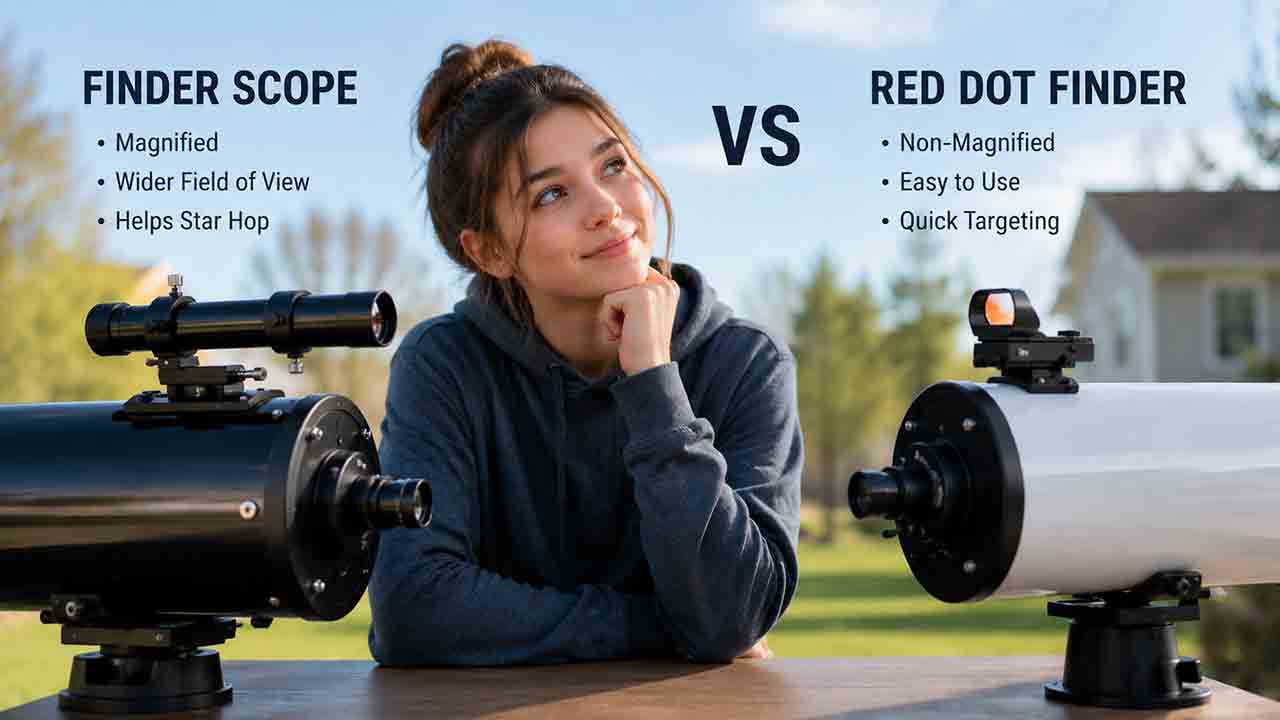
A red dot finder is usually the easier choice for quickly pointing a telescope at the Moon, planets, bright stars, or computerized-mount alignment targets. An optical finder scope is more useful when the observer needs magnification, additional light gathering, and detailed star patterns to locate faint clusters, nebulae, or galaxies. This guide compares unmagnified red dot sights with straight-through, right-angle, correct-image, and illuminated optical finders. It explains field of view, image orientation, light-pollution performance, batteries, ergonomics, mounting compatibility, alignment, and solar safety. The original SIGHT decision framework helps readers evaluate sky visibility, image orientation, geometry, hardware, and targeting method. A field-of-view calculation, dual-finder workflow, real-world scenarios, decision tree, buying checklist, common mistakes, and troubleshooting table help beginners choose a finder that matches their telescope and observing style
Telescope Filters Explained: Moon, Planetary, Solar, and Nebula Filters
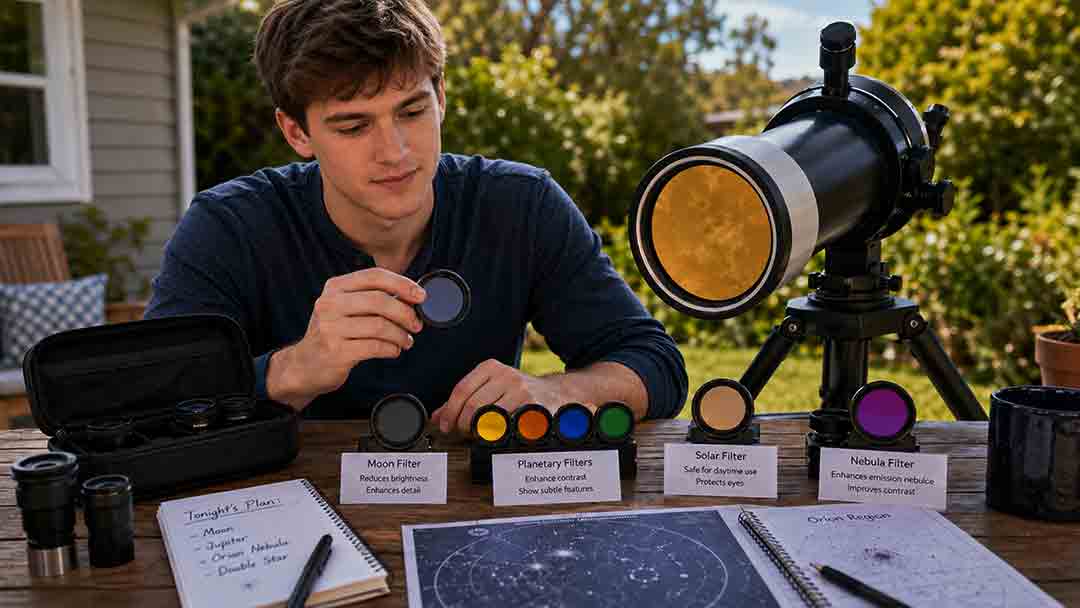
Telescope filters solve different observing problems and should never be treated as interchangeable accessories. This guide explains how neutral-density and variable polarizing filters can improve lunar comfort, how colored planetary filters selectively change contrast, why telescope solar filters require strict front-aperture safety, and how UHC, OIII, H-beta, and broadband filters affect selected deep-sky targets. It also clarifies why nebula filters usually do not improve galaxies, star clusters, or reflection nebulae. Readers receive a target-based comparison framework, an 8-inch Dobsonian example, visual-versus-imaging guidance, 1.25-inch and 2-inch compatibility checks, troubleshooting steps, solar-safety rules, and a detailed buying checklist. The central recommendation is to choose filters by target, transmission behavior, optical system, and intended use rather than by darkness, marketing name, or price
Alt-Azimuth vs Equatorial Mounts: Which Is Easier to Use?
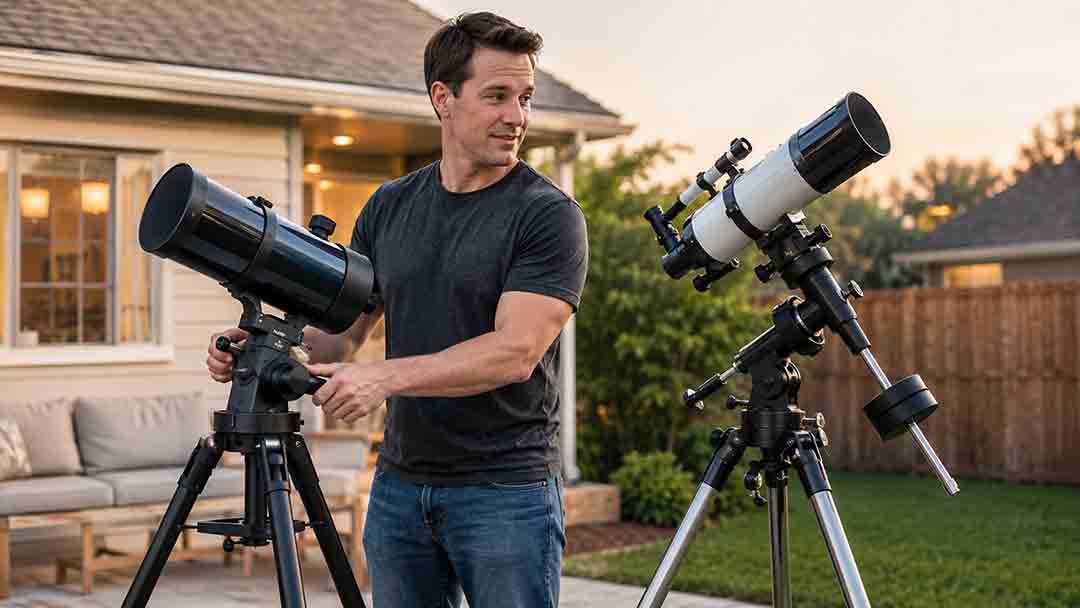
An alt-azimuth mount is usually easier for beginners because it moves naturally up–down and left–right, sets up quickly, and works well for visual or daytime observing. An equatorial mount requires polar alignment, balancing, and more equipment, but it becomes easier for sustained celestial tracking and is generally the practical choice for long-exposure deep-sky astrophotography. This guide explains how both axis systems work, why motorized alt-azimuth tracking still creates field rotation, and when one-axis right ascension tracking becomes useful. It also provides the original TRACK decision framework, a complete payload calculation, setup workflows, real-world user scenarios, a mount-selection decision tree, a buying checklist, common mistakes, and troubleshooting guidance. Readers can compare portability, counterweights, eyepiece position, meridian flips, software requirements, and upgrade plans before choosing a mount
Explore More Topics
How to Choose Your First Telescope: A Beginner’s Buying Guide
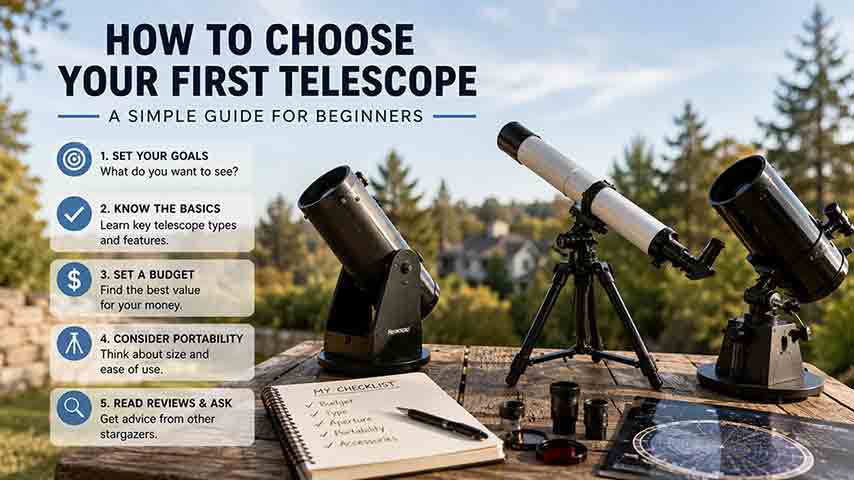
Choosing a first telescope requires more than comparing aperture or advertised magnification. This practical beginner’s guide explains how to match a telescope to observing goals, light pollution, storage space, setup tolerance, and interest in visual observing or imaging. It compares refractors, Dobsonian reflectors, compound telescopes, and smart telescopes, then shows how aperture, focal length, focal ratio, magnification, and mount stability affect real use. Readers can use a quick-selection table, the original SPACE decision framework, a worked specification comparison, realistic household scenarios, new and used equipment checklists, and a troubleshooting chart. The guide also explains why a larger aperture cannot fully overcome bright urban skies, what to verify before buying a software-dependent smart telescope, and how to observe the Sun safely. Recommendations are based on authoritative guidance and published specifications rather than hands-on product testing or paid rankings
How Much Should You Spend on Your First Telescope?
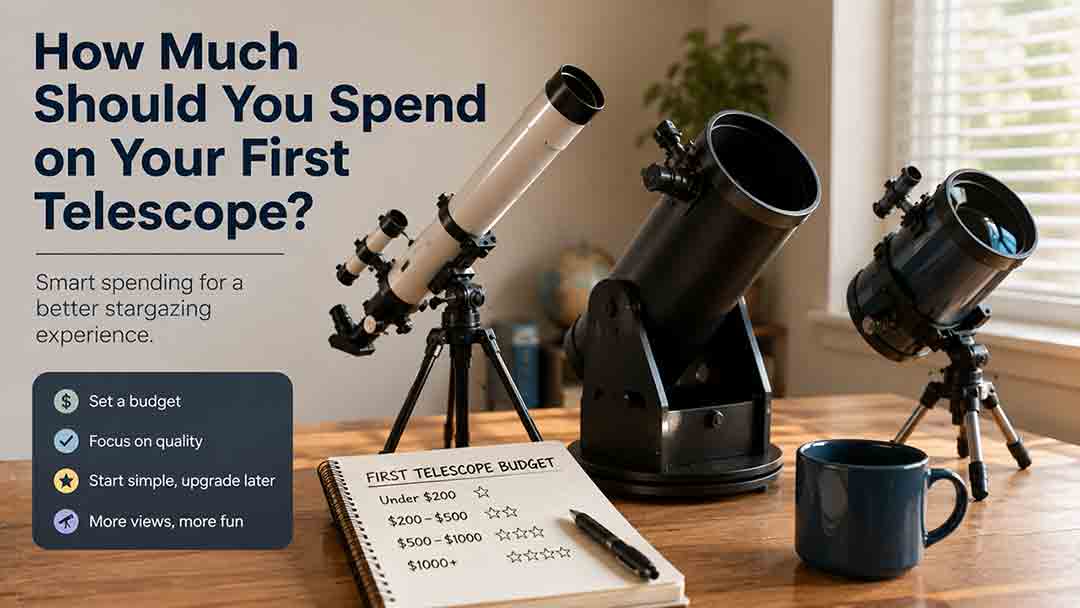
Most beginners should plan a complete first-telescope budget of roughly $350–$700, although the right amount depends on observing goals, portability, automation, and whether the buyer wants direct eyepiece viewing or screen-based imaging. This guide explains what different budget ranges can realistically provide, why very low-cost telescope packages require caution, and when spending more for aperture, GoTo control, smart imaging, or compact optics is justified. It also separates visual astronomy from modular astrophotography, calculates total ownership cost, and shows how accessories, power, storage, shipping, and software can change the real price. The original FIRST Budget Test helps readers evaluate favorite targets, included equipment, real-world portability, desired skills, and total cost. Practical scenarios, a buying checklist, common mistakes, troubleshooting guidance, safety information, and current US market examples help beginners choose a stable, complete setup they are likely to use regularly.
Are Smart Telescopes Worth It for Beginners?
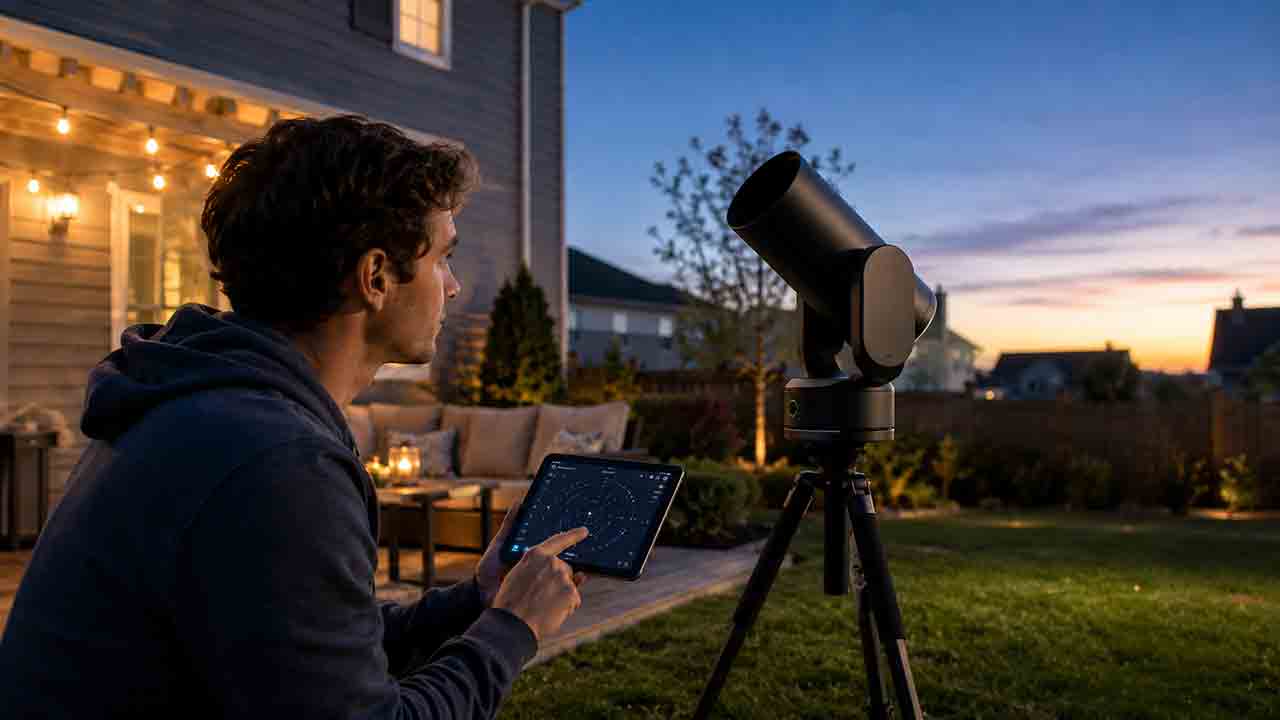
Smart telescopes can be worthwhile for beginners who want automated target finding, live-stacked deep-sky images, and a compact system controlled from a phone or tablet. However, they are not a universal replacement for traditional telescopes. Beginners who value direct eyepiece views, high-magnification planetary observing, manual sky navigation, or component-by-component upgrades may prefer a refractor, reflector, or catadioptric telescope. This guide explains how smart telescopes combine optics, cameras, motorized tracking, and image processing; compares them with traditional and modular imaging setups; and examines costs, software dependence, batteries, light pollution, target suitability, and long-term flexibility. It also provides the original WORTH decision framework, a hypothetical cost-per-session example, real-world beginner scenarios, a purchase checklist, common mistakes, and troubleshooting steps. The goal is to help readers choose based on their actual observing style rather than marketing claims or specifications alone