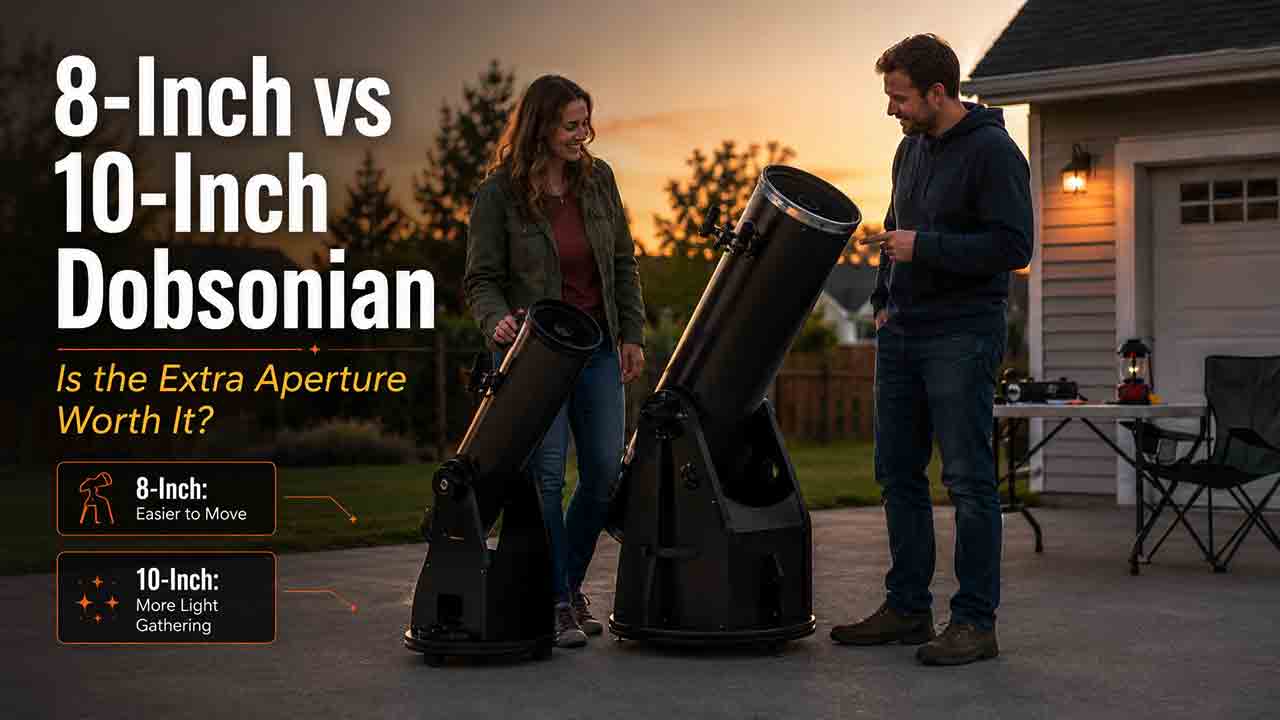
8-Inch vs 10-Inch Dobsonian: Is the Extra Aperture Worth It?

8-Inch vs 10-Inch Dobsonian: Is the Extra Aperture Worth It?
For most first-time Dobsonian buyers, an 8-inch model is the safer all-around choice because it is easier to carry, collimate, store, and use often. A 10-inch Dobsonian is worth the extra aperture when deep-sky observing is the priority and the wider, heavier tube can be moved without becoming a barrier. The optical gain is real, but it is incremental rather than transformative.
Key Takeaways
- A 10-inch mirror has about 56% more collecting area than an 8-inch mirror before accounting for obstruction and transmission differences.
- The 10-inch can reveal fainter stars and make many deep-sky targets easier, especially under dark skies, but it does not overcome poor seeing or severe light pollution.
- Many commercial 8-inch and 10-inch Dobsonians share a focal length near 1,200 mm, so the 10-inch may be wider and heavier without being much longer.
- The common 10-inch f/4.7 design is more demanding of collimation, low-power eyepieces, and off-axis image quality than a typical 8-inch f/5.9 design.
- The better buy is the largest telescope you can transport, cool, collimate, and use regularly—not the largest aperture that fits the budget once.
This guide compares real optical gains, planetary and deep-sky performance, portability, focal ratio, collimation, eyepiece behavior, ownership cost, and storage. It also provides a current same-series specification example, a decision framework, practical observing scenarios, and a pre-purchase fit test.
Editorial note: This guide is based on published specifications, authoritative documentation, optical calculations, and practical selection criteria rather than hands-on testing of a specific 8-inch or 10-inch Dobsonian.
Which Is the Better Buy: An 8-Inch or 10-Inch Dobsonian?
Buy the 8-inch Dobsonian when convenience, frequent use, stairs, limited storage, or a smaller vehicle matters. Buy the 10-inch when deep-sky performance matters more and you have an easy ground-level route from storage to the observing site.
| Decision factor | 8-inch Dobsonian | 10-inch Dobsonian |
|---|---|---|
| First telescope | Lower-risk choice for most buyers | Good when size and handling have already been tested |
| Deep-sky performance | Strong general-purpose aperture | Noticeably better on faint stars, globular clusters, and subtle structure |
| Moon and planets | Excellent when optics, seeing, cooling, and collimation cooperate | Higher theoretical resolution, but atmosphere often limits the gain |
| Portability | Easier tube diameter and lower component weight | Wider and heavier; handles and route matter |
| Storage | Easier in closets, apartments, and smaller cases | Needs more floor width and safer lifting clearance |
| Collimation | Usually more forgiving around f/6 | Often faster around f/4.7–f/5 and more alignment-sensitive |
| Eyepiece demands | More tolerant of basic wide-field eyepieces | Edge aberrations and coma are easier to notice |
| Cooling | Usually easier to manage | Larger or thicker mirror may need more preparation |
| Best buyer | Wants one simple telescope used frequently | Prioritizes deep sky and accepts added handling |
| Overall verdict | Best default recommendation | Best when the logistics are already solved |
The recommendation is conditional. A compact collapsible 10-inch may fit a vehicle better than a long solid-tube 8-inch in some situations, while a heavy base can make the opposite true. Compare the exact model rather than aperture alone.
How Much More Light Does a 10-Inch Dobsonian Collect?
A nominal 10-inch aperture has 1.5625 times the collecting area of an 8-inch aperture, which is about 56% more.
Light-gathering area scales with the square of aperture diameter.[1]
Collecting-area ratio:
(10 ÷ 8)² = 1.5625
This calculation is a geometric comparison. The real delivered difference also depends on:
- Secondary-obstruction size
- Mirror reflectivity
- Coating condition
- Baffling
- Dust and dew
- Eyepiece transmission
- Observer adaptation
- Sky brightness
Does 56% more light look 56% more dramatic?
No. Human visual perception is not a linear light meter, and many astronomical objects are limited by sky background, contrast, atmospheric transparency, and observer experience.
The extra aperture is easiest to notice when:
- Resolving more stars in a globular cluster
- Detecting a fainter companion or field star
- Holding a low-contrast galaxy feature with averted vision
- Using higher magnification while maintaining a useful exit pupil
- Observing under a dark, transparent sky
The gain is less obvious on:
- The bright Moon
- Bright planets in poor seeing
- Objects viewed through haze
- Targets low above the horizon
- Sessions before the mirror has thermally stabilized
What is the theoretical limiting-magnitude gain?
Using collecting area alone, the difference corresponds to roughly 0.48 magnitude:
2.5 × log₁₀(1.5625) ≈ 0.48
This is a theoretical comparison, not a promise that every observer will see stars exactly 0.48 magnitude fainter. Published limiting-magnitude values vary with the assumed sky, observer, magnification, coatings, and target.
Does the 10-Inch Have Better Resolution?
Yes in theory: diffraction-limited angular resolution improves as aperture increases, but real planetary resolution is often limited by seeing, thermal currents, focus, and collimation.
OpenStax and the Royal Astronomical Society of Canada explain that larger aperture improves both light gathering and theoretical resolving power.[1][2]
A representative current Celestron same-series comparison lists:
- 8-inch Dawes resolution: 0.57 arcsecond
- 10-inch Dawes resolution: 0.46 arcsecond[3][4]
That is approximately a 20% reduction in the theoretical minimum angular separation.
Will the 10-inch always show more planetary detail?
No. The 10-inch has greater potential, but it must receive a sufficiently steady wavefront.
The 10-inch advantage becomes usable when:
- Atmospheric seeing is steady
- The mirror is near outdoor temperature
- Collimation is accurate
- The planet is high enough in the sky
- The eyepiece is properly focused
- The observer avoids excessive magnification
An accurately collimated, thermally stable 8-inch can outperform a poorly prepared 10-inch during the same session.
What Will You Actually See Differently?
How Do the Moon and Planets Compare?
Both apertures are capable lunar and planetary telescopes. The 10-inch can show finer detail under excellent conditions, but the 8-inch reaches useful performance more easily.
With an 8-inch Dobsonian
Expect strong views of:
- Lunar crater walls, rilles, and mountain shadows
- Jupiter’s main belts and changing atmospheric detail
- Galilean moon transits under suitable conditions
- Saturn’s rings and major ring divisions when seeing permits
- Mars’ larger albedo features near a favorable opposition
- Uranus and Neptune as small disks under appropriate conditions
With a 10-inch Dobsonian
The same targets may show:
- More secure low-contrast detail
- Finer separation in small features
- More usable magnification during steady seeing
- Brighter images at the same magnification
- Easier visibility of faint moons or nearby field stars
The difference is not equivalent to moving from a small beginner telescope to an 8-inch Dobsonian. It is a refinement of already strong performance.
How Do Globular Clusters and Open Clusters Compare?
Globular clusters are among the clearest reasons to choose the 10-inch.
The extra light and resolution can:
- Resolve more stars toward a globular cluster’s core
- Make faint outer members easier to hold
- Support higher magnification while preserving image brightness
- Improve separation in dense stellar fields
Open clusters are often attractive in both sizes. Because many 8-inch and 10-inch models have similar focal lengths, the same eyepiece can produce a similar true field, although the faster 10-inch may show more edge coma.
How Do Galaxies and Nebulae Compare?
The 10-inch generally makes faint structure easier, but sky darkness remains more important than a two-inch aperture increase.
Under dark skies, the 10-inch may improve:
- Dust-lane visibility
- Galaxy core-to-halo contrast
- Detection of small companion galaxies
- HII-region visibility in nearby galaxies
- Fine filamentary detail in bright nebulae
- Planetary-nebula response to higher magnification
Under strong light pollution, both telescopes lose low-contrast galaxy detail. The 10-inch can still collect more object light, but it also collects more sky background at the same magnification. Increasing magnification appropriately can darken the background while using the larger aperture’s resolution.
A nebula filter may improve selected emission nebulae, but it does not replace dark skies and usually does not make galaxies substantially better.
How Do Double Stars Compare?
The 10-inch has a smaller theoretical diffraction limit, but seeing and thermal stability frequently determine the actual result.
For close double stars:
- Center the target
- Use accurate collimation
- Let the mirror stabilize
- Increase magnification gradually
- Judge the split during steady moments
A 10-inch mirror does not guarantee a cleaner split if the star image is boiling from atmospheric or tube currents.
How Much Larger and Heavier Is a 10-Inch Dobsonian?
The difference is often more about width and component weight than tube length.
Many commercial solid-tube 8-inch and 10-inch Dobsonians use focal lengths close to 1,200 mm. A 10-inch at approximately f/4.7 and an 8-inch at approximately f/5.9 can therefore have similar tube lengths.
Representative current same-series example
The following specifications come from the Celestron StarSense Explorer 8-inch and 10-inch Dobsonian pages accessed July 30, 2026.[3][4] They illustrate one product line and should not be treated as universal dimensions.
| Specification | 8-inch model | 10-inch model | Practical difference |
|---|---|---|---|
| Aperture | 203 mm | 254 mm | 25% greater diameter |
| Focal length | 1,200 mm | 1,200 mm | Same magnification with the same eyepiece |
| Focal ratio | f/5.9 | f/4.7 | 10-inch is optically faster |
| Tube length | 44 in | 44 in | No meaningful length increase in this line |
| Tube diameter | 9.5 in | 11.5 in | 10-inch is harder to wrap arms around |
| Tube weight | 20.6 lb | 29.2 lb | 8.6 lb more in the carried tube |
| Base weight | 22.8 lb | 25.6 lb | Base difference is smaller |
| Total kit weight | 43.4 lb | 54.8 lb | 11.4 lb more overall |
| Base footprint | 27 × 19 × 19 in | 26.5 × 21 × 21 in | 10-inch needs greater width |
The heaviest or most awkward component matters more than total weight. A user normally carries the tube and base separately.
Why is tube diameter important?
A wider tube can be harder to:
- Lift from the floor
- Hold against the body
- Turn through a doorway
- Place across a rear seat
- Fit into a padded bag
- Lower into a deep vehicle trunk
- Carry while wearing winter clothing
Handles, lifting straps, a hand truck, or a ground-level storage route can change the decision more than a specification sheet suggests.
Is the 10-Inch Harder to Collimate?
Usually yes, because common 10-inch Dobsonians use a faster focal ratio and faster Newtonians require more careful alignment.
A typical 8-inch, 1,200 mm Dobsonian is near f/6. A typical 10-inch, 1,200 mm Dobsonian is near f/4.7.
The 10-inch does not necessarily require a complicated procedure, but it benefits from:
- A reliable collimation cap, Cheshire, or verified laser
- Consistent tool seating
- A center-marked primary
- A quick check before high-power observing
- A final centered-star check when performance matters
Newtonian axial tolerances become more demanding as focal ratio decreases.[8] This does not make the 10-inch unsuitable for beginners; it means the owner should be willing to learn a repeatable alignment routine.
How often will each telescope need adjustment?
Frequency depends on:
- Solid-tube or collapsible construction
- Transport vibration
- Mirror-cell design
- Secondary-holder stability
- Storage orientation
- Temperature change
- Handling
Check both telescopes before a serious session. Adjust only when the tool shows a meaningful error.
Does the 10-Inch Need Better Eyepieces?
The 10-inch does not require luxury eyepieces, but its faster focal ratio reveals off-axis aberrations more clearly.
In a parabolic Newtonian, coma makes stars away from the center appear increasingly comet-like. Tele Vue notes that Newtonians faster than f/5 show the greatest visible benefit from coma correction.[7]
At f/4.7, the view can expose:
- Newtonian coma
- Eyepiece astigmatism
- Field-edge softness
- Focus sensitivity
- Poor tool registration
- Large exit pupils from long eyepieces
At f/5.9, the 8-inch is generally more forgiving.
Is a coma corrector mandatory?
No. Many observers use a 10-inch f/4.7 Dobsonian without one, especially with narrower apparent fields or when concentrating on the center.
A coma corrector becomes more attractive when:
- Wide apparent-field eyepieces are used
- Edge sharpness matters
- Dense star fields are a priority
- The observer notices coma after eyepiece aberrations are controlled
- Imaging is attempted with a compatible optical system
Do not include a coma corrector in the minimum purchase budget unless the observing preference justifies it.
Will the Same Eyepieces Work in Both?
Yes, but the same eyepiece can produce different exit pupils even when magnification is identical.
Magnification is:
Telescope focal length ÷ eyepiece focal length
If both telescopes have a 1,200 mm focal length, a 25 mm eyepiece gives:
1,200 ÷ 25 = 48×
The magnification is the same.
Why is the view still different?
Exit pupil is approximately:
Eyepiece focal length ÷ telescope focal ratio
With a 30 mm eyepiece:
- 8-inch f/5.9: 30 ÷ 5.9 ≈ 5.1 mm
- 10-inch f/4.7: 30 ÷ 4.7 ≈ 6.4 mm
An observer’s dark-adapted pupil varies. If the eye cannot accept the full exit pupil, some of the 10-inch aperture is effectively unused with that eyepiece.
A 24 mm eyepiece in the f/4.7 telescope gives approximately:
24 ÷ 4.7 ≈ 5.1 mm
This illustrates why the 10-inch may reach a similar exit pupil with a shorter eyepiece and therefore higher magnification.
What is the practical large-aperture advantage?
At the same exit pupil, an extended object has broadly similar surface brightness, but the 10-inch can show it at about 25% more magnification because its aperture is 25% larger.
That larger image scale can make structure easier to detect even when the apparent surface brightness is similar.
Does a 10-Inch Dobsonian Take Longer to Cool?
It often requires more thermal preparation, but mirror thickness, glass, fan design, storage temperature, and outdoor conditions matter more than aperture alone.
Thermal problems can create:
- Soft planetary detail
- Moving star patterns
- Focus drift
- Tube currents
- Boundary-layer distortion
Practical thermal recommendations
For either telescope:
- Store it near outdoor temperature when the environment is dry and safe.
- Move it outside before high-power observing.
- Use the supplied or approved cooling fan.
- Avoid observing across roofs or pavement releasing heat.
- Judge readiness from stable star images, not a fixed waiting time.
A larger mirror may take longer to settle, but no universal cooling duration is accurate for every 10-inch Dobsonian.
Is the 10-Inch Better Under Light-Polluted Skies?
It is better in capability, but it does not neutralize light pollution.
The 10-inch can still improve:
- Star clusters
- Planetary nebulae
- Double stars
- Small bright galaxies
- Lunar and planetary resolution
- Higher-magnification views
However, bright sky background suppresses the contrast of extended galaxies and nebulae in both telescopes.
Which purchase strategy is better for a city observer?
Choose the 8-inch when its easier handling means it will be taken to a darker location more often.
Choose the 10-inch when it can remain near a yard, driveway, or balcony observing position and still be transported when needed.
An 8-inch under dark skies can reveal more low-contrast deep-sky detail than a 10-inch used only under heavy urban skyglow.
What Is the Real Cost Difference?
The telescope price is only part of the decision; the 10-inch may also change transport, storage, eyepiece, cooling, and collimation needs.
Current prices vary by country, retailer, included accessories, shipping, and promotions. Compare delivered prices on the purchase date rather than relying on an evergreen article for a fixed number.
Potential added costs for the 10-inch
- Larger padded tube bag
- Wider storage area
- Hand truck or transport straps
- Cooling fan or power source
- More precise collimation tool
- Better-corrected wide-field eyepiece
- Optional coma corrector
- Larger vehicle space
- Higher shipping or return cost
None of these is automatically required. The point is to compare the usable system rather than the optical tube alone.
Value per observing session
A useful way to evaluate value is:
Total ownership cost ÷ sessions actually used
The calculation does not need a precise forecast. It simply highlights that a less expensive 8-inch used twice as often may deliver more value than a 10-inch that remains in storage.
What Are the Pros and Cons?
8-inch Dobsonian advantages
- Easier tube handling
- More forgiving focal ratio in common designs
- Strong lunar, planetary, and deep-sky performance
- Lower purchase and accessory burden
- Easier apartment and vehicle storage
- Good first telescope for learning collimation
- Often similar tube length to a 10-inch
8-inch Dobsonian limitations
- Fewer resolved stars in difficult globular clusters
- Less reach on faint field stars and small galaxies
- Lower theoretical resolution
- Less image brightness at the same magnification
- May leave a dedicated deep-sky observer wanting more aperture
10-inch Dobsonian advantages
- About 56% more nominal collecting area
- Higher theoretical resolution
- Better globular-cluster resolution
- Greater reach on faint stars and subtle deep-sky detail
- Higher magnification at a given exit pupil
- Significant capability without moving to a much longer tube in many product lines
10-inch Dobsonian limitations
- Wider and heavier tube
- More difficult stairs, doors, and vehicle loading
- Faster focal ratio in common designs
- More visible coma and eyepiece edge limitations
- More demanding collimation
- Potentially longer thermal preparation
- Higher system cost
Which Telescope Fits Your Situation?
Choose the 8-Inch If:
- This is your first full-size telescope.
- You live above ground level without an elevator.
- Storage space is narrow.
- The telescope must cross several doors or turns.
- You have a small vehicle.
- Observing sessions are often short.
- You want a forgiving telescope for general use.
- You expect to travel frequently to darker skies.
- Lifting the representative 10-inch tube feels uncertain.
Choose the 10-Inch If:
- Deep-sky observing is the main priority.
- Storage and observing are on the same level.
- The route outside is short and unobstructed.
- The tube and base can be carried safely as separate pieces.
- The vehicle opening has been measured.
- You are willing to check collimation regularly.
- You accept the possibility of more demanding eyepiece behavior.
- The extra cost does not remove the budget for a chair, finder, eyepieces, or transport support.
Keep an Existing 8-Inch If:
- It is not being used frequently now.
- The current limitation is light pollution rather than aperture.
- Collimation and cooling are not yet controlled.
- Transport already feels difficult.
- The money would be better spent on dark-sky access, an observing chair, or a missing eyepiece.
- The expected upgrade must feel dramatic.
Moving from 8 inches to 10 inches is meaningful, but not a night-and-day transformation. An existing 8-inch owner should solve current usage barriers before assuming more aperture will solve them.
A Practical Pre-Purchase Fit Test
Test the logistics before comparing accessory lists.
Step 1: Measure the route
Measure:
- Storage opening
- Narrowest doorway
- Stair width
- Sharpest turn
- Vehicle door or trunk opening
- Available tube length and width
- Base floor footprint
Step 2: Check component weights
Use the exact manufacturer specifications.
Compare:
- Optical-tube weight
- Base weight
- Largest component dimensions
- Location of handles
- Grip diameter
- Whether the tube must be lifted from floor level
Step 3: Simulate the carry
At a store or with a safe substitute:
- Lift a similarly weighted object from the expected storage height.
- Hold it at the required distance from the body.
- Turn through the narrowest path.
- Lower it into the vehicle or observing position.
- Repeat for the base.
- Consider winter clothing, darkness, and dew.
Do not use a fragile household object as a weight substitute.
Step 4: Include setup friction
Ask whether every session requires:
- Multiple flights of stairs
- Moving a vehicle
- Reassembling a collapsible tube
- Installing a cooling fan
- Carrying an accessory case
- Waiting for a secure observing area
- Returning wet equipment indoors
A telescope that is easy to use on a product page may still be inconvenient in the actual home.
Real-World Buying Scenarios
Scenario 1: Apartment observer with stairs
The observer must carry the telescope down one flight, cross two doors, and load a compact car.
Better buy: 8-inch.
The 10-inch optical gain does not compensate for a wider, heavier tube that reduces observing frequency. The 8-inch remains powerful at a dark site.
Scenario 2: Suburban observer with a ground-level garage
The telescope travels a short distance from a dry garage cabinet to a driveway. The observer mainly views galaxies and globular clusters.
Better buy: 10-inch, if the garage environment is suitable.
The carrying route is easy, and the extra aperture is aligned with the observing priority.
Scenario 3: Family telescope for mixed use
Several people will view the Moon, planets, bright nebulae, and clusters. The telescope must be simple to set up and store.
Better buy: 8-inch.
The more forgiving focal ratio and lower handling burden improve the chance that different family members can use it safely.
Scenario 4: Experienced 8-inch owner seeking an upgrade
The owner already observes regularly under dark skies and wants more globular-cluster resolution.
Conditional choice: 10-inch.
The improvement will be visible, but the owner should compare it with larger upgrade paths and the associated logistics. The 10-inch is most compelling when it remains the largest conveniently usable telescope.
What Buying Mistakes Should You Avoid?
| Mistake | Why it leads to a poor decision | Better approach |
|---|---|---|
| Comparing aperture only | Ignores transport, storage, and focal ratio | Compare the complete system |
| Looking only at total weight | The awkward tube may be the limiting component | Check each piece separately |
| Assuming a 10-inch is much longer | Many 8-inch and 10-inch models share a similar focal length | Compare exact dimensions |
| Expecting a dramatic 56% visual jump | Perception and contrast are not linear | Expect a meaningful but incremental gain |
| Treating manufacturer maximum magnification as routine | Seeing and preparation usually set lower limits | Compare usable image quality |
| Ignoring focal ratio | A faster 10-inch changes collimation and eyepiece behavior | Include f-ratio in the decision |
| Spending the full budget on aperture | Leaves no room for essential supporting equipment | Budget for the usable system |
| Buying before measuring the vehicle | Tube diameter can block loading even when length fits | Measure the opening and turning space |
| Assuming aperture defeats light pollution | Sky brightness still controls low-contrast visibility | Include dark-sky access |
| Upgrading before mastering the 8-inch | Existing performance may be limited by setup | Fix collimation, cooling, and observing technique first |
Why Might a 10-Inch Not Look Better Than an 8-Inch?
The most common causes are poor seeing, thermal instability, miscollimation, inappropriate magnification, bright sky, or an unfair side-by-side setup.
Check these factors
- Are both telescopes aimed at the same target at the same time?
- Are they using comparable magnification rather than the same eyepiece blindly?
- Are both mirrors near outdoor temperature?
- Is the 10-inch accurately collimated?
- Is the target centered?
- Is the atmosphere steady enough to use the extra resolution?
- Are the optics free from dew?
- Is one eyepiece introducing more aberration?
- Is the target too low above the horizon?
- Has the observer had enough time to adapt and compare subtle detail?
A larger aperture raises the performance ceiling. It does not guarantee that every session reaches that ceiling.
8-Inch vs 10-Inch Dobsonian Buying Checklist
Optical priorities
- Deep-sky observing is important enough to justify extra aperture
- The focal ratio is understood
- The included focuser accepts planned eyepieces
- The primary mirror is center-marked or can be collimated as specified
- A cooling fan is included or supported
- Coma expectations are realistic
Logistics
- Tube weight is manageable
- Base weight is manageable
- Tube diameter fits the grip
- Doorways and turns have been measured
- Vehicle opening has been measured
- Storage footprint is available
- The telescope can be dried after damp sessions
- A safe two-piece carrying route exists
Budget
- Delivered telescope price is known
- Return shipping conditions are understood
- An observing chair fits the budget
- At least one suitable low-power eyepiece is available
- A collimation tool is included or budgeted
- Transport and storage supplies are included
- Optional coma correction is not mistaken for an immediate requirement
Usage
- The telescope will be used under the available sky
- Setup time matches typical sessions
- The owner is willing to collimate a Newtonian
- The telescope can be safely handled after dark
- Aperture is not being used to compensate for an unsuitable location
How We Developed This Comparison
This article separates the decision into five layers:
- Optical gain: geometric collecting area and diffraction-limited resolution.
- Visual outcome: how the gain affects planets, clusters, galaxies, nebulae, and double stars.
- Optical demands: focal ratio, coma, exit pupil, collimation, and cooling.
- Physical friction: tube width, component weight, storage, doors, stairs, and vehicles.
- Ownership value: total system cost and probable observing frequency.
Current product specifications are used only as representative examples. A collapsible, truss, premium, mass-market, computerized, or locally manufactured Dobsonian may differ substantially.
Which Dobsonian Should You Buy?
For the majority of first-time buyers, the 8-inch Dobsonian is the better default purchase. It already has substantial aperture, is more forgiving, and is more likely to be used frequently.
Choose the 10-inch Dobsonian when the extra 56% nominal collecting area directly supports a deep-sky priority and the larger tube can move from storage to observing without stairs, awkward lifting, or vehicle problems.
For an existing 8-inch owner, improve collimation, thermal control, eyepieces, observing skill, and dark-sky access before upgrading. The 10-inch is worthwhile when the current telescope is already being used well and the added size remains convenient.
Frequently Asked Questions
Is a 10-inch Dobsonian much better than an 8-inch?
It is meaningfully better for faint stars, globular clusters, small deep-sky targets, and high-resolution observing under good conditions. The improvement is incremental rather than dramatic, and an inconvenient 10-inch can deliver less value than an 8-inch used frequently.
Does a 10-inch Dobsonian collect twice as much light as an 8-inch?
No. Using nominal aperture area, a 10-inch collects about 1.56 times as much light, or approximately 56% more, before accounting for obstruction and transmission differences.
Are 8-inch and 10-inch Dobsonians the same length?
Many common models are close because both use a focal length near 1,200 mm. The 10-inch is usually wider and heavier. Collapsible and truss designs can have very different transport dimensions, so compare the exact model.
Is an 8-inch Dobsonian enough for galaxies?
Yes. An 8-inch can show many galaxies and selected structural details under dark, transparent skies. A 10-inch improves reach and makes some low-contrast features easier, but sky darkness remains critical.
Does a 10-inch Dobsonian require a coma corrector?
No. A coma corrector is optional for visual use. It becomes more valuable with wide-field eyepieces, faster focal ratios, and observers who want sharper stars near the edge of the field.
Is it worth upgrading from an 8-inch to a 10-inch Dobsonian?
It can be worthwhile for a regular dark-sky observer who wants more globular-cluster resolution and faint-object reach. It is less compelling when the 8-inch is already difficult to transport or when light pollution, poor collimation, or limited observing time is the main constraint.
Sources
Sources were accessed July 30, 2026.
- OpenStax Astronomy 2e — 6.1 Telescopes
- Royal Astronomical Society of Canada — Telescope Basics
- Celestron — StarSense Explorer 8-Inch Dobsonian Specifications
- Celestron — StarSense Explorer 10-Inch Dobsonian Specifications
- Sky-Watcher — 8-Inch Traditional Dobsonian
- Sky-Watcher — 10-Inch Collapsible Dobsonian
- Astronomy.com — Tele Vue Paracorr Type 2 Coma Corrector
- CATSEYE Collimation — Newtonian Axial Tolerances
- Sky-Watcher — Telescope Instruction Manual and Collimation Guidance
- Royal Astronomical Society of Canada — Beginner Telescopes and Accessories
More from Telescope Comparisons & Tests
Buying a Used Telescope: A Complete Inspection Checklist
A used telescope can offer excellent value when the buyer verifies the exact model, ownership, optical condition, mechanical safety, electronic function, and complete accessory list before payment. This guide provides a structured inspection process for refractors, Newtonian and Dobsonian reflectors, Schmidt-Cassegrains, Maksutovs, manual and computerized mounts, eyepieces, filters, cameras, and smart telescopes. It distinguishes harmless dust and cosmetic wear from fungus, coating failure, bent hardware, water damage, unsupported electronics, and unsafe solar equipment. Readers also receive seller questions, daytime and nighttime test procedures, a repair-adjusted pricing formula, transaction-safety guidance, four practical scenarios, a buy-negotiate-walk-away framework, and a comprehensive printable checklist. The central recommendation is to price only verified function and preserve enough budget for missing parts, repairs, and uncertainty.
Manual vs GoTo Telescope: Which Is Better for Beginners?
Manual and GoTo telescopes solve different beginner problems. A manual telescope offers simpler setup, fewer electronic dependencies, and often more optical capability within a limited budget, while a GoTo telescope can locate cataloged objects and track them after a successful alignment. This comparison explains why GoTo does not improve aperture, remove light pollution, or automatically make a telescope suitable for long-exposure astrophotography. It compares setup time, tracking, portability, reliability, learning value, power requirements, and total ownership cost. The article also introduces the original TRACK decision framework, an illustrative break-even calculation for session time, five real-world buyer scenarios, separate purchase checklists, and troubleshooting tables for both manual and computerized systems. Beginners can use the guide to decide whether they prefer learning sky navigation, managing an electronic alignment workflow, or choosing a push-to system that combines manual movement with digital guidance."
Refractor vs Reflector Telescope for Viewing Planets
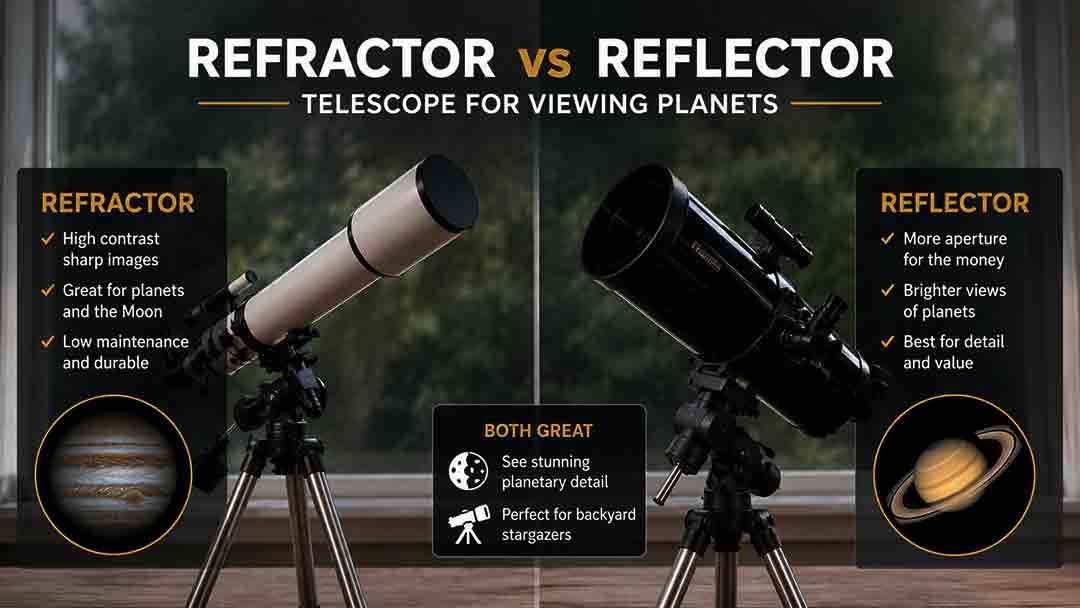
A refractor is usually the easier planetary telescope at the same aperture, while a Newtonian reflector usually provides more resolving power for the same budget by offering a larger mirror. This guide compares unobstructed contrast, chromatic aberration, central obstruction, collimation, thermal preparation, mount stability, tracking, magnification, and portability. It explains how each design performs on the Moon, Jupiter, Saturn, Mars, Venus, Uranus, and Neptune, and separates equal-aperture, equal-price, and equal-portability comparisons. A 100 mm versus 150 mm aperture calculation, size recommendations, real-world buyer scenarios, a six-step decision framework, troubleshooting guidance, and a complete buying checklist help readers select a telescope that will deliver useful planetary performance in their actual observing environment.
Explore More Topics
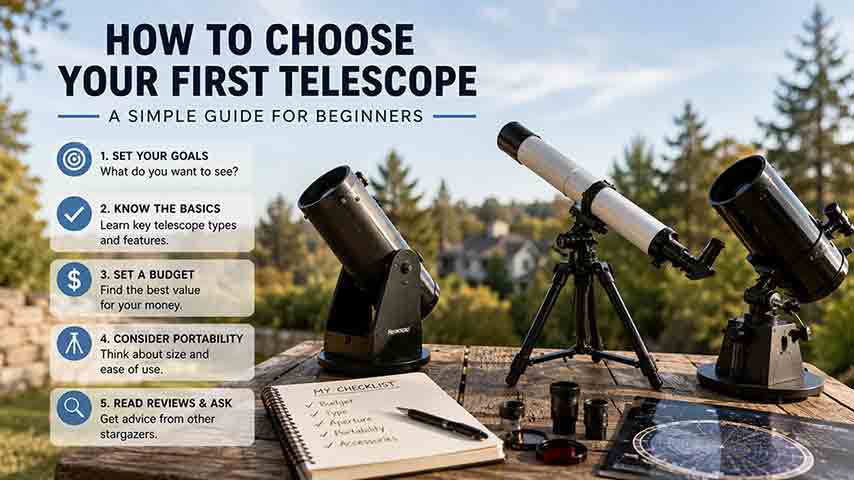
How to Choose Your First Telescope: A Beginner’s Buying Guide
Choosing a first telescope requires more than comparing aperture or advertised magnification. This practical beginner’s guide explains how to match a telescope to observing goals, light pollution, storage space, setup tolerance, and interest in visual observing or imaging. It compares refractors, Dobsonian reflectors, compound telescopes, and smart telescopes, then shows how aperture, focal length, focal ratio, magnification, and mount stability affect real use. Readers can use a quick-selection table, the original SPACE decision framework, a worked specification comparison, realistic household scenarios, new and used equipment checklists, and a troubleshooting chart. The guide also explains why a larger aperture cannot fully overcome bright urban skies, what to verify before buying a software-dependent smart telescope, and how to observe the Sun safely. Recommendations are based on authoritative guidance and published specifications rather than hands-on product testing or paid rankings
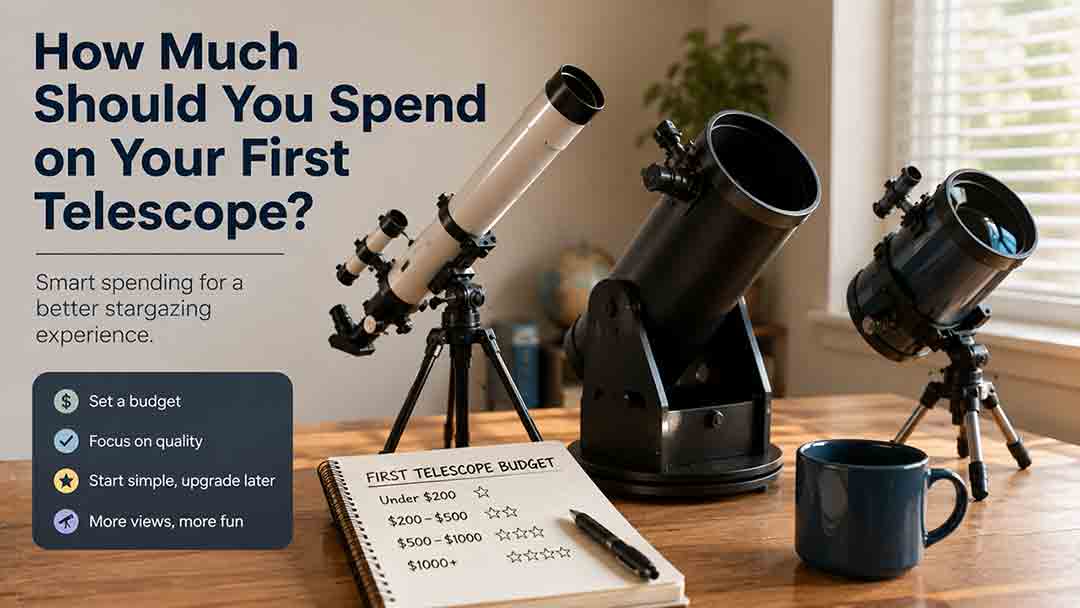
How Much Should You Spend on Your First Telescope?
Most beginners should plan a complete first-telescope budget of roughly $350–$700, although the right amount depends on observing goals, portability, automation, and whether the buyer wants direct eyepiece viewing or screen-based imaging. This guide explains what different budget ranges can realistically provide, why very low-cost telescope packages require caution, and when spending more for aperture, GoTo control, smart imaging, or compact optics is justified. It also separates visual astronomy from modular astrophotography, calculates total ownership cost, and shows how accessories, power, storage, shipping, and software can change the real price. The original FIRST Budget Test helps readers evaluate favorite targets, included equipment, real-world portability, desired skills, and total cost. Practical scenarios, a buying checklist, common mistakes, troubleshooting guidance, safety information, and current US market examples help beginners choose a stable, complete setup they are likely to use regularly.
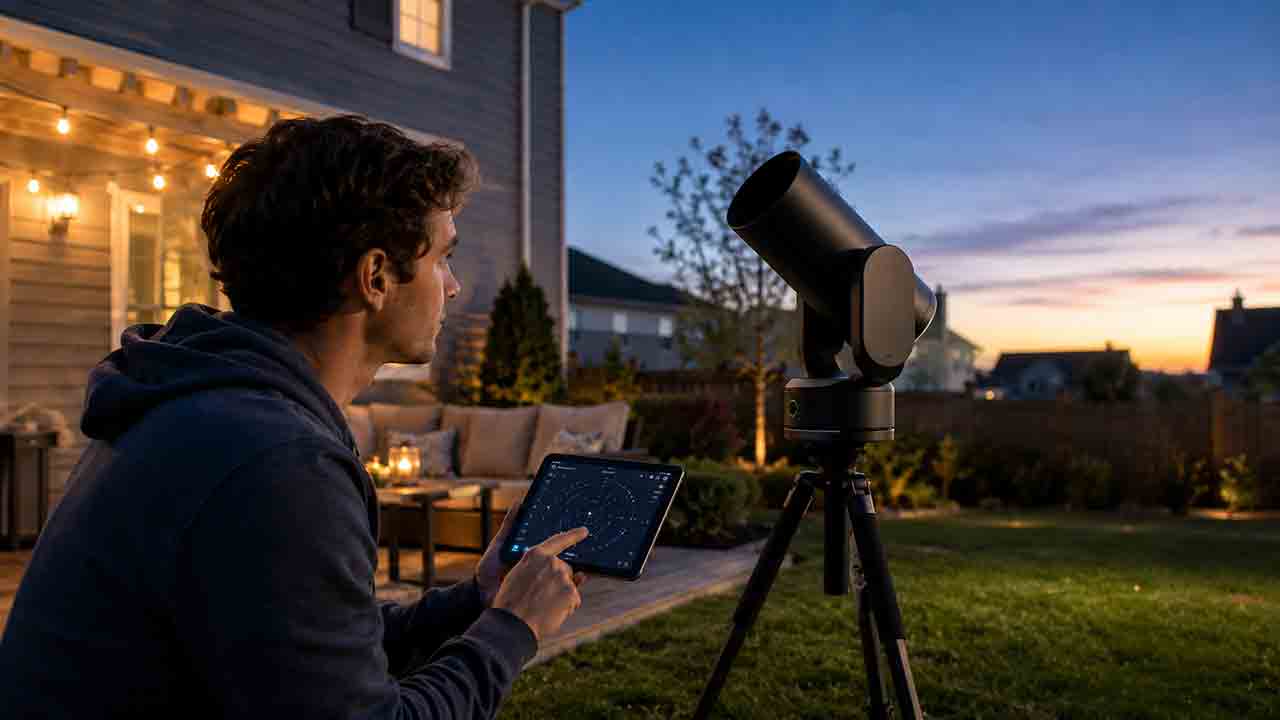
Are Smart Telescopes Worth It for Beginners?
Smart telescopes can be worthwhile for beginners who want automated target finding, live-stacked deep-sky images, and a compact system controlled from a phone or tablet. However, they are not a universal replacement for traditional telescopes. Beginners who value direct eyepiece views, high-magnification planetary observing, manual sky navigation, or component-by-component upgrades may prefer a refractor, reflector, or catadioptric telescope. This guide explains how smart telescopes combine optics, cameras, motorized tracking, and image processing; compares them with traditional and modular imaging setups; and examines costs, software dependence, batteries, light pollution, target suitability, and long-term flexibility. It also provides the original WORTH decision framework, a hypothetical cost-per-session example, real-world beginner scenarios, a purchase checklist, common mistakes, and troubleshooting steps. The goal is to help readers choose based on their actual observing style rather than marketing claims or specifications alone