6-Inch vs 8-Inch Dobsonian Telescope: Which Is the Better Buy?

6-Inch vs 8-Inch Dobsonian Telescope: Which Is the Better Buy?
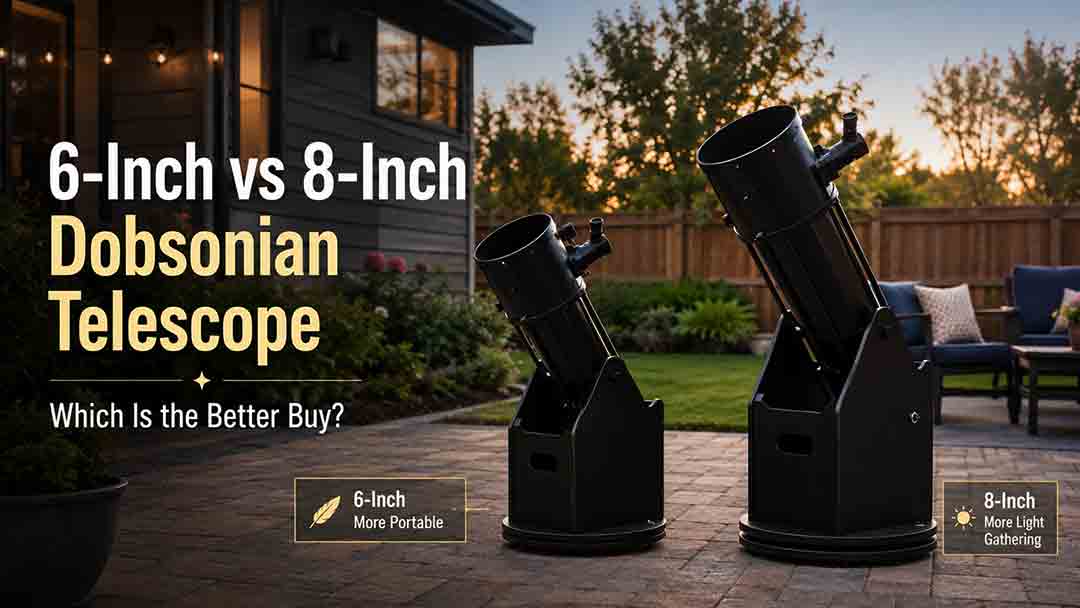
For many buyers, the 8-inch Dobsonian is the better value because it collects about 78% more light than a 6-inch while often retaining a similar tube length. Choose the 6-inch Dobsonian when the wider tube, extra weight, higher price, or faster focal ratio of an 8-inch would reduce how often you observe. The better buy is the telescope you can carry, store, collimate, and use regularly.
Key Takeaways
- An 8-inch mirror has about 1.78 times the gross collecting area of a 6-inch mirror, before accounting for differences in secondary obstruction and coatings.
- An 8-inch Dobsonian usually shows fainter stars, resolves more detail under steady conditions, and gives deep-sky targets more observing headroom.
- A typical 6-inch f/8 Dobsonian is easier on inexpensive eyepieces, less demanding of precise collimation, and often easier to carry.
- Price, tube diameter, base design, included accessories, and the heaviest individual component matter more than the aperture label alone.
- The 8-inch is the stronger optical value only when it fits the buyer’s storage, vehicle, lifting ability, setup time, and total budget.
This guide compares real optical gains with real ownership costs. It includes a dated same-family specification example, aperture and price calculations, the original LIFT buying framework, target-by-target recommendations, a decision tree, practical scenarios, a pre-purchase route test, a checklist, common mistakes, and troubleshooting guidance.
Method note: This guide is based on published specifications, authoritative astronomy guidance, and practical selection criteria rather than hands-on product testing. The Sky-Watcher Classic 150P and 200P are used as a dated comparison example because they share a product family and nominal 1,200 mm focal length. Other 6-inch and 8-inch Dobsonians can differ substantially in price, weight, tube design, mirror construction, accessories, and portability.
Quick Navigation
- Quick Comparison
- Light-Gathering Difference
- What You Can See
- Planetary Performance
- Deep-Sky Performance
- Portability
- Current Price Example
- LIFT Framework
- Decision Tree
- Buying Checklist
- FAQ
How Do 6-Inch and 8-Inch Dobsonians Compare?
A 6-inch Dobsonian prioritizes manageable size, forgiving optics, and lower cost. An 8-inch Dobsonian prioritizes greater aperture while remaining small enough for many adults to move in two pieces.
A Dobsonian telescope is normally a Newtonian reflector mounted on a simple manual altitude-azimuth rocker box. The optical tube moves up–down and left–right without the counterweights or tripod commonly associated with an equatorial mount.
Generic Comparison
| Decision factor | 6-inch Dobsonian | 8-inch Dobsonian |
|---|---|---|
| Nominal aperture | About 150–152 mm | About 200–203 mm |
| Gross mirror-area ratio | 1.00 | About 1.78 |
| Common focal length in full-size models | Around 1,200 mm | Around 1,200 mm |
| Common focal ratio | Around f/8 | Around f/6 |
| Faint-object capability | Strong beginner performance | Greater reach and detail |
| Theoretical resolution | Lower | Higher |
| Eyepiece tolerance | More forgiving in a typical f/8 model | More demanding toward the field edge in a typical f/6 model |
| Collimation sensitivity | Usually more forgiving | Usually requires greater accuracy |
| Tube width | Narrower | Wider |
| Mirror cooling | Often faster, all else equal | Can take longer, depending on mirror and temperature change |
| Purchase price | Lower | Higher |
| Best fit | Portability, budget, simple visual use | Maximum practical visual capability before larger-Dob tradeoffs |
These are common patterns, not universal specifications. A collapsible 6-inch tabletop model, a premium 8-inch Dobsonian, and a smartphone-assisted 8-inch model may have completely different ownership requirements.
Dated Same-Family Example: Sky-Watcher Classic 150P vs 200P
The following official US specifications were checked on July 30, 2026. Sky-Watcher USA, “Classic 150P Dobsonian,” official US price and specifications Sky-Watcher USA, “Classic 200P Dobsonian,” official US price and specifications
| Specification | Classic 150P | Classic 200P |
|---|---|---|
| Official listed price | $515 | $725 |
| Primary aperture | 152 mm | 203 mm |
| Focal length | 1,200 mm | 1,200 mm |
| Focal ratio | f/7.9 | f/5.9 |
| OTA length | 44.5 in | 43 in |
| OTA outside diameter | 7.125 in | 9.375 in |
| OTA weight with accessories | 15 lb | 20 lb |
| Base weight | 25 lb | 25 lb |
| Combined listed component weight | 40 lb | 45 lb |
| Base footprint | 29 × 20.5 in | 29 × 20.5 in |
| Included finder | 6×30 | 9×50 |
| Focuser | 2-inch rack-and-pinion | 2-inch Crayford-style |
| Published Dawes limit | 0.77 arcsec | 0.57 arcsec |
This example shows why buyers should not assume that an 8-inch tube is much longer. In this specific family, both telescopes use a 1,200 mm focal length and similar tube length; the main physical differences are tube width and a 5 lb increase in the optical tube.
It also shows why comparing only aperture is incomplete. The 8-inch package includes a different finder and focuser, while both bases have the same published weight and footprint.
How Much More Light Does an 8-Inch Dobsonian Collect?
An 8-inch circular mirror has about 78% more gross area than a 6-inch circular mirror.
The area of a circle increases with the square of its diameter:
Relative collecting area = (8 ÷ 6)² ≈ 1.78
Another way to show the calculation is:
- 6-inch gross mirror area: π × 3² ≈ 28.3 square inches
- 8-inch gross mirror area: π × 4² ≈ 50.3 square inches
- Difference: approximately 22.0 square inches
- Percentage increase: approximately 78%
Sky-Watcher publishes the Classic 200P as 78% brighter than its 150 mm model, consistent with the aperture-area relationship. Sky-Watcher USA, “Classic 200P Dobsonian,” official US price and specifications
Does 78% More Area Mean Every View Looks 78% Brighter?
No. Gross mirror area is not the same as perceived image brightness in every observing situation.
The final view also depends on:
- Secondary obstruction.
- Mirror reflectivity.
- Eyepiece transmission.
- Magnification.
- Exit pupil.
- Sky brightness.
- Observer vision.
- Target surface brightness.
- Atmospheric transparency.
- Optical cleanliness and collimation.
At the same magnification, an 8-inch telescope normally produces a larger exit pupil than a 6-inch telescope, within the observer’s pupil limit. At the same exit pupil, an 8-inch can use more magnification while maintaining similar surface brightness, making many extended targets appear larger and easier to study.
The most reliable conclusion is not that every object becomes exactly 78% brighter. It is that the 8-inch has substantially more light-gathering capacity and can use that capacity for fainter stars, larger image scale, or greater observing margin.
How Much More Detail Can an 8-Inch Resolve?
A larger aperture has a smaller diffraction limit, so an 8-inch telescope has better theoretical resolving power than a 6-inch telescope.
The same-family Sky-Watcher specifications list:
- 6-inch Dawes limit: approximately 0.77 arcsecond
- 8-inch Dawes limit: approximately 0.57 arcsecond
Sky & Telescope gives the rounded comparison as approximately 0.8 arcsecond for a 150 mm telescope and 0.6 arcsecond for a 200 mm telescope. Sky & Telescope, “Pushing Limits: A Spring Sky Double Star Romp,” Dawes-limit examples for 150 mm and 200 mm apertures
This does not mean an 8-inch always delivers visibly sharper images. Reaching the theoretical limit requires:
- Stable atmospheric seeing.
- Accurate collimation.
- A cooled or thermally stable mirror.
- Good optical quality.
- Appropriate magnification.
- A target that supports the test.
- A stable mount and careful focusing.
Poor seeing can make both telescopes show a similarly soft planetary image. Under steady conditions, the 8-inch has more potential to separate close double stars and show fine lunar or planetary detail.
What Can You See Through Each Size?
Both sizes can support years of visual observing. The difference is not “objects versus no objects,” but how bright, detailed, resolved, and repeatable the views become under the same conditions.
What a 6-Inch Dobsonian Can Show
A well-collimated 6-inch Dobsonian under suitable conditions can provide strong views of:
- Lunar craters, mountain ranges, rilles, and changing shadows.
- Jupiter’s main cloud belts and four Galilean moons.
- Saturn’s rings and brighter moons.
- Mars during favorable apparitions.
- Venus’s phases.
- Many double stars.
- Bright open clusters.
- Globular clusters as concentrated hazy objects with some resolved stars under favorable conditions.
- Bright nebulae such as the Orion Nebula.
- Many galaxies from dark skies.
- Comets and variable stars.
- Wide-field Milky Way star fields with an appropriate eyepiece.
A 6-inch is not a temporary “toy” size. RASC uses the 6-inch f/8 Dobsonian as a standard example when explaining telescope focal length, focal ratio, and magnification. Royal Astronomical Society of Canada, “Telescope Basics,” aperture, focal ratio, magnification, and 6-inch f/8 Dobson...
What the 8-Inch Adds
An 8-inch generally provides:
- More resolved stars in globular clusters.
- Greater reach for faint stars and compact deep-sky objects.
- More visible structure in bright nebulae under good skies.
- Better separation of close double stars when seeing supports it.
- More planetary and lunar detail during steady moments.
- More useful image scale at a given exit pupil.
- Greater flexibility when using filters or higher magnification.
- A larger performance reserve under suburban skies.
The gain is meaningful, but sky quality remains critical. A larger mirror cannot remove light pollution, haze, poor transparency, or atmospheric turbulence.
Which Is Better for the Moon and Planets?
Both are capable planetary telescopes, but the 8-inch has the higher performance ceiling while the 6-inch can be easier to keep operating near its potential.
Why the 8-Inch Can Show More
The 8-inch has:
- Better theoretical resolution.
- More light for higher magnification.
- Greater ability to support image scale while preserving brightness.
- More potential for subtle lunar, planetary, and double-star detail.
When seeing is steady and the telescope is properly cooled and collimated, the extra aperture is useful.
Why the 6-Inch Can Be More Forgiving
A typical full-size 6-inch Dobsonian is around f/8. This slower focal ratio generally:
- Makes precise collimation less demanding.
- Reduces visible off-axis coma.
- Works more comfortably with basic eyepieces.
- Provides a wider tolerance for small setup errors.
- May reach thermal equilibrium sooner when the mirror is smaller or thinner.
A typical 8-inch around f/6 is still manageable, but optical alignment and eyepiece quality become more important. Celestron notes that Newtonians at f/6 and faster can show coma and generally require regular collimation for best performance. Celestron, “The Ultimate Guide to Celestron Optical Tubes,” Newtonian focal ratio, coma, and collimation considerations
Practical Planetary Verdict
Choose the 8-inch for the highest realistic visual ceiling.
Choose the 6-inch when easier handling, a forgiving f/8 system, shorter setup routines, or limited observing time will help the telescope reach the sky more often.
Which Is Better for Deep-Sky Observing?
The 8-inch is usually the better deep-sky instrument because its larger mirror provides more light-gathering capacity.
The improvement is most noticeable on:
- Globular clusters.
- Planetary nebulae.
- Small galaxies.
- Galaxy groups.
- Faint open-cluster members.
- Low-contrast structure in brighter nebulae.
- Objects observed with narrowband or line filters.
Does the 8-Inch Transform Galaxies Into Photographs?
No. Visual astronomy does not reproduce the color and detail of processed long-exposure images.
Most galaxies remain gray and subtle. The 8-inch can improve detection and structure, but results depend heavily on:
- Dark adaptation.
- Sky darkness.
- Transparency.
- Target altitude.
- Averted vision.
- Magnification.
- Observer experience.
Sky & Telescope notes that larger aperture reveals fainter objects and finer detail, while also emphasizing that portability and convenience should not be ignored. Sky & Telescope, “How to Choose Your First Telescope,” aperture, portability, and beginner-purchase guidance
Is a 6-Inch Still Good for Deep-Sky Objects?
Yes. A 6-inch under a dark sky can show many nebulae, clusters, and galaxies, and it may outperform a larger telescope that is rarely transported away from city lights.
A 6-inch also encourages frequent observing because it can be less intimidating to carry and collimate. Repeated experience often produces larger gains in object detection than a one-time aperture upgrade without observing practice.
Does Focal Ratio Change the Buying Decision?
Yes. In common full-size designs, the 6-inch is often f/8 and the 8-inch is often f/6 even when both have approximately 1,200 mm focal length.
The focal ratio is:
Focal ratio = focal length ÷ aperture
RASC uses a 150 mm, 1,200 mm Dobsonian as an f/8 example and explains that magnification depends on telescope focal length divided by eyepiece focal length. Royal Astronomical Society of Canada, “Telescope Basics,” aperture, focal ratio, magnification, and 6-inch f/8 Dobson...
What Does f/8 Mean for the 6-Inch?
A 6-inch f/8 design tends to be forgiving:
- Collimation tolerances are less demanding.
- Basic eyepieces usually perform better toward the field edge.
- Coma is less noticeable.
- Focus can feel less sensitive.
- The smaller secondary obstruction common in some models can support strong contrast.
These are general optical tendencies, not guarantees of superior image quality.
What Does f/6 Mean for the 8-Inch?
An 8-inch f/6 design remains practical for beginners, but:
- Precise collimation matters more.
- Off-axis coma is more apparent in wide fields.
- Low-cost wide-angle eyepieces may show more edge aberrations.
- A larger mirror may need more thermal-management attention.
- The wider tube requires more storage clearance.
For normal visual use, many observers do not need a coma corrector at f/6. Eyepiece design, expectations, and field width determine how distracting edge imperfections become.
Is an 8-Inch Dobsonian Much Harder to Move?
Sometimes—but the difference may be smaller than buyers expect when comparing traditional models from the same family.
In the Sky-Watcher Classic example:
- Both bases are listed at 25 lb.
- The 6-inch optical tube is listed at 15 lb.
- The 8-inch optical tube is listed at 20 lb.
- Both tubes are roughly 44 inches long.
- The 8-inch tube is about 2.25 inches wider.
The main burden is therefore not a dramatically longer tube. It is the wider grip, larger volume, and 5 lb increase in the optical tube.
Why Tube Diameter Matters
A wider tube can be harder to:
- Grip securely.
- Fit through a narrow doorway.
- Place across a vehicle seat.
- Store behind a door.
- Carry down stairs.
- Lift over a balcony railing.
- Protect in a case or padded bag.
A 20 lb cylinder can feel less manageable than a 20 lb compact object because the load sits farther from the body.
Use the Two-Trip Carry Test
Before buying, simulate two separate trips:
Trip 1: The base
Carry an object with the approximate base weight and footprint from storage to the observing location.
Trip 2: The optical tube
Carry a long object with the approximate tube length, diameter, and weight. Check every turn, stair, doorway, and vehicle opening.
Do not test only whether you can lift the telescope once. Test whether you can move it safely at night, when tired, while protecting mirrors and avoiding walls.
When the 6-Inch Is the Better Buy
The 6-inch is usually the better ownership decision when:
- Stairs are unavoidable.
- The observer has limited grip strength or mobility.
- Storage space is narrow.
- A small vehicle is used.
- Sessions are usually short.
- The telescope must be moved by one person.
- The lower price leaves room for essential accessories.
- The 8-inch would remain indoors more often.
The best telescope is the one that is actually used, a principle emphasized in independent telescope-buying guidance. Sky & Telescope, “How to Choose Your First Telescope,” aperture, portability, and beginner-purchase guidance
Is the 8-Inch Worth the Higher Price?
In many same-family comparisons, yes—but only after accounting for the complete package and the buyer’s use pattern.
Dated Price Calculation
Using the July 30, 2026 Sky-Watcher US list prices:
- Classic 150P: $515
- Classic 200P: $725
- Price difference: $210
- Percentage price increase: approximately 41%
- Gross collecting-area increase: approximately 78%
On gross mirror area alone, the 8-inch provides more aperture growth than price growth.
Gross Aperture-per-Dollar Example
Using circular mirror area before obstruction and coating differences:
- 6-inch: approximately 28.3 square inches ÷ $515
- 8-inch: approximately 50.3 square inches ÷ $725
In this dated example, the 8-inch provides about 26% more gross collecting area per dollar than the 6-inch.
This is not a complete value score. It excludes:
- Ease of use.
- Storage.
- Carrying burden.
- Included accessories.
- Focuser quality.
- Finder quality.
- Warranty.
- Shipping.
- Tax.
- Replacement parts.
- Observing frequency.
- Resale value.
A telescope with better aperture-per-dollar can still be the worse personal purchase.
Compare Complete Packages, Not Aperture Alone
The 8-inch package may also include:
- A larger finder.
- A different focuser.
- Different eyepieces.
- A cooling fan.
- Smartphone guidance.
- A different tension system.
- A dual-speed focuser.
- A collapsible tube.
- Additional weight or power requirements.
For example, Celestron’s current StarSense Explorer 8-inch Dobsonian is listed at $879 and includes smartphone-assisted navigation, a 2-inch Crayford focuser, red-dot finder, 25 mm eyepiece, and collimation tool. Celestron, “StarSense Explorer 8-inch Dobsonian,” current price, weight, accessories, focal length, and smartphone-na... That product should not be compared with a basic 6-inch solely by aperture.
What Does Total Ownership Cost Include?
The purchase price is only the beginning.
A realistic first-year budget may include:
- Low-power eyepiece.
- Planetary eyepiece.
- Collimation cap, Cheshire, or laser.
- Red flashlight.
- Star chart or app.
- Observing chair.
- Transport straps or padded bag.
- Dust cover.
- Cooling fan or battery pack.
- Dew protection for finder and eyepieces.
- Nebula filter.
- Tax and shipping.
- Return-shipping risk.
- Vehicle or storage modifications.
Do not assume every accessory is necessary immediately. Use the included equipment first, identify a specific limitation, and buy only the item that solves it.
How Can You Use the LIFT Buying Framework?
The LIFT framework is an original method for deciding whether the extra 2 inches of aperture will improve the owner’s real observing experience.
L — Lift and Carry
Record:
- Heaviest individual component.
- Number of trips.
- Tube grip and diameter.
- Stair count.
- Doorway width.
- Vehicle opening.
- Distance from storage to observing site.
- Whether another person is normally available.
If the 8-inch fails the route test, the optical advantage has little value.
I — Intended Targets
Choose the primary goal:
- Moon and planets.
- Double stars.
- Bright clusters.
- Faint galaxies.
- Nebulae.
- Globular clusters.
- Public outreach.
- Casual family viewing.
- Manual star-hopping.
- Smartphone-assisted locating.
An 8-inch adds the most value when faint objects, globular clusters, and fine detail matter. A 6-inch may be entirely sufficient for bright targets and short sessions.
F — Fit, Focal Ratio, and Frequency
Evaluate:
- Storage fit.
- Vehicle fit.
- f/8 versus f/6 tolerance.
- Eyepiece quality.
- Collimation confidence.
- Mirror-cooling routine.
- Expected sessions per month.
- Whether the telescope can remain partly assembled.
Frequency is crucial. A 6-inch used twice as often can provide more practical value than an 8-inch that feels burdensome.
T — Total Budget
Add:
- Telescope price.
- Required accessories.
- Taxes and shipping.
- Transport solution.
- Collimation equipment.
- Chair or table.
- Storage protection.
- Maintenance reserve.
The 8-inch is not affordable if buying it removes the budget for safe transport, comfortable observing, or necessary setup tools.
What Does the 6-Inch vs 8-Inch Decision Tree Recommend?
Can you safely carry and store an 8-inch after testing the complete route?
- No: choose the 6-inch.
- Yes: continue.
Is the extra purchase cost comfortable after required accessories and tax?
- No: choose the 6-inch and avoid financing unnecessary accessories.
- Yes: continue.
Are faint deep-sky objects, globular clusters, or maximum visual detail major goals?
- Yes: favor the 8-inch.
- No: continue.
Do you strongly value forgiving collimation and inexpensive eyepiece performance?
- Yes: favor a typical 6-inch f/8.
- No: continue.
Will the telescope frequently travel in a compact vehicle or move through stairs?
- Yes: compare actual dimensions; the 6-inch may be the better buy.
- No: continue.
Are both models similarly easy to deploy in your home and vehicle?
- Yes: the 8-inch usually offers the stronger visual value.
- No: choose the model that will be used more often.
What Do Real-World Scenarios Suggest?
Scenario 1: Apartment With Stairs
The telescope must move down two flights of stairs for every session.
The 6-inch is usually the safer choice unless the buyer has tested the 8-inch tube and base route. The optical difference does not compensate for an unsafe or exhausting setup.
Scenario 2: Garage Storage and Backyard Observing
The telescope can remain in a dry garage and move a short distance to a level observing area.
The 8-inch is usually the better buy. The wider tube and 5 lb same-family OTA increase are less important when stairs and vehicle loading are removed.
Scenario 3: Suburban Deep-Sky Observer
The buyer wants galaxies, nebulae, and globular clusters but cannot travel frequently.
The 8-inch provides more useful aperture, although expectations must remain realistic under light pollution. A narrowband or line filter can help selected emission nebulae but does not make galaxies immune to skyglow.
Scenario 4: Planetary Observer With Short Sessions
The observer usually spends 30–45 minutes on the Moon, Jupiter, and Saturn.
A 6-inch f/8 can be an excellent choice because it is forgiving and quick to deploy. The 8-inch remains preferable when thermal management, collimation, and transport do not create extra friction.
Scenario 5: Family or Public Outreach
Several people will use the telescope, and the operator must reposition it repeatedly.
Either aperture works. Prioritize base smoothness, finder quality, eyepiece height, safety, and ease of centering. The 8-inch gives brighter high-magnification views, while the 6-inch may be easier to supervise and move.
What Common Buying Mistakes Should You Avoid?
Assuming 8 Inches Is Always Better
The 8-inch has stronger optical potential, but not when it cannot be stored, moved, cooled, or collimated conveniently.
Comparing Only Total Weight
The heaviest component, tube diameter, grip position, and route matter more than one combined number.
Assuming Every 6-Inch Is f/8 and Every 8-Inch Is f/6
Tabletop, collapsible, premium, and computerized models use different focal lengths and structures. Check the exact product.
Treating 78% More Area as 78% More Detail
Light gathering and resolution are related but different. Atmospheric seeing, collimation, optical quality, and target contrast determine visible detail.
Ignoring Included Accessories
A larger finder, better focuser, extra eyepiece, cooling fan, or smartphone dock can materially change the value comparison.
Buying Maximum Magnification Claims
Magnification is calculated from telescope and eyepiece focal lengths. Usable power is limited by seeing, aperture, optics, collimation, and thermal stability. RASC explains the focal-length calculation, while Sky & Telescope warns against buying based on implausibly high magnification claims. Royal Astronomical Society of Canada, “Telescope Basics,” aperture, focal ratio, magnification, and 6-inch f/8 Dobson... Sky & Telescope, “How to Choose Your First Telescope,” aperture, portability, and beginner-purchase guidance
Planning Long-Exposure Deep-Sky Imaging on a Manual Dobsonian
A standard manual Dobsonian is designed primarily for visual observing. Lunar and planetary snapshots or video may be possible, but conventional long-exposure deep-sky imaging normally requires accurate equatorial tracking.
Skipping Collimation
Newtonian mirrors can move out of alignment, especially after transport. Sky & Telescope notes that a cooled and well-collimated reflector is required for best high-magnification performance. Sky & Telescope, “How to Align Your Newtonian Reflector Telescope,” collimation, cooling, and high-magnification perf...
What Should You Check Before Buying?
Optical and Mechanical Specifications
- The primary mirror is parabolic.
- Aperture, focal length, and focal ratio are clearly published.
- OTA and base weights are listed separately.
- Tube length and outside diameter fit the storage route.
- The base footprint fits the observing location.
- Eyepiece height is suitable for seated or standing use.
- The focuser accepts the eyepieces you plan to use.
- The altitude bearings handle expected accessory weight.
- The mirror cell supports safe collimation and ventilation.
Included Equipment
- Finder type and size are stated.
- Included eyepiece focal lengths are stated.
- A collimation tool or cap is included or budgeted.
- Dust caps are included.
- Cooling fan requirements are understood.
- Smartphone guidance or electronics are compatible with current devices.
- Batteries, cables, and adapters are included when required.
Portability and Storage
- I have measured every doorway and vehicle opening.
- I can lift the OTA without gripping optical or moving parts.
- I can move the base safely.
- I have tested a two-trip route.
- The tube can be secured during vehicle transport.
- The storage area is dry and protected.
- I can set up and pack down in low light.
Budget and Support
- Taxes and shipping are included in the budget.
- Heavy-item return costs are understood.
- Warranty and service support are acceptable.
- Replacement parts are available.
- The accessory budget is based on real needs.
- Affiliate or dealer recommendations are independently verified.
How Can You Troubleshoot Common Problems After Buying?
| Problem | Likely causes | First checks |
|---|---|---|
| Planetary image looks soft | Poor seeing, thermal imbalance, collimation, excessive magnification | Lower magnification, allow cooling, and check collimation |
| Stars look like comets near the center | Collimation error | Recheck secondary and primary alignment |
| Stars flare only near the edge | Coma or eyepiece aberration | Center the target, compare eyepieces, and confirm expectations for focal ratio |
| Tube drops with a heavy eyepiece | Balance or altitude-tension issue | Use the approved tension or balance solution |
| Telescope vibrates while focusing | Base, ground, loose hardware, or focusing force | Check assembly, surface stability, and fasteners |
| Object leaves the field quickly | High magnification and manual tracking | Use lower power and practice small two-axis movements |
| Mirror remains soft after moving outdoors | Thermal imbalance | Allow more time and use an approved cooling fan if supported |
| Finder points away from the eyepiece view | Finder misalignment | Align on a distant target with the lowest-power eyepiece |
| Telescope is rarely used | Carrying or setup friction | Store safely closer to the observing route or reconsider the smaller size |
| Base swells or moves poorly | Moisture exposure or damaged bearing surfaces | Dry the base, inspect it, and follow manufacturer service guidance |
Stop using the telescope if the mirror cell, altitude bearing, base, handle, or tube-retention hardware appears damaged. Do not carry the assembled telescope by a focuser, finder, tension knob, or other part not designed as a handle.
Which Dobsonian Is the Better Buy?
Choose the 8-inch Dobsonian when it fits your home, vehicle, lifting ability, and budget. It offers about 78% more gross collecting area than a 6-inch and usually provides the stronger long-term visual value for deep-sky objects, double stars, lunar detail, and planets.
Choose the 6-inch Dobsonian when portability, a forgiving f/8 optical system, lower cost, or frequent short sessions matter more than maximum aperture. A well-used 6-inch is a better purchase than an 8-inch that is difficult to deploy.
Before ordering, complete the LIFT test: carry an approximate base and tube through the real route, list the targets you care about, confirm the focal ratio and dimensions, and calculate the complete first-year budget.
Frequently Asked Questions
Is an 8-inch Dobsonian much better than a 6-inch?
An 8-inch has about 78% more gross mirror area and better theoretical resolution. The difference is meaningful for faint stars, globular clusters, close double stars, and fine detail, but sky quality, collimation, cooling, and observing skill still control the result.
Is a 6-inch Dobsonian enough for a beginner?
Yes. A 6-inch f/8 Dobsonian is a capable visual telescope with enough aperture for planets, the Moon, double stars, clusters, nebulae, and many galaxies. It is also relatively forgiving of basic eyepieces and small collimation errors.
Are 6-inch and 8-inch Dobsonians the same length?
Many traditional full-size models are similar in length because both use focal lengths around 1,200 mm. The 8-inch is wider and usually heavier. Tabletop, collapsible, and premium models can differ, so check exact dimensions.
Does an 8-inch Dobsonian need better eyepieces?
Not necessarily, but a typical f/6 system reveals more off-axis coma and eyepiece-edge aberrations than a typical f/8 system. Basic eyepieces still work, while better-corrected wide-angle designs can improve the outer field.
Which size is better under light pollution?
The 8-inch retains the aperture advantage, but it cannot remove skyglow. The 6-inch may be the better practical choice if it is easier to transport to darker skies. Observing site, transparency, target selection, and experience remain important.
Can I use a 6-inch or 8-inch Dobsonian for astrophotography?
Both can support lunar and planetary snapshots or short video with suitable adapters and balance. A standard manual Dobsonian is not the normal choice for long-exposure deep-sky astrophotography because it does not provide equatorial tracking.
Sources
The following sources were accessed on July 30, 2026. Prices, specifications, included accessories, availability, and software support can change.
- Sky-Watcher USA, “Classic 150P Dobsonian,” official US price and specifications
- Sky-Watcher USA, “Classic 200P Dobsonian,” official US price and specifications
- Royal Astronomical Society of Canada, “Telescope Basics,” aperture, focal ratio, magnification, and 6-inch f/8 Dobson...
- Sky & Telescope, “How to Choose Your First Telescope,” aperture, portability, and beginner-purchase guidance
- Sky & Telescope, “How to Choose a Telescope for Astronomy,” focal ratio, Dobsonian value, and Newtonian maintenance
- Sky & Telescope, “Pushing Limits: A Spring Sky Double Star Romp,” Dawes-limit examples for 150 mm and 200 mm apertures
- Sky & Telescope, “How to Align Your Newtonian Reflector Telescope,” collimation, cooling, and high-magnification perf...
- Celestron, “The Ultimate Guide to Celestron Optical Tubes,” Newtonian focal ratio, coma, and collimation considerations
- Celestron, “StarSense Explorer 8-inch Dobsonian,” current price, weight, accessories, focal length, and smartphone-na...
Editorial Method
Editorial method: Specifications and technical claims were checked against the sources listed above. No hands-on comparison or product ranking is claimed.
More from Telescope Comparisons & Tests
Buying a Used Telescope: A Complete Inspection Checklist
A used telescope can offer excellent value when the buyer verifies the exact model, ownership, optical condition, mechanical safety, electronic function, and complete accessory list before payment. This guide provides a structured inspection process for refractors, Newtonian and Dobsonian reflectors, Schmidt-Cassegrains, Maksutovs, manual and computerized mounts, eyepieces, filters, cameras, and smart telescopes. It distinguishes harmless dust and cosmetic wear from fungus, coating failure, bent hardware, water damage, unsupported electronics, and unsafe solar equipment. Readers also receive seller questions, daytime and nighttime test procedures, a repair-adjusted pricing formula, transaction-safety guidance, four practical scenarios, a buy-negotiate-walk-away framework, and a comprehensive printable checklist. The central recommendation is to price only verified function and preserve enough budget for missing parts, repairs, and uncertainty.
Manual vs GoTo Telescope: Which Is Better for Beginners?
Manual and GoTo telescopes solve different beginner problems. A manual telescope offers simpler setup, fewer electronic dependencies, and often more optical capability within a limited budget, while a GoTo telescope can locate cataloged objects and track them after a successful alignment. This comparison explains why GoTo does not improve aperture, remove light pollution, or automatically make a telescope suitable for long-exposure astrophotography. It compares setup time, tracking, portability, reliability, learning value, power requirements, and total ownership cost. The article also introduces the original TRACK decision framework, an illustrative break-even calculation for session time, five real-world buyer scenarios, separate purchase checklists, and troubleshooting tables for both manual and computerized systems. Beginners can use the guide to decide whether they prefer learning sky navigation, managing an electronic alignment workflow, or choosing a push-to system that combines manual movement with digital guidance."
Refractor vs Reflector Telescope for Viewing Planets
A refractor is usually the easier planetary telescope at the same aperture, while a Newtonian reflector usually provides more resolving power for the same budget by offering a larger mirror. This guide compares unobstructed contrast, chromatic aberration, central obstruction, collimation, thermal preparation, mount stability, tracking, magnification, and portability. It explains how each design performs on the Moon, Jupiter, Saturn, Mars, Venus, Uranus, and Neptune, and separates equal-aperture, equal-price, and equal-portability comparisons. A 100 mm versus 150 mm aperture calculation, size recommendations, real-world buyer scenarios, a six-step decision framework, troubleshooting guidance, and a complete buying checklist help readers select a telescope that will deliver useful planetary performance in their actual observing environment.
Explore More Topics
How to Choose Your First Telescope: A Beginner’s Buying Guide
Choosing a first telescope requires more than comparing aperture or advertised magnification. This practical beginner’s guide explains how to match a telescope to observing goals, light pollution, storage space, setup tolerance, and interest in visual observing or imaging. It compares refractors, Dobsonian reflectors, compound telescopes, and smart telescopes, then shows how aperture, focal length, focal ratio, magnification, and mount stability affect real use. Readers can use a quick-selection table, the original SPACE decision framework, a worked specification comparison, realistic household scenarios, new and used equipment checklists, and a troubleshooting chart. The guide also explains why a larger aperture cannot fully overcome bright urban skies, what to verify before buying a software-dependent smart telescope, and how to observe the Sun safely. Recommendations are based on authoritative guidance and published specifications rather than hands-on product testing or paid rankings
How Much Should You Spend on Your First Telescope?
Most beginners should plan a complete first-telescope budget of roughly $350–$700, although the right amount depends on observing goals, portability, automation, and whether the buyer wants direct eyepiece viewing or screen-based imaging. This guide explains what different budget ranges can realistically provide, why very low-cost telescope packages require caution, and when spending more for aperture, GoTo control, smart imaging, or compact optics is justified. It also separates visual astronomy from modular astrophotography, calculates total ownership cost, and shows how accessories, power, storage, shipping, and software can change the real price. The original FIRST Budget Test helps readers evaluate favorite targets, included equipment, real-world portability, desired skills, and total cost. Practical scenarios, a buying checklist, common mistakes, troubleshooting guidance, safety information, and current US market examples help beginners choose a stable, complete setup they are likely to use regularly.
Are Smart Telescopes Worth It for Beginners?
Smart telescopes can be worthwhile for beginners who want automated target finding, live-stacked deep-sky images, and a compact system controlled from a phone or tablet. However, they are not a universal replacement for traditional telescopes. Beginners who value direct eyepiece views, high-magnification planetary observing, manual sky navigation, or component-by-component upgrades may prefer a refractor, reflector, or catadioptric telescope. This guide explains how smart telescopes combine optics, cameras, motorized tracking, and image processing; compares them with traditional and modular imaging setups; and examines costs, software dependence, batteries, light pollution, target suitability, and long-term flexibility. It also provides the original WORTH decision framework, a hypothetical cost-per-session example, real-world beginner scenarios, a purchase checklist, common mistakes, and troubleshooting steps. The goal is to help readers choose based on their actual observing style rather than marketing claims or specifications alone