How to Store a Telescope Without Damaging the Optics

How to Store a Telescope Without Damaging the Optics
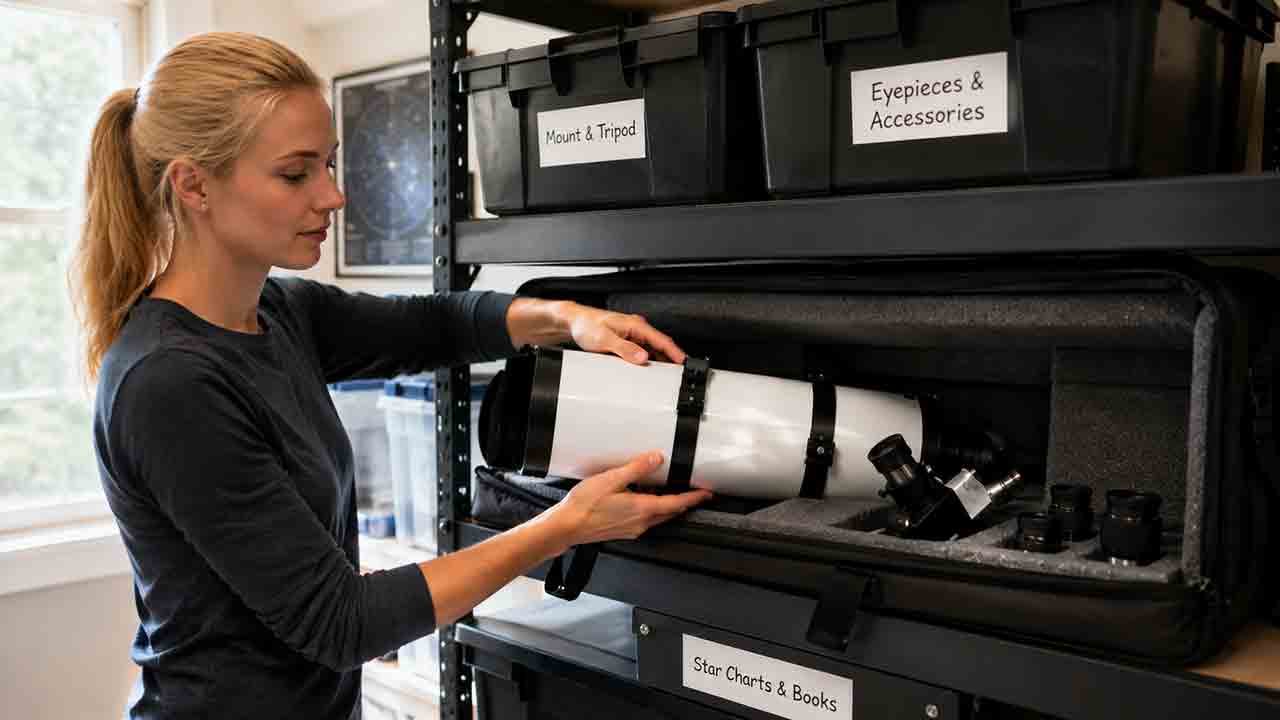
Store a telescope in a clean, dry, temperature-stable indoor location, with every optical opening capped only after the equipment is fully dry. Support the optical tube so it cannot roll, tip, or rest on the focuser, disconnect power, and remove disposable batteries for long storage. Use a dry case or breathable indoor cover, but never seal dew or condensation inside.
Key Takeaways
- Dry the telescope completely before installing tight caps, closing a case, or wrapping it in a cover.
- Indoor storage is usually safer than a garage, shed, vehicle, balcony, or permanent outdoor cover.
- The safest tube orientation depends on the telescope design, support system, and manufacturer instructions.
- Remove disposable batteries and disconnect cables; manage built-in lithium batteries according to the exact battery manual.
- Desiccant can support humidity control, but it cannot rescue a damp telescope sealed in a case.
This guide explains where to keep a telescope, how to handle dew after an observing session, whether to store the optical tube assembled or separately, how storage changes for refractors, Newtonians, Dobsonians, and catadioptric telescopes, and how to protect mounts, eyepieces, filters, cameras, and batteries.
Editorial note: This guide is based on current manufacturer care instructions, telescope manuals, and practical risk-reduction criteria rather than hands-on testing of a specific storage case, cover, cabinet, or telescope model.
What Is the Safest Telescope Storage Setup?
The safest general setup is a stable indoor location that remains dry, avoids large temperature swings, keeps dust and pests out, and protects the telescope from impact.
Celestron recommends indoor storage and allowing damp or cold equipment to warm and dry before replacing covers. Sky-Watcher similarly recommends a clean, dry, dust-free environment with the optical openings capped.
Quick storage decision table
| Storage option | Suitability | Main advantage | Main risk |
|---|---|---|---|
| Climate-controlled indoor room | Best general option | Stable temperature, low weather exposure | Household traffic, pets, or accidental impact |
| Dry indoor closet | Very good | Dust and light protection | Poor airflow if damp equipment is stored too soon |
| Padded dry case indoors | Very good after drying | Impact and dust protection | Traps moisture if closed while equipment is damp |
| Controlled observatory | Good when designed correctly | Fast setup and permanent installation | Heat, humidity, condensation, pests, and weather intrusion |
| Garage or basement | Conditional | Convenient for large telescopes | Humidity, temperature cycling, fumes, dust, and pests |
| Shed or balcony | Poor for routine storage | Avoids carrying equipment indoors | Weather, condensation, corrosion, theft, insects, and heat |
| Vehicle or trunk | Not suitable for long-term storage | Convenient during a trip | Extreme heat, cold, vibration, and theft |
| Outdoor cover only | Last resort | Protects from direct rain and dust | Cover can trap moisture and does not control temperature |
The exact manufacturer manual overrides generic storage advice, especially for permanently mounted systems, built-in batteries, optical tubes with moving primary mirrors, and specialized solar or imaging equipment.
What Can Damage Telescope Optics During Storage?
Moisture, temperature cycling, dust, chemical fumes, impact, pests, battery leakage, and mechanical stress are the main storage risks.
Moisture and condensation
Moisture can:
- Leave mineral or organic residue
- Encourage fungus or corrosion
- Reach electronics and connectors
- Soak foam or fabric cases
- Cause fasteners to rust
- Damage untreated mechanical surfaces
- Become trapped behind caps or inside accessories
A telescope does not need to be visibly wet for moisture to become a problem. Cold equipment moved into warm humid air can develop condensation on exposed metal, glass, and electronics.
Temperature extremes and rapid changes
Extreme heat can affect:
- Lubricants
- Adhesives
- plastics and foam
- Battery life
- Electronics
- Paint and finishes
- Mechanical tolerances
Repeated temperature changes can also encourage cycles of condensation and evaporation. Avoid attics, parked vehicles, direct sunlight, and other locations that heat rapidly.
No single universal storage-temperature range applies to every telescope, mount, battery, camera, or accessory. Follow the limits in the exact product manuals.
Dust, pollen, and insects
Dust is usually more of a maintenance issue than an immediate optical emergency. Long exposure can still deposit grit, pollen, webbing, and insect debris on difficult-to-clean surfaces.
Caps, rear-port plugs, mirror-box covers, and clean cases reduce contamination. Inspect covers periodically because insects can enter through a missing finder cap, focuser opening, fan vent, cable port, or loose case zipper.
Impact and mechanical stress
A telescope can be damaged without falling. Long-term pressure on a focuser, finder bracket, motor housing, diagonal, or camera adapter can bend or loosen parts.
The storage position should support the optical tube at intended structural points, such as:
- Tube rings
- Dovetail bar
- Manufacturer-approved cradle
- Dobsonian altitude bearings
- Padded case supports
- Original shipping foam
Do not use the focuser, finder, hand controller, counterweight shaft, or accessory rail as a support point.
Chemical fumes
Avoid storing optics near:
- Fuel
- Paint
- Solvents
- Pool chemicals
- Pesticides
- Cleaning chemicals
- Battery-charging areas with corrosive vapors
- Freshly treated wood or foam with a strong odor
A closed cabinet does not necessarily protect equipment if the contaminant is already inside the cabinet.
How Should You Store a Telescope After a Damp Night?
Shut down safely, remove vulnerable accessories, let moisture evaporate in a protected place, and install tight caps only after the equipment is dry.
This sequence is more important than buying an expensive case.
Step 1: Park and power down the mount
Use the mount’s park or shutdown procedure when required. Turn off heaters, cameras, controllers, and power distribution equipment.
Disconnect cables by holding the connector rather than pulling the wire. Coil them loosely without sharp bends.
Step 2: Remove accessories that trap moisture
Remove and separately inspect:
- Eyepieces
- Barlow lenses
- Filters
- Camera adapters
- Cameras
- Diagonals
- Finder eyepieces
- Phone holders
- Dew straps
- Fabric shrouds
A damp eyepiece left in a capped diagonal can trap moisture in both accessories.
Step 3: Move the telescope to a protected drying location
Place the telescope where it is stable, protected from falling dust, and able to warm gradually.
Celestron advises bringing damp or cold equipment indoors, orienting it downward, and allowing accumulated moisture to evaporate before installing covers. Apply that principle only in a mechanically safe position and follow the exact telescope instructions.
Do not rest an objective, corrector plate, or open tube directly against a floor or towel.
Step 4: Keep wet surfaces unsealed
Leave tight optical caps off, loose, or positioned as the manufacturer recommends while visible moisture remains.
Protect the equipment from household dust during drying with a clean loose cover that does not contact the optics or block evaporation. Do not use a sealed plastic bag around wet equipment.
Step 5: Dry cases and fabric separately
Open padded cases, bags, foam inserts, shrouds, and covers. A dry telescope placed into damp foam can absorb moisture again.
Check:
- Seams
- Zippers
- Foam recesses
- Accessory pockets
- Velcro straps
- Fabric handles
- Case corners
Step 6: Inspect before capping
When the telescope has reached room conditions and all visible moisture has cleared, check:
- Objective or corrector exterior
- Mirror-box interior
- Focuser
- Rear cell
- Mount electronics
- Battery compartment
- Connectors
- Case lining
Then install clean, dry caps.
Step 7: Return the equipment to storage
Place the optical tube in its stable storage support. Add dry desiccant where appropriate, disconnect removable power, and record any issue that requires attention before the next session.
Should You Seal a Cold Telescope Before Bringing It Indoors?
Only seal equipment that is already dry, and use a dry case or bag to slow warming—not to trap field moisture.
When a dry, cold telescope enters a warm humid room, water can condense on the cold surface. A clean, dry closed case can slow the temperature change and reduce immediate exposure to humid indoor air.
However:
- Do not close a wet telescope in a case.
- Do not seal wet dew straps or fabric with the optical tube.
- Do not assume a case is dry because its exterior feels dry.
- Open and inspect the case after the equipment has warmed.
- Follow the manufacturer’s procedure for sealed cameras and electronic instruments.
This is a decision based on the condition of the equipment, not a universal rule to bag every telescope.
Where Should You Store a Telescope Indoors?
Choose a low-traffic, dry area away from direct sunlight, heaters, air-conditioning discharge, kitchens, bathrooms, laundry rooms, and chemical storage.
Good indoor locations
Potential locations include:
- Dedicated equipment closet
- Dry spare room
- Interior storage cabinet
- Padded case on a stable low shelf
- Telescope corner protected by a rigid barrier
- Controlled observatory cabinet
The equipment should not block an exit or create a tripping hazard.
Locations to avoid
Avoid:
- A shelf above head height
- A wobbly table
- Direct sunlight through a window
- Beside a radiator or space heater
- Under an air-conditioning vent
- Near a humidifier
- Beside a shower, washing machine, or dryer
- A kitchen with cooking grease
- A workshop with grinding dust
- A room where children or pets can reach the tripod
- A place where a door can strike the optical tube
Should you use a dust cover?
A clean indoor dust cover is useful for a fully assembled telescope, especially when the telescope is used frequently.
A good cover should:
- Fit without pressing on the finder or focuser
- Stay clear of exposed optics
- Allow appropriate airflow
- Be dry before installation
- Avoid shedding fibers
- Not drag dust across the tube
A cover is not a humidity-control system.
Is a Garage or Basement Safe for Telescope Storage?
A garage or basement is acceptable only when it remains dry, reasonably clean, chemically safe, and protected from large temperature swings and pests.
Do not decide from room temperature alone. Monitor the environment over changing weather.
Garage risks
Garages may contain:
- Vehicle exhaust residue
- Fuel and solvent fumes
- Fine road dust
- Rapid summer heating
- Cold metal surfaces
- Condensation after weather changes
- Insects and rodents
- Door vibration
- Accidental impact
Basement risks
Basements may contain:
- Persistent humidity
- Water leaks
- Condensation on walls or floors
- Mold
- Sump or drainage failures
- Dust from concrete
- Laundry moisture
Practical evaluation framework
A garage or basement becomes more suitable when:
- A hygrometer shows a stable trend rather than persistent dampness.
- The telescope sits above floor level.
- The area has no history of leaks.
- Chemicals and fuel are stored elsewhere.
- A closed cabinet or dry case is used only after the telescope is dry.
- Desiccant is inspected and regenerated or replaced according to its instructions.
- The equipment is checked periodically.
If the location smells musty, corrodes tools, or repeatedly produces condensation, it is not a good optics-storage environment.
Can You Store a Telescope Outdoors Under a Cover?
Outdoor storage should be treated as a last resort unless the telescope is in a properly designed observatory or enclosure.
Sky-Watcher notes that an outdoor telescope should be covered against water, while Celestron generally recommends keeping telescopes indoors when not in use. These positions are compatible when outdoor storage is understood as a constrained fallback rather than the preferred default.
A simple cover cannot reliably control:
- Humidity
- Condensation
- Wind-driven rain
- Heat
- Cold
- Insects
- Corrosion
- UV exposure
- Theft
If outdoor storage is unavoidable:
- Use a cover designed for telescope storage.
- Keep the equipment above standing water.
- Prevent direct contact between the cover and optics.
- Provide the ventilation or heating strategy recommended for the enclosure.
- Inspect after storms and rapid weather changes.
- Remove disposable batteries.
- Keep electrical connections protected and de-energized.
- Move the telescope indoors when severe weather is expected.
Do not wrap a telescope tightly in ordinary plastic and assume it is protected.
Should You Store the Telescope Fully Assembled?
A telescope may remain assembled for frequent indoor use when the system is stable, dry, protected, and not a tipping hazard. Separating the optical tube is safer when the mount is crowded, top-heavy, or easy to bump.
Celestron notes that daily-use equipment may remain assembled with covers installed, while also advising that a quick-release optical tube is often safest when removed and stored securely. Sky-Watcher states that storage in one unit can be acceptable in a clean, dry environment.
Leave it assembled when:
- The tripod or base is highly stable.
- The room is low traffic.
- The optical tube cannot swing.
- Children and pets cannot reach it.
- Cables are disconnected or safely routed.
- Caps are installed after drying.
- The mount is parked or locked as instructed.
- The system will be used frequently.
Separate the optical tube when:
- The assembly is top-heavy.
- The tripod must remain folded.
- The telescope is stored in a closet.
- The mount can be struck by a door.
- The optical tube uses a secure quick-release saddle.
- A dedicated case or cradle is available.
- The mount and tube have different environmental requirements.
- Long-term storage is planned.
Always support the optical tube until the dovetail, rings, or cradle are fully released or secured.
Which Tube Orientation Is Best?
There is no universal storage orientation. Choose the position approved for the telescope that minimizes tipping, structural load, contamination, and stress on moving components.
Horizontal storage
Horizontal storage works well when:
- The tube rests in a padded cradle or case.
- The focuser, finder, and knobs are not load-bearing.
- The tube cannot roll.
- No heavy accessory remains installed.
- The case foam supports the structural tube rather than the optics.
Vertical storage
Vertical storage can reduce floor space, but the tube must be designed and supported for it.
Do not stand an optical tube on:
- A corrector plate
- An objective cell not designed as a base
- A focuser
- A rear visual port
- A fan guard
- A mirror-adjustment knob
For some Celestron Schmidt-Cassegrain models, the manufacturer provides specific vertical orientation and primary-mirror positioning guidance. Apply that advice only to the relevant models and confirm it in the exact manual or support documentation.
Should a Newtonian be stored upside down?
Sky-Watcher notes that some users store a reflector tube inverted in an attempt to reduce dust on the primary but states that the benefit is not proven.
A better approach is to:
- Cap both tube openings.
- Use the intended storage supports.
- Keep the tube dry.
- Prevent insects from entering.
- Avoid an unstable inverted position.
- Inspect the mirror only during normal maintenance.
How Should Different Telescope Designs Be Stored?
How should you store a refractor?
Cap the objective and focuser after drying, retract or position the dew shield as instructed, and support the tube at its rings, dovetail, or case pads.
Avoid pressure on:
- Objective cell
- Fine-focus shaft
- Rotator
- Camera adapter
- Finder bracket
Do not store a damp refractor with the dew shield retracted over a wet objective.
How should you store an SCT or Maksutov?
Keep both front and rear openings protected after drying, avoid resting weight on the corrector or rear port, and follow model-specific primary-mirror and storage-orientation guidance.
Remove heavy diagonals, cameras, reducers, and focus accessories for long storage unless the manufacturer approves the assembled load.
Internal haze or recurring moisture should be evaluated by the manufacturer or an optical service provider rather than addressed by opening the corrector assembly.
How should you store a solid-tube Newtonian?
Cap the front opening and focuser, support the tube securely, and keep the primary end away from standing water and impact.
Before long storage:
- Remove eyepieces and cameras.
- Disconnect the cooling fan.
- Check the fan grille for insects.
- Confirm the primary-cell fasteners are secure.
- Avoid pressure on collimation knobs.
- Recheck collimation before the next high-power session.
How should you store a Dobsonian?
Store the base and optical tube where neither can absorb moisture, warp, tip, or place unwanted load on the bearings.
For a solid-tube Dobsonian:
- The tube may remain in the base when stable and protected.
- Remove it when the assembly can be bumped or the base is on a damp floor.
- Keep particleboard or wood bases away from leaks and wet concrete.
- Do not use the focuser as a lifting or tie-down point.
For a truss Dobsonian:
- Dry the shroud separately.
- Install the mirror-box cover only after moisture has cleared.
- Cap truss ends and accessory openings.
- Store poles where they cannot bend.
- Protect the secondary cage from impact.
- Follow the mirror maker’s storage guidance for premium optics.
How should you store an observatory telescope?
A permanent observatory needs environmental control, ventilation, leak monitoring, pest exclusion, and periodic inspection.
Celestron notes that permanently mounted telescopes can experience heat extremes and may benefit from ventilation, insulation, or modest temperature management appropriate to the climate.
Do not direct a household heater at an optic. Any heater, ventilation fan, dehumidifier, or enclosure-control system should be installed with electrical and fire safety in mind.
How Should You Store the Mount and Tripod?
Keep the mount dry, unloaded when appropriate, protected from impact, and stored according to its parking, clutch, and battery instructions.
Manual mounts
For long storage:
- Remove the optical tube.
- Remove counterweights when they create a tipping or handling hazard.
- Store the counterweight shaft where it cannot injure someone.
- Retract tripod legs when practical.
- Dry the feet and spreader.
- Keep slow-motion cables from bending sharply.
- Do not add lubricant unless the manufacturer specifies the type and location.
Computerized mounts
Also:
- Park the mount if required.
- Turn it off before disconnecting power.
- Cover open ports.
- Remove disposable batteries.
- Store the hand controller dry.
- Avoid pulling or tightly wrapping controller cables.
- Follow firmware and encoder guidance for the exact model.
- Charge built-in or external rechargeable batteries according to their own manuals.
Do not assume every lithium battery should be stored at the same charge level or charging interval.
How Should You Store Eyepieces, Filters, and Cameras?
Eyepieces and Barlow lenses
Cap both ends only after the optics and barrels are dry.
Store them:
- Upright or in fitted foam
- In a dry case
- Without pressure on eye guards
- Away from loose metal tools
- With clean caps
- With desiccant when appropriate
For long storage, remove threaded filters and adapters unless the manufacturer recommends leaving them assembled. Separate storage makes inspection easier and reduces trapped moisture.
Filters
Store filters in their individual cases without pressure on the glass or coated surface.
Do not stack unprotected filters together. Solar filters require rigid protection from puncture, creasing, pressure, and abrasion, plus inspection before every use.
A storage case cannot make a damaged solar filter safe.
Cameras and electronic accessories
Use the camera manufacturer’s humidity, desiccant, and battery procedure.
Cooled astronomy cameras may contain internal desiccant tablets or sealed chambers. ZWO, for example, publishes model-specific instructions for drying desiccant and caring for protective windows.
Do not open a camera chamber or regenerate desiccant using a generic method.
Store:
- USB and power ports capped where possible
- Cables disconnected
- Sensor or protective-window cap installed
- Camera body dry
- Filters and filter wheels protected
- Rechargeable batteries according to their manuals
How Should You Use Desiccant?
Use desiccant as a humidity-control aid inside a dry case or cabinet, not as a substitute for drying the equipment first.
Good practice includes:
- Use a product intended for equipment storage.
- Keep packets from touching optical coatings.
- Keep loose beads contained.
- Follow indicator and regeneration instructions.
- Replace damaged or leaking packets.
- Inspect more often in humid climates.
- Do not assume an unchanged indicator proves the case is dry.
- Keep desiccant away from children and pets.
A small hygrometer can help reveal whether a cabinet or case remains persistently humid, but use equipment-specific guidance rather than assuming one universal humidity target.
What Should You Do With Batteries and Power Supplies?
Remove disposable batteries for storage, disconnect external power, and follow the exact rechargeable-battery manual.
Celestron specifically recommends removing batteries from battery-powered telescope components to prevent leakage and electronics damage.
Disposable batteries
- Remove them from mounts, finders, controllers, and illuminated accessories.
- Do not mix old and new cells.
- Inspect contacts for residue.
- Store batteries separately according to the battery manufacturer.
Rechargeable battery packs
- Turn the pack off.
- Disconnect it from the telescope.
- Store it away from heat and direct sunlight.
- Inspect for swelling, damage, or corrosion.
- Follow the battery’s specified storage-charge and maintenance schedule.
- Do not leave an incompatible charger connected indefinitely.
Built-in telescope batteries
Some computerized telescopes contain built-in lithium batteries. Do not open the mount or disconnect an internal pack unless the manual provides a user procedure.
Real-World Example: Storing the Same Telescope in Three Homes
Assume an observer owns an 8-inch Schmidt-Cassegrain, computerized mount, diagonal, four eyepieces, and an external battery.
Apartment storage
The observer uses the telescope twice a month.
Recommended approach:
- Dry the system after every session.
- Remove the optical tube from the mount.
- Store the tube in a padded dry case on a low interior shelf.
- Cap the front and rear openings after drying.
- Store eyepieces separately with dry desiccant.
- Remove disposable finder batteries.
- Store the external battery according to its manual.
The main risk is physical impact rather than environmental exposure.
Humid garage storage
The garage is convenient but becomes damp during storms.
Recommended approach:
- Use a raised enclosed cabinet rather than the floor.
- Monitor humidity trends.
- Keep chemicals and fuel elsewhere.
- Dry the telescope indoors before returning it to the cabinet.
- Use inspected desiccant in the case.
- Check connectors, screws, foam, and cases periodically.
- Move the telescope indoors if condensation or musty odor appears.
The main risk is persistent moisture and temperature cycling.
Backyard observatory
The telescope remains mounted.
Recommended approach:
- Use a weatherproof enclosure designed for astronomy equipment.
- Provide climate-appropriate ventilation and insulation.
- Monitor leaks, humidity, heat, pests, and cable condition.
- Park the mount correctly.
- Remove or manage batteries according to the manual.
- Keep covers dry and off the optics until dew has cleared.
- Inspect after severe weather.
The main risk is assuming that a roof alone controls the environment.
What Are the Most Common Telescope Storage Mistakes?
| Mistake | Why it causes problems | Better approach |
|---|---|---|
| Capping a wet optic | Traps moisture and residue | Dry first, then cap |
| Closing a damp padded case | Foam can retain moisture | Dry case and telescope separately |
| Leaving batteries installed | Leakage can damage electronics | Remove disposable batteries |
| Storing in a parked vehicle | Heat, cold, vibration, and theft risk | Move equipment indoors |
| Using ordinary plastic as permanent outdoor protection | Traps condensation and offers little thermal control | Use indoor storage or a designed enclosure |
| Resting the tube on the focuser | Can bend or loosen the mechanism | Support the structural tube or dovetail |
| Leaving a heavy camera attached | Adds long-term leverage and impact risk | Remove and cap the camera train |
| Placing equipment directly on a basement floor | Exposes it to leaks, condensation, and impact | Use a raised shelf or cabinet |
| Ignoring wet shrouds and dew straps | Fabric returns moisture to the case | Dry fabric separately |
| Assuming desiccant solves every moisture problem | Saturated desiccant cannot dry wet equipment reliably | Dry first and inspect packets |
| Keeping fuel or solvents nearby | Vapors and residues can affect equipment | Use a clean chemical-free area |
| Never inspecting stored equipment | Small leaks, pests, corrosion, or foam failure go unnoticed | Inspect periodically |
| Overtightening cases or straps against controls | Applies pressure to knobs and optics | Support at intended structural points |
| Storing a solar filter loose | Allows punctures, folds, and abrasion | Use rigid protective storage |
How Do You Troubleshoot Storage Problems?
Why is the telescope fogged after coming indoors?
The equipment was colder than the indoor air’s dew point.
Move it to a protected drying position, keep tight caps off until moisture clears, and dry the case separately. Do not wipe the optical surface unless residue remains after complete drying and the correct cleaning procedure is justified.
Why does the case smell musty?
The case may contain retained moisture, mold, wet foam, or contaminated fabric.
Remove the equipment, isolate the case, and inspect it in a well-ventilated area. Do not return clean optics until the case is fully dry and free of contamination. Replace deteriorated or moldy foam rather than placing optics against it.
Why is there rust on tripod hardware?
Moisture remained on the tripod, or the storage area is persistently damp.
Dry and inspect the hardware, follow the mount manufacturer’s corrosion-care instructions, and correct the environment. Do not apply random lubricant or rust remover near optical or electronic components.
Why is there haze inside an SCT or refractor?
Possible causes include:
- Internal condensation
- Fungus
- Lubricant vapor
- Previous improper storage
- Seal or assembly issue
- Coating deterioration
Do not open the corrector plate or objective cell. Contact the manufacturer or an optical service provider.
Why did collimation change during storage?
Possible causes include:
- Optical tube impact
- Mirror-cell movement
- Loose secondary holder
- Pressure on adjustment knobs
- Truss disassembly
- Heavy accessories left attached
- Mount or case movement
Check mechanical security, then collimate according to the exact telescope procedure.
Why is the mount behaving erratically after storage?
Check:
- Battery leakage
- Low rechargeable-battery state
- Corroded connectors
- Cable damage
- Moisture in ports
- Incorrect power adapter
- Hand-controller damage
- Mechanical obstruction
Do not power wet electronics. Allow them to dry and contact technical support when corrosion or internal moisture is suspected.
Why does the desiccant never change color?
The indicator may be inactive, the case may not be sealed as expected, or the product may not use a visible indicator.
Follow the packet instructions and use an independent hygrometer when environmental confirmation matters.
Long-Term Telescope Storage Checklist
Before storage
- Read the exact telescope, mount, camera, and battery manuals
- Finish the shutdown or park procedure
- Disconnect power and cables
- Remove disposable batteries
- Remove heavy cameras, diagonals, and accessories
- Dry dew straps, shrouds, bags, and foam separately
- Let the telescope reach stable indoor conditions
- Confirm optics, ports, and cases are dry
- Install clean dust caps
- Choose a stable support position
- Keep chemicals and direct sunlight away
- Add inspected desiccant where appropriate
During storage
- Keep the equipment above floor level
- Prevent children, pets, doors, and furniture from striking it
- Monitor humidity trends in questionable locations
- Check for leaks, pests, rust, and musty odor
- Maintain rechargeable batteries according to their manuals
- Replace or regenerate desiccant as instructed
- Inspect foam and fabric for deterioration
- Do not stack heavy objects on cases
Before the next observing session
- Inspect optical caps and openings
- Check the mount and tripod for loose hardware
- Inspect cables and battery contacts
- Confirm the finder and accessories are dry and clean
- Recheck Newtonian collimation
- Test computerized equipment indoors
- Inspect every solar filter before use
- Allow the telescope to approach outdoor temperature before high-power observing
How We Developed These Recommendations
This guide uses five storage priorities:
- Dryness: prevent dew and condensation from being trapped inside caps, cases, and fabric.
- Environmental stability: avoid weather, chemical fumes, direct sun, persistent humidity, and large temperature cycles.
- Mechanical support: store tubes, mounts, and accessories at intended structural points without tipping or sustained leverage.
- Electrical safety: disconnect power, remove disposable batteries, and follow rechargeable-battery manuals.
- Design-specific care: apply the correct orientation and storage method for refractors, catadioptrics, Newtonians, Dobsonians, mounts, cameras, and solar equipment.
No specific telescope case, cover, cabinet, desiccant, heater, or storage facility was hands-on tested for this article.
How Should You Store Your Telescope?
For frequent home observing, keep a fully dry telescope assembled only when the setup is stable, protected, and not a tipping hazard.
For a closet or shared room, remove the optical tube and place it in a padded dry case or cradle on a low shelf.
For a humid garage or basement, improve the environment, monitor moisture, raise equipment above the floor, and move the telescope indoors if condensation or musty odor persists.
For long-term storage, remove disposable batteries, separate heavy accessories, dry every case and fabric part, protect all openings, and inspect the system periodically.
The most important rule is simple: do not seal moisture inside. A basic dry indoor storage area with clean caps and stable support usually protects optics better than an expensive case used while the equipment is still damp.
Frequently Asked Questions
Can you store a telescope in a garage?
Yes, but only when the garage stays dry, reasonably clean, chemically safe, and protected from large temperature swings. Use a raised cabinet or dry case, monitor humidity, remove batteries, and move the telescope indoors if condensation, rust, or musty odor appears.
Should telescope caps stay on during storage?
Yes, after the optics and equipment are fully dry. Tight caps installed over dew or condensation can trap moisture. During drying, protect the telescope from dust with a clean loose cover or the exact method recommended by the manufacturer.
Is it safe to leave a telescope assembled?
It can be safe indoors when the base is stable, the optical tube cannot swing, the system is protected from impact, and the equipment is dry. Separating the optical tube is safer for top-heavy systems, narrow closets, folded tripods, and long-term storage.
Can silica gel prevent telescope fungus?
Dry, maintained desiccant can help control humidity in a case or cabinet, but it cannot guarantee fungus prevention and should not be used to compensate for damp equipment or a wet storage space. Persistent humidity or internal contamination requires environmental correction or professional evaluation.
Should a telescope be stored horizontally or vertically?
Either can be appropriate when the manufacturer allows it and the tube is supported safely. Never stand a telescope on the objective, corrector, focuser, rear port, fan guard, or adjustment knobs. Use the exact model guidance for moving-primary-mirror telescopes.
Can a telescope stay in a car between observing sessions?
A vehicle is not suitable for long-term storage. Parked vehicles can experience extreme temperatures, vibration, moisture, and theft risk. Use the vehicle for transportation, then move the telescope to a stable indoor storage location.
Sources
Sources were accessed July 30, 2026.
- Celestron — Caring for Your Telescope: Maintain, Store, and Ship
- Celestron — Manuals and Software
- Celestron — The Ultimate Telescope Battery Guide
- Sky-Watcher — Telescope Storage and Transportation FAQ
- Sky-Watcher — Product Manual Library
- Celestron — Caring for Your Telescope: Maintain, Store, and Ship
- Astro-Physics — Dew Removers and Dew-Control Guidance
- Baader Planetarium — Important Care Tips for Astronomical Instruments
- Baader Planetarium — Cleaning and Maintenance of Optics
- ZWO — Camera Cleaning and Desiccant Maintenance Guide
- ZWO — Guides and Manuals
- iOptron — Telescope Mount Manuals
More from Setup Collimation & Maintenance
How to Prevent Dew on a Telescope
Telescope dew is best prevented before condensation becomes visible. Check the air temperature and dew point, extend or install a correctly fitted dew shield, and apply gentle controlled heat to exposed lenses, corrector plates, finder scopes, eyepieces, guide scopes, or secondary mirrors when conditions require it. This guide explains why optics can cool below the surrounding air, how to use dew-point spread as a planning signal, and why a shield and heater often work better together. It provides the original CLEAR decision framework, telescope-specific recommendations, a step-by-step setup process, a hypothetical battery-runtime calculation, real-world observing scenarios, a decision tree, buying and setup checklists, common mistakes, drying and storage guidance, and a troubleshooting table. The article also explains why optics should not be wiped while wet or sealed in a case before fully drying.
How to Clean Telescope Lenses and Mirrors Safely
Safe telescope cleaning begins by deciding whether cleaning is needed at all. This guide explains why a few dust particles should usually be left alone, how to remove loose debris without scratching coatings, and how to clean accessible eyepiece lenses, refractor objectives, and corrector-plate exteriors with minimal contact. It separates lens care from Newtonian primary-mirror washing, secondary-mirror handling, diagonal-mirror instructions, dew management, and sealed optical assemblies that require professional service. Readers also receive a surface-by-surface comparison table, a clean-wait-service decision framework, three real-world contamination examples, troubleshooting guidance, and complete preparation and aftercare checklists. The central recommendation is to follow the exact manufacturer instructions and use the least invasive method that solves a genuine performance or contamination problem.
How to Collimate a Reflector Telescope Step by Step
Collimating a Newtonian or Dobsonian reflector means aligning the secondary mirror, focuser axis, and primary mirror in the correct order. This guide shows readers how to identify the adjustment hardware, center and rotate the secondary, aim it at the primary center mark, align the primary with a cap or Cheshire, and verify the result on a centered star. It also compares collimation caps, sight tubes, Cheshires, lasers, Barlowed lasers, and autocollimators; explains laser safety and tool-registration errors; and provides an 8-inch f/6 Dobsonian example. Troubleshooting sections address shifting alignment, oval secondary reflections, conflicting tool readings, off-axis star tests, and mechanical flexure. The central recommendation is to make only the adjustment supported by the observed error and to follow the exact telescope and tool manuals.
Explore More Topics
How to Choose Your First Telescope: A Beginner’s Buying Guide
Choosing a first telescope requires more than comparing aperture or advertised magnification. This practical beginner’s guide explains how to match a telescope to observing goals, light pollution, storage space, setup tolerance, and interest in visual observing or imaging. It compares refractors, Dobsonian reflectors, compound telescopes, and smart telescopes, then shows how aperture, focal length, focal ratio, magnification, and mount stability affect real use. Readers can use a quick-selection table, the original SPACE decision framework, a worked specification comparison, realistic household scenarios, new and used equipment checklists, and a troubleshooting chart. The guide also explains why a larger aperture cannot fully overcome bright urban skies, what to verify before buying a software-dependent smart telescope, and how to observe the Sun safely. Recommendations are based on authoritative guidance and published specifications rather than hands-on product testing or paid rankings
How Much Should You Spend on Your First Telescope?
Most beginners should plan a complete first-telescope budget of roughly $350–$700, although the right amount depends on observing goals, portability, automation, and whether the buyer wants direct eyepiece viewing or screen-based imaging. This guide explains what different budget ranges can realistically provide, why very low-cost telescope packages require caution, and when spending more for aperture, GoTo control, smart imaging, or compact optics is justified. It also separates visual astronomy from modular astrophotography, calculates total ownership cost, and shows how accessories, power, storage, shipping, and software can change the real price. The original FIRST Budget Test helps readers evaluate favorite targets, included equipment, real-world portability, desired skills, and total cost. Practical scenarios, a buying checklist, common mistakes, troubleshooting guidance, safety information, and current US market examples help beginners choose a stable, complete setup they are likely to use regularly.
Are Smart Telescopes Worth It for Beginners?
Smart telescopes can be worthwhile for beginners who want automated target finding, live-stacked deep-sky images, and a compact system controlled from a phone or tablet. However, they are not a universal replacement for traditional telescopes. Beginners who value direct eyepiece views, high-magnification planetary observing, manual sky navigation, or component-by-component upgrades may prefer a refractor, reflector, or catadioptric telescope. This guide explains how smart telescopes combine optics, cameras, motorized tracking, and image processing; compares them with traditional and modular imaging setups; and examines costs, software dependence, batteries, light pollution, target suitability, and long-term flexibility. It also provides the original WORTH decision framework, a hypothetical cost-per-session example, real-world beginner scenarios, a purchase checklist, common mistakes, and troubleshooting steps. The goal is to help readers choose based on their actual observing style rather than marketing claims or specifications alone