Dobsonian vs Refractor vs Reflector: Which Telescope Is Right for You?

Dobsonian vs Refractor vs Reflector: Which Telescope Is Right for You?
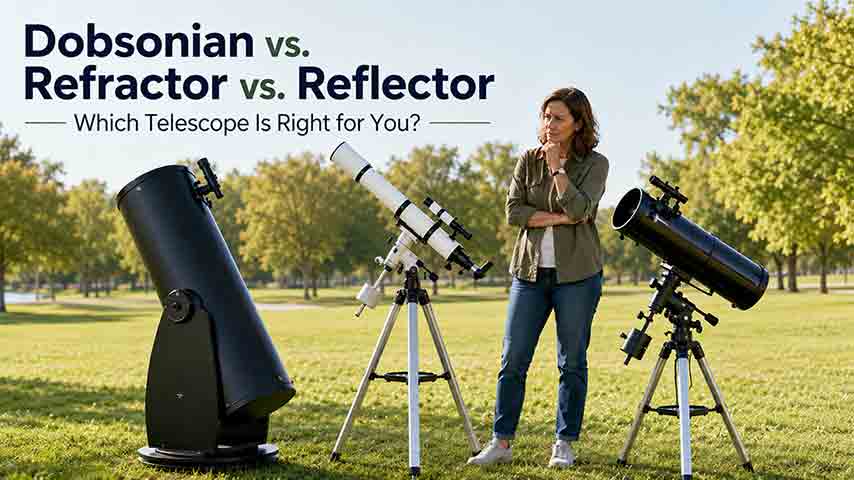
Choose a Dobsonian if you want the most visual observing power for your budget, a refractor if you value portability and low maintenance, or a Newtonian reflector on a tripod or equatorial mount if you want more mounting flexibility. The key detail is that a Dobsonian is usually a type of reflector—the difference is mainly the mount, not the mirror design.
Key Takeaways
- A Dobsonian telescope is normally a Newtonian reflector on a simple alt-azimuth rocker-box mount.
- Dobsonians generally provide the most aperture for visual observing at a given budget, but full-size models can be bulky.
- Refractors are usually the easiest to set up and maintain, although larger, well-corrected models can become expensive.
- A Newtonian reflector on a tripod or equatorial mount can be versatile, but the mount must be stable and appropriate for the intended use.
- For long-exposure astrophotography, tracking accuracy and mount quality usually matter more than choosing between these labels alone.
This guide will help you compare the three options by optical design, mount, portability, maintenance, observing targets, and photography potential. It is based on published specifications, authoritative documentation, and practical selection criteria rather than hands-on product testing.
Are Dobsonian, Refractor, and Reflector Three Separate Telescope Types?
Not exactly. A refractor and a reflector describe how a telescope forms an image, while Dobsonian usually describes a Newtonian reflector paired with a particular style of mount.
A refractor uses an objective lens at the front of the tube. A Newtonian reflector uses a curved primary mirror near the back of the tube and a small secondary mirror that directs light to an eyepiece on the side. NASA explains the same basic distinction: refracting telescopes focus light with lenses, while reflecting telescopes use mirrors.
A Dobsonian telescope normally combines:
- A Newtonian reflector optical tube.
- A manual alt-azimuth mount.
- A low, stable rocker-box base.
- Simple up-down and left-right movement.
For clarity, this article uses “reflector” to mean a Newtonian reflector mounted on a tripod, alt-azimuth head, or equatorial mount rather than on a traditional Dobsonian base.
Dobsonian vs Refractor vs Reflector: Quick Comparison
| Factor | Dobsonian | Refractor | Newtonian Reflector on Tripod/EQ Mount |
|---|---|---|---|
| Optical system | Usually Newtonian reflector | Front objective lens | Newtonian reflector |
| Typical mount | Manual alt-az rocker box | Alt-az, equatorial, or computerized | Alt-az, equatorial, or computerized |
| Best-known strength | Large aperture for visual observing | Simple setup and low routine maintenance | Flexible tube-and-mount combinations |
| Common beginner use | Moon, planets, clusters, nebulae, galaxies | Moon, planets, double stars, wide-field viewing, daytime use | General visual observing; imaging when properly mounted |
| Portability | Tabletop models can be compact; full-size models can be bulky | Small models are highly portable | Varies; tripod and counterweights can add bulk |
| Collimation | Periodic mirror alignment is expected | Usually little or no user collimation | Periodic mirror alignment is expected |
| Chromatic aberration | None from the mirror system | Possible in achromatic refractors | None from the mirror system |
| Long-exposure imaging | Poor with a basic manual base | Good potential on a suitable tracking mount | Good potential on a suitable equatorial tracking mount |
| Terrestrial viewing | Generally inconvenient because of image orientation and eyepiece position | Usually the most practical of the three | Generally less convenient |
| Main limitation | Size, manual tracking, and collimation | Cost rises quickly with aperture and optical correction | A weak mount can undermine the optical tube |
Which Telescope Gives You the Most Aperture for Your Budget?
A traditional Dobsonian is usually the strongest choice when the goal is maximum visual aperture without paying for a complex mount. Its simple rocker-box base directs more of the purchase price toward the optical tube and mirror.
Aperture is the diameter of the main light-collecting lens or mirror. NASA notes that larger telescope optics gather more light, making faint objects easier to detect. Aperture also influences the amount of detail a telescope can potentially resolve, although atmospheric conditions, optical quality, thermal stability, and alignment affect the view.
A Simple Aperture Calculation
Light-collecting area increases with the square of the aperture diameter. As an idealized comparison:
- Telescope A: 100 mm aperture
- Telescope B: 200 mm aperture
- Relative collecting area:
(200 ÷ 100)² = 4
A 200 mm aperture therefore has four times the geometric collecting area of a 100 mm aperture. Actual delivered brightness is lower than the ideal calculation because coatings, glass transmission, mirror reflectivity, and the secondary-mirror obstruction affect throughput.
This calculation explains why a moderate increase in diameter can produce a meaningful difference on faint star clusters, nebulae, and galaxies. It does not mean every object will look four times more impressive, because sky brightness and observing conditions still matter.
Which Is Better for Beginners?
For a beginner who mainly wants to observe the night sky, the best choice depends more on lifestyle than on optical theory.
Choose a Dobsonian if:
- You want strong views of both planets and deep-sky objects.
- You have a garage, ground-floor storage area, or easy route to the observing site.
- You are comfortable learning manual star-finding and occasional collimation.
- You prefer visual observing over long-exposure imaging.
- You want a stable mount without a complicated tripod or counterweight system.
A tabletop Dobsonian can be a practical compromise for limited storage, but it needs a solid table, crate, or platform. A full-size floor-standing Dobsonian is more self-contained at the observing site but may require separate trips for the tube and base.
Choose a refractor if:
- You want a telescope that can be carried outside in one trip.
- You prefer minimal optical maintenance.
- You mainly observe the Moon, planets, double stars, bright clusters, or wide fields.
- You may also use the telescope for distant terrestrial subjects.
- You want to place the optical tube on a tracking mount later.
Small refractors are easy to understand because the eyepiece stays at the back of the tube and the optical path is enclosed. However, inexpensive achromatic refractors can show purple or blue color fringes around bright objects. Extra-low-dispersion and apochromatic designs reduce this effect, but they generally cost more.
Choose a Newtonian reflector on a tripod or equatorial mount if:
- You want reflector aperture with a mount that can track or be upgraded.
- You are willing to learn both collimation and mount setup.
- You understand that the mount must be strong enough for the tube.
- You may pursue planetary imaging or deep-sky imaging with suitable equipment.
- You have room for a tripod, accessories, and possibly counterweights.
A reflector on an undersized mount can be frustrating even when the optics are good. Vibrations, difficult focusing, and awkward tube positions often come from the mount rather than the mirror.
How Does Each Design Perform on the Moon and Planets?
All three designs can show the Moon and bright planets well when the optics are aligned, the telescope is thermally stable, and the atmosphere is steady.
A refractor often provides a clean, high-contrast view with little setup. Long-focus achromatic refractors can perform well visually, while ED or apochromatic refractors reduce color fringing around bright targets.
A Dobsonian can reveal more planetary detail when its larger aperture, mirror alignment, and atmospheric conditions work together. The tradeoff is manual tracking: at high magnification, the observer must nudge the tube to keep the planet in view unless the telescope has tracking.
A Newtonian reflector on a stable tracking mount can be convenient for extended high-power observation. It still requires collimation, and the eyepiece can rotate into awkward positions on some equatorial mounts.
Practical recommendation: Choose the telescope you can set up, cool, align, and use regularly. A smaller instrument used often is more valuable than a larger one that remains in storage.
Which Is Better for Galaxies, Nebulae, and Star Clusters?
For visual deep-sky observing, aperture and sky darkness are usually the leading factors. A Dobsonian often offers the strongest combination because it can pair a relatively large mirror with a stable, inexpensive base.
Large open clusters and broad nebulae can also look excellent in a short-focus refractor because the instrument can provide a wide field of view. However, a smaller aperture may show fewer faint details than a larger reflector under the same sky.
A tripod-mounted Newtonian can perform similarly to a Dobsonian of the same aperture and optical quality. The difference is how the tube is supported and moved. The tripod or equatorial mount may add tracking and flexibility, but it can also increase cost, weight, and setup time.
Light pollution can overwhelm the benefit of additional aperture on low-contrast objects. For urban observers, portability to a darker location may matter more than choosing the largest telescope that fits the budget.
Which Telescope Is Best for Astrophotography?
For long-exposure astrophotography, the mount is the first major decision. A basic manual Dobsonian is designed for visual movement, not accurate tracking during long exposures.
A small refractor on a well-matched equatorial tracking mount is a common entry path because the tube is compact and places relatively modest demands on the mount. A Newtonian reflector can also be an effective imaging telescope, but the mount must handle the tube’s weight, length, wind exposure, and tracking requirements.
Use this distinction:
- Visual astronomy: prioritize aperture, stability, comfort, and setup time.
- Lunar and planetary imaging: short video captures can work with many telescope types, including tracked or manually guided Dobsonians.
- Long-exposure deep-sky imaging: prioritize an equatorial tracking mount, suitable focal length, camera compatibility, and precise focusing.
A computerized label does not automatically make a telescope suitable for long exposures. Many computerized alt-azimuth mounts can track objects for visual use but still produce field rotation during longer photographic exposures.
How Much Maintenance Does Each Telescope Need?
A refractor generally needs the least routine optical maintenance because its lenses are held in a fixed cell and the tube is enclosed. The user should still protect the lens from dust, fingerprints, dew, and impact.
Newtonian reflectors—including Dobsonians—need periodic collimation, which means aligning the primary and secondary mirrors so that the optical system shares the correct axis. Celestron notes that poor collimation can produce distorted or degraded images.
Collimation frequency depends on the telescope’s construction, transport, and handling. A reflector that remains assembled in one room may hold alignment for long periods, while a telescope carried over rough roads may need more frequent checks.
Reflectors can also need more time to approach outdoor temperature, especially when the primary mirror is large. Observing before the optics stabilize can create soft, moving images that resemble poor focus.
Which Is Easier to Store and Transport?
Small refractors are usually the easiest to transport, but the complete system matters. A long refractor on a tall tripod can occupy more space than its aperture suggests.
Tabletop Dobsonians are compact, although they require a stable support. Traditional 150–200 mm floor-standing Dobsonians are often manageable for home use, but buyers should check the tube length, base width, component weight, doorways, stairs, and vehicle space before ordering.
Tripod-mounted Newtonians can break down into separate pieces, but the tripod, mount head, counterweights, optical tube, and accessory case can make the total package larger than expected.
The Doorway Test
Before buying, measure:
- The narrowest doorway or stair turn.
- The storage footprint.
- The vehicle’s usable cargo length.
- The heaviest single component you can carry safely.
- The distance from storage to the observing position.
These measurements often predict long-term satisfaction better than a telescope’s advertised magnification.
Use the SPACE Framework to Choose
The SPACE framework is a practical way to compare telescopes without becoming lost in specifications.
S — Storage and Transport
Where will the telescope live, and how many steps, doors, or stairs separate it from the sky? Eliminate any model that is too difficult to move regularly.
P — Primary Targets
Choose the objects you most want to observe:
- Moon and planets: all three can work.
- Faint galaxies and nebulae: favor aperture and dark-sky portability.
- Wide star fields: favor a shorter focal length and suitable eyepiece.
- Daytime landscapes: favor a refractor with the correct diagonal.
- Long-exposure imaging: start with the mount.
A — Aperture per Budget
Compare realistic complete packages, not optical tubes alone. Include the mount, finder, usable eyepieces, collimation tool if needed, power supply if required, and transport case.
C — Care and Collimation Tolerance
Choose a refractor if you strongly prefer low maintenance. Choose a reflector or Dobsonian if you are willing to learn a short alignment routine in exchange for more aperture or mounting options.
E — Exposure Goals
Decide whether “photography” means a quick Moon image with a phone, planetary video, or multi-minute deep-sky exposures. These are different activities with different mount requirements.
A Practical Decision Tree
Follow these questions in order:
Is long-exposure deep-sky photography your main goal?
- Yes: choose a suitable equatorial tracking mount first, then select a compatible refractor or imaging Newtonian.
- No: continue.
Is low maintenance and one-trip portability your top priority?
- Yes: choose a small or medium refractor on a stable alt-az mount.
- No: continue.
Do you want the most visual aperture for the budget?
- Yes: choose a Dobsonian that fits your storage and transport limits.
- No: continue.
Do you want reflector optics with tracking or mount flexibility?
- Yes: choose a Newtonian reflector on a properly rated mount.
- No: reconsider a refractor or compact tabletop Dobsonian.
Practical Starting Sizes for Different Users
The following are selection ranges, not universal rules. Mount quality and optical quality still matter.
| User situation | Practical starting point | Why it fits |
|---|---|---|
| Apartment or balcony observer | 70–102 mm refractor or 100–130 mm tabletop Dobsonian | Easier storage and shorter setup |
| Family backyard observing | 130–150 mm tabletop Dobsonian or 150–200 mm full-size Dobsonian | Stable, intuitive movement and useful aperture |
| Frequent dark-sky travel | Compact refractor or collapsible/tabletop Dobsonian | Transport may matter more than maximum aperture |
| Planet-focused visual observer | Long-focus refractor, 150–200 mm Dobsonian, or tracked Newtonian | Multiple designs can work; stability and seeing are decisive |
| Beginner deep-sky visual observer | 150–200 mm Dobsonian if storage permits | Strong aperture-to-cost balance |
| Beginner deep-sky imager | Small refractor plus suitable equatorial mount | Lower tube weight and simpler mount demands |
| Mixed visual and future imaging user | Optical tube and mount purchased as a planned system | Avoids buying a visual-only mount that cannot meet later goals |
Celestron’s beginner guidance identifies approximately 102 mm refractors and 130 mm reflectors as useful starting categories for many newcomers. Treat those figures as examples rather than minimum requirements.
Real-World Buying Scenarios
Scenario 1: The suburban backyard observer
A buyer wants to see the Moon, Jupiter, Saturn, clusters, and brighter nebulae. The telescope can be stored in a garage and rolled or carried a short distance.
Best fit: A 150–200 mm Dobsonian is a strong starting choice. The buyer accepts manual tracking and occasional collimation in exchange for visual capability and a stable base.
Scenario 2: The upstairs apartment observer
A buyer must carry the complete setup down stairs and has only a small closet. Observing sessions may last 20–40 minutes.
Best fit: A compact refractor on a sturdy alt-az mount is likely to be used more often. A tabletop Dobsonian is another option when a stable outdoor support is available.
Scenario 3: The buyer who wants “astrophotography later”
A buyer wants visual observing now but expects to take long-exposure nebula images in the future.
Best fit: Define the imaging plan before purchasing. A manual Dobsonian remains excellent for visual use but is not a straightforward foundation for long-exposure imaging. A small refractor and a suitable equatorial mount may provide a clearer upgrade path.
Scenario 4: The road-trip deep-sky observer
A buyer has access to dark skies but limited vehicle space.
Best fit: A collapsible or tabletop Dobsonian may provide more aperture in a compact form, while a short refractor may be better when setup speed and wide-field observing are the priorities.
Pros and Cons at a Glance
Dobsonian Pros
- High visual aperture for the purchase price.
- Stable, intuitive manual movement.
- Strong general-purpose performance.
- Simple mechanical design.
- No tripod or counterweights on traditional models.
Dobsonian Cons
- Full-size tubes and bases can be bulky.
- Manual tracking becomes demanding at high magnification.
- Mirror collimation is part of ownership.
- Traditional models are poorly suited to long-exposure imaging.
- Eyepiece height and position change as the telescope moves.
Refractor Pros
- Fast setup and minimal routine collimation.
- Enclosed optical tube.
- Convenient eyepiece position.
- Practical for terrestrial use with appropriate accessories.
- Compact models work well on lighter mounts.
Refractor Cons
- Large apertures are usually expensive.
- Achromatic models can show color fringing.
- Long tubes may require substantial mounts.
- Small apertures collect less light than larger reflectors.
- A cheap tripod can still cause vibration.
Newtonian Reflector Pros
- Good aperture without refractor-style chromatic aberration.
- Available on manual, tracking, and equatorial mounts.
- Can support visual observing or imaging when properly configured.
- Replaceable and adjustable components are widely available.
Newtonian Reflector Cons
- Requires collimation.
- The side-mounted eyepiece can become awkward.
- Long tubes place demanding leverage on a mount.
- Entry-level equatorial mounts can feel complicated.
- Open tubes expose mirrors to dust and ambient air.
Common Telescope Buying Mistakes
Buying by advertised magnification
Magnification is calculated by dividing the telescope focal length by the eyepiece focal length. A 1,000 mm telescope with a 20 mm eyepiece gives 50× magnification. High magnification is not automatically useful; the atmosphere, aperture, alignment, mount stability, and target brightness set practical limits.
Ignoring the mount
A good optical tube on a shaky mount produces a poor observing experience. Check the mount’s payload rating, but also consider tube length and vibration because a long tube can challenge a mount even when the listed weight appears acceptable.
Choosing the largest telescope that fits the budget
The largest affordable telescope may not fit the buyer’s home, car, schedule, or lifting ability. Usable aperture is the aperture that reaches the observing site.
Assuming a Dobsonian is a separate optical design
Most Dobsonians are Newtonian reflectors. Comparing “Dobsonian optics” with “reflector optics” misses the main difference: the traditional Dobsonian uses a simple alt-azimuth base.
Treating all astrophotography as the same activity
A handheld phone image of the Moon, a high-frame-rate video of Jupiter, and a guided long exposure of a nebula require different equipment. Define the intended result before selecting the telescope.
Spending the full budget on the telescope alone
Reserve room for a comfortable observing chair, red light, star chart or app, appropriate eyepieces, dew control where needed, collimation tools for reflectors, and safe transport.
Troubleshooting: Why Does the View Look Disappointing?
The image shakes when focusing
The mount may be unstable, the tripod may be extended too far, or the ground may be transmitting vibration. Shorten tripod legs where practical, tighten connections, reduce wind exposure, and avoid touching the telescope while viewing.
Stars will not focus to small points
Possible causes include poor collimation, thermal instability, poor atmospheric seeing, dew, dirty optics, or an eyepiece that is not fully seated. Start with a low-power eyepiece and test a bright star well above the horizon.
Planets look tiny
Planets are physically small in angular size. Increase magnification gradually with shorter-focal-length eyepieces, but stop when the image becomes dim, soft, or difficult to track.
The telescope cannot find anything
Use the lowest-power eyepiece, align the finder during daylight on a distant object, and begin with an easy target such as the Moon or a bright planet. A wide field of view makes initial aiming easier.
A reflector shows a soft image after transport
Check collimation. Newtonian mirror alignment can shift during handling, and correcting it is a normal maintenance task rather than evidence that the telescope is defective.
A refractor shows colored edges around the Moon or Jupiter
The telescope may be an achromatic refractor showing chromatic aberration. This occurs when different wavelengths do not focus at exactly the same point. Longer focal ratios, ED glass, and apochromatic designs can reduce the effect.
Telescope Purchase Checklist
Before ordering, confirm:
- The complete system fits the storage area.
- The heaviest component is manageable.
- The mount is stable enough for the optical tube.
- The telescope suits the primary observing targets.
- The package includes at least one useful low-power eyepiece.
- The finder is practical and adjustable.
- Reflector owners have a realistic collimation plan.
- Imaging buyers have verified camera focus and mount compatibility.
- The return policy and warranty are clear.
- The telescope can be used safely without observing the Sun unless a purpose-built, securely attached solar filter is supplied and used exactly as directed.
Which Telescope Should You Buy?
Choose a Dobsonian when visual performance and aperture per budget matter most, and storage is not a serious obstacle. Choose a refractor when ease of use, portability, low maintenance, and occasional terrestrial viewing matter more than maximum aperture. Choose a Newtonian reflector on a tripod or equatorial mount when you need reflector optics with tracking or a specific upgrade path.
The next step is to measure your storage and transport limits, define whether your goal is visual observing or a specific kind of imaging, and compare complete telescope systems rather than optical tubes alone.
Frequently Asked Questions
Is a Dobsonian better than a refractor for planets?
A Dobsonian can show more planetary detail when it has substantially more aperture, accurate collimation, and time to reach outdoor temperature. A refractor may provide a cleaner, easier setup with less maintenance. The better choice depends on aperture, optical quality, mount stability, and observing conditions rather than the label alone.
Is a Dobsonian the same as a reflector?
A Dobsonian is usually a Newtonian reflector mounted on a simple alt-azimuth rocker-box base. “Reflector” describes the mirror-based optical system; “Dobsonian” usually describes the way that optical tube is mounted.
Can a refractor see galaxies and nebulae?
Yes. A refractor can show bright galaxies, nebulae, and star clusters, especially under dark skies. A larger reflector will generally collect more light at a comparable budget, but a compact refractor may be easier to transport to darker locations.
Can you use a Dobsonian for astrophotography?
A manual Dobsonian can capture the Moon and planets with short exposures or video, but it is not designed for conventional long-exposure deep-sky imaging. Specialized tracking platforms and motorized Dobsonians exist, although they add cost and complexity.
Do reflector telescopes need frequent collimation?
They need periodic checks, but “frequent” depends on transport and construction. A carefully stored reflector may hold alignment well, while one moved regularly may need adjustment more often. Checking collimation becomes a quick routine with practice.
Is a bigger aperture always better?
A larger aperture gathers more light and can potentially resolve finer detail, but it also tends to increase size, weight, cooling time, and mount demands. The best aperture is the largest one the owner can transport, stabilize, maintain, and use regularly.
Sources
NASA Space Place — How Do Telescopes Work?
Used for the basic distinction between lens-based refractors and mirror-based reflectors, and for the relationship between optical size and light gathering.NASA Science — Telescope Overview
Used for the role of a telescope’s primary light-collecting optic.Celestron — The Ultimate Guide to Optical Tubes
Used for optical-design definitions, including Newtonian reflectors and Dobsonian configurations.Sky-Watcher — Traditional Dobsonian Design
Used for the Dobsonian alt-azimuth mount definition and rocker-box movement.Sky-Watcher USA — Classic 200P Dobsonian
Used as a current manufacturer example of the simple Dobsonian design and aperture-focused positioning. Product details and availability may change.Celestron — What Is Telescope Magnification?
Used for the focal-length divided by eyepiece-focal-length magnification formula.Celestron — ED Glass and Chromatic Aberration
Used for the definition of chromatic aberration and the role of extra-low-dispersion glass.Celestron — How to Collimate a Newtonian
Used for the need to align Newtonian primary and secondary mirrors.Sky-Watcher USA — AZ-EQ5 Mount
Used to distinguish casual alt-azimuth visual use from equatorial mounting for serious astrophotography.Celestron — Understanding Wedges for Alt-Az Telescopes
Used for the explanation of field rotation during long-exposure imaging with alt-azimuth mounts.Celestron — How to Buy Your First Telescope
Used for beginner-oriented aperture examples and telescope-selection considerations.NASA Science — Eclipse Viewing Safety
Used for the requirement to place a special-purpose solar filter securely over the front of a telescope before viewing the Sun.
Source review date: July 30, 2026.
Editorial Method
More from Telescope Buying Guides
How to Choose Your First Telescope: A Beginner’s Buying Guide
Choosing a first telescope requires more than comparing aperture or advertised magnification. This practical beginner’s guide explains how to match a telescope to observing goals, light pollution, storage space, setup tolerance, and interest in visual observing or imaging. It compares refractors, Dobsonian reflectors, compound telescopes, and smart telescopes, then shows how aperture, focal length, focal ratio, magnification, and mount stability affect real use. Readers can use a quick-selection table, the original SPACE decision framework, a worked specification comparison, realistic household scenarios, new and used equipment checklists, and a troubleshooting chart. The guide also explains why a larger aperture cannot fully overcome bright urban skies, what to verify before buying a software-dependent smart telescope, and how to observe the Sun safely. Recommendations are based on authoritative guidance and published specifications rather than hands-on product testing or paid rankings
How Much Should You Spend on Your First Telescope?
Most beginners should plan a complete first-telescope budget of roughly $350–$700, although the right amount depends on observing goals, portability, automation, and whether the buyer wants direct eyepiece viewing or screen-based imaging. This guide explains what different budget ranges can realistically provide, why very low-cost telescope packages require caution, and when spending more for aperture, GoTo control, smart imaging, or compact optics is justified. It also separates visual astronomy from modular astrophotography, calculates total ownership cost, and shows how accessories, power, storage, shipping, and software can change the real price. The original FIRST Budget Test helps readers evaluate favorite targets, included equipment, real-world portability, desired skills, and total cost. Practical scenarios, a buying checklist, common mistakes, troubleshooting guidance, safety information, and current US market examples help beginners choose a stable, complete setup they are likely to use regularly.
Are Smart Telescopes Worth It for Beginners?
Smart telescopes can be worthwhile for beginners who want automated target finding, live-stacked deep-sky images, and a compact system controlled from a phone or tablet. However, they are not a universal replacement for traditional telescopes. Beginners who value direct eyepiece views, high-magnification planetary observing, manual sky navigation, or component-by-component upgrades may prefer a refractor, reflector, or catadioptric telescope. This guide explains how smart telescopes combine optics, cameras, motorized tracking, and image processing; compares them with traditional and modular imaging setups; and examines costs, software dependence, batteries, light pollution, target suitability, and long-term flexibility. It also provides the original WORTH decision framework, a hypothetical cost-per-session example, real-world beginner scenarios, a purchase checklist, common mistakes, and troubleshooting steps. The goal is to help readers choose based on their actual observing style rather than marketing claims or specifications alone
Explore More Topics
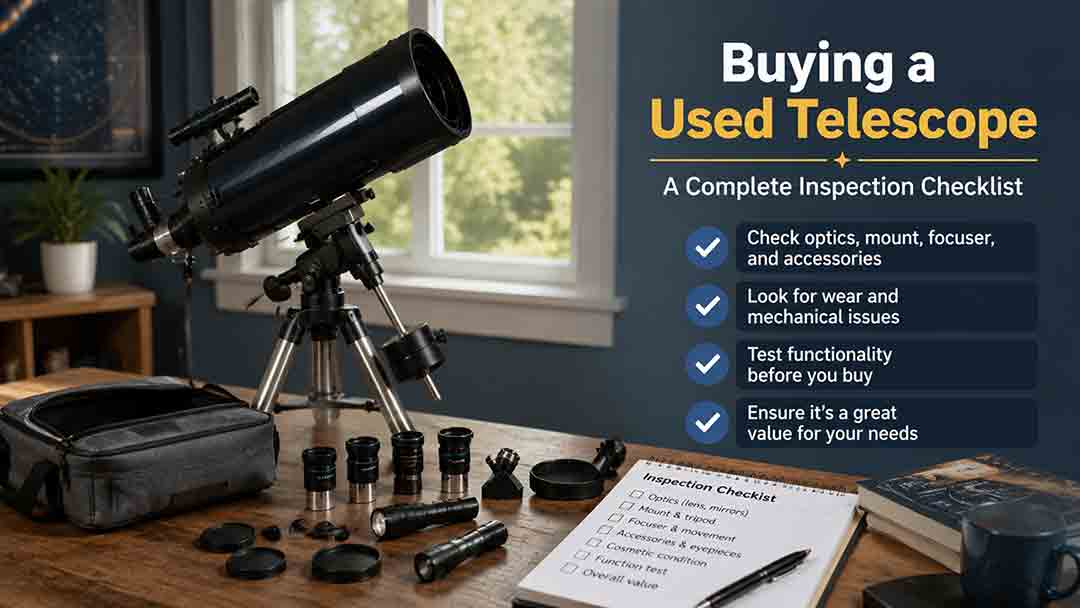
Buying a Used Telescope: A Complete Inspection Checklist
A used telescope can offer excellent value when the buyer verifies the exact model, ownership, optical condition, mechanical safety, electronic function, and complete accessory list before payment. This guide provides a structured inspection process for refractors, Newtonian and Dobsonian reflectors, Schmidt-Cassegrains, Maksutovs, manual and computerized mounts, eyepieces, filters, cameras, and smart telescopes. It distinguishes harmless dust and cosmetic wear from fungus, coating failure, bent hardware, water damage, unsupported electronics, and unsafe solar equipment. Readers also receive seller questions, daytime and nighttime test procedures, a repair-adjusted pricing formula, transaction-safety guidance, four practical scenarios, a buy-negotiate-walk-away framework, and a comprehensive printable checklist. The central recommendation is to price only verified function and preserve enough budget for missing parts, repairs, and uncertainty.
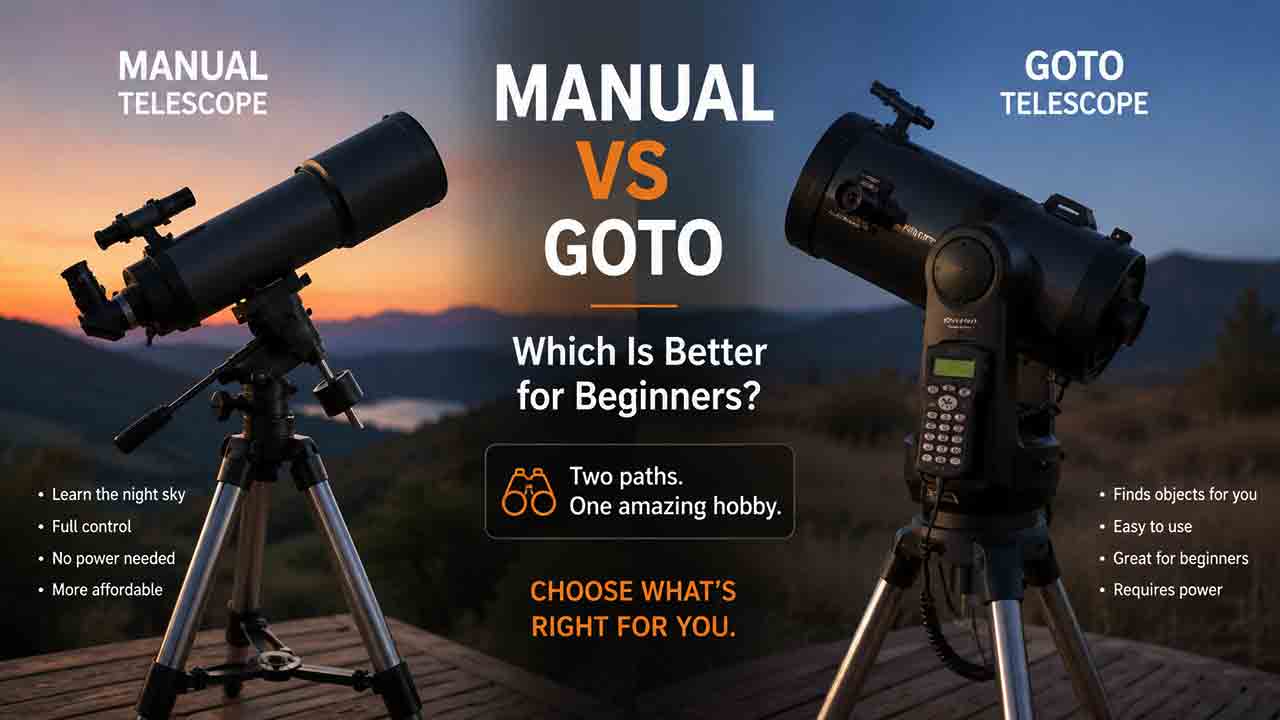
Manual vs GoTo Telescope: Which Is Better for Beginners?
Manual and GoTo telescopes solve different beginner problems. A manual telescope offers simpler setup, fewer electronic dependencies, and often more optical capability within a limited budget, while a GoTo telescope can locate cataloged objects and track them after a successful alignment. This comparison explains why GoTo does not improve aperture, remove light pollution, or automatically make a telescope suitable for long-exposure astrophotography. It compares setup time, tracking, portability, reliability, learning value, power requirements, and total ownership cost. The article also introduces the original TRACK decision framework, an illustrative break-even calculation for session time, five real-world buyer scenarios, separate purchase checklists, and troubleshooting tables for both manual and computerized systems. Beginners can use the guide to decide whether they prefer learning sky navigation, managing an electronic alignment workflow, or choosing a push-to system that combines manual movement with digital guidance."
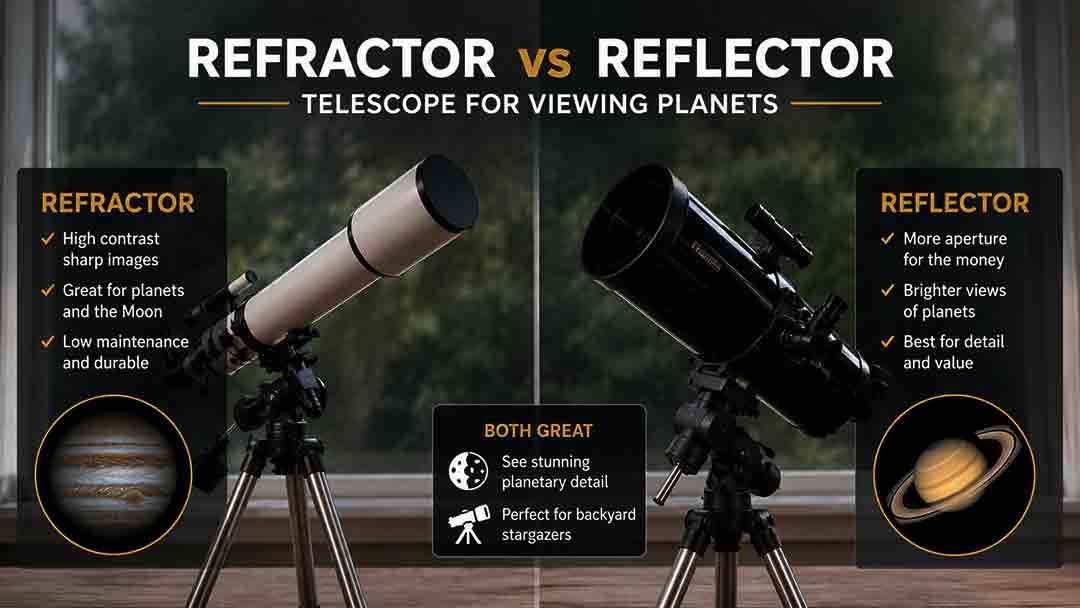
Refractor vs Reflector Telescope for Viewing Planets
A refractor is usually the easier planetary telescope at the same aperture, while a Newtonian reflector usually provides more resolving power for the same budget by offering a larger mirror. This guide compares unobstructed contrast, chromatic aberration, central obstruction, collimation, thermal preparation, mount stability, tracking, magnification, and portability. It explains how each design performs on the Moon, Jupiter, Saturn, Mars, Venus, Uranus, and Neptune, and separates equal-aperture, equal-price, and equal-portability comparisons. A 100 mm versus 150 mm aperture calculation, size recommendations, real-world buyer scenarios, a six-step decision framework, troubleshooting guidance, and a complete buying checklist help readers select a telescope that will deliver useful planetary performance in their actual observing environment.